A business that uses commodities has one problem that a regular investor may not think about much: the price can change before the business is ready to buy or sell.
Take an airline. Fuel is a major expense, and crude oil prices can move sharply in a matter of weeks. A manufacturer buying metals faces a similar issue. If copper or aluminium becomes more expensive before the next purchase, production costs can rise even though nothing has changed inside the factory.
Businesses cannot control commodity prices. They can, however, plan for them.
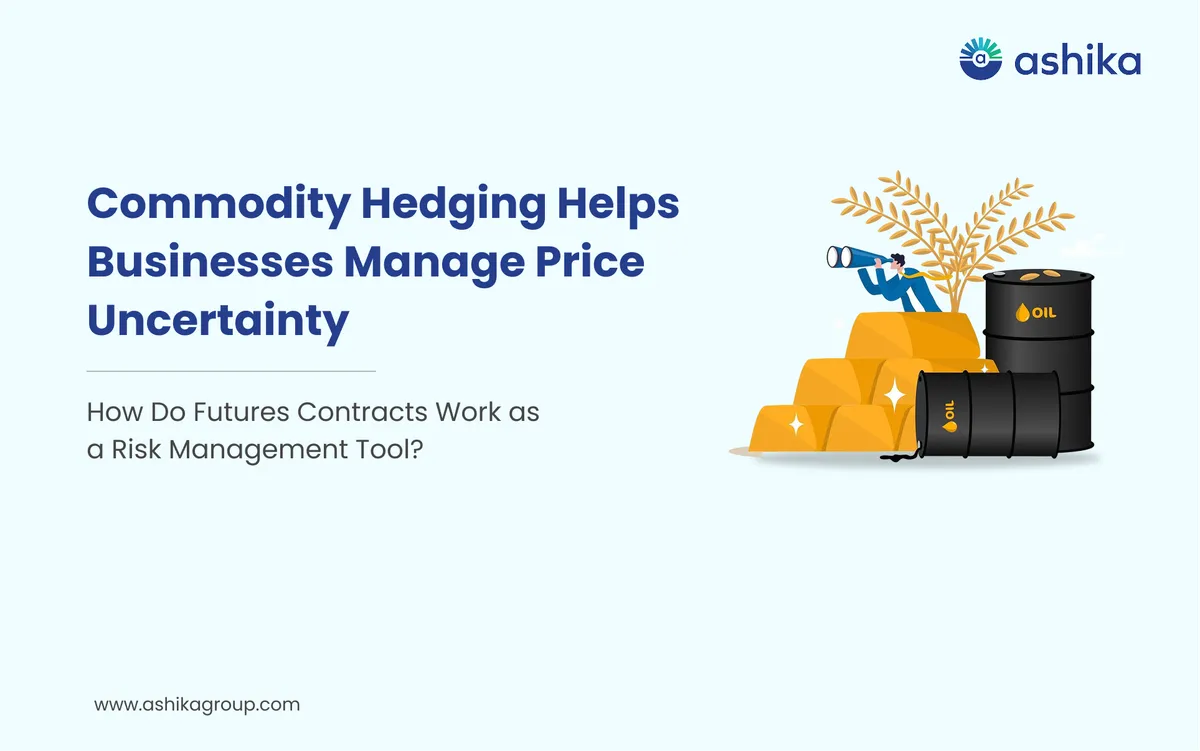
One way they do that is through hedging in commodity trading. Futures contracts are among the tools used for this purpose. The idea is fairly simple — take a position in the derivatives market that can offset some of the financial impact of an unfavourable move in the actual commodity price.
It is worth stressing the word offset. Hedging is not about making a guaranteed profit.
Table of Contents
- Why would a business hedge?
- How commodity futures come into the picture
- A simple example
- Long hedge and short hedge
- Hedging isn't the same as speculation
- There is no such thing as a perfect hedge
- Which businesses use commodity hedging?
- What happens if the market moves in the business's favour?
- How investors access commodity futures
- The bigger picture
- Frequently Asked Questions
Why would a business hedge?
Imagine a company knows it will need to purchase a large quantity of crude oil three months from now.
Today, the price looks manageable. The finance team prepares its budget around that number. But if crude rises significantly before the purchase, the company's actual cost will be higher than expected.
That creates a problem for the business.
It could affect margins, pricing decisions and even cash-flow planning.
A futures contract can provide a way to manage some of that uncertainty. If the physical commodity becomes more expensive, a gain on the futures position can potentially compensate for part of the additional cost.
Of course, the reverse is also possible.
If commodity prices fall, the business may get the physical commodity at a cheaper price. At the same time, the futures position used as a hedge could lose money.
That is not necessarily a failure of the strategy. The business was paying for some protection against a price increase.
How commodity futures come into the picture
A futures contract is a standardised agreement traded on an exchange to buy or sell an underlying commodity at a specified price and according to the contract's terms.
In India, commodity derivatives are available through exchanges such as MCX and NCDEX, depending on the commodity.
The business does not necessarily need to wait until the actual commodity purchase to deal with the risk. It can use the futures market to take a position before that happens.
The size and timing of the hedge depend on the company's actual exposure.
That last part matters. A business doesn't simply hedge because a commodity is moving. It generally hedges because it has a financial exposure that could hurt if prices move in the wrong direction.
A simple example
Consider a manufacturer that expects to buy copper after three months.
The company is concerned that copper prices may rise during that period. It takes a suitable futures position as part of its risk-management strategy.
Three months later, copper prices have increased.
The company now has to pay more for the physical copper. But the futures position may have gained value, helping to offset some of that increase.
Now imagine copper prices move the other way.
The physical purchase becomes cheaper, which is good for the manufacturer. But the futures position may produce a loss.
The company has given up some of the benefit of falling prices in exchange for reducing the uncertainty associated with rising prices.
That is the trade-off involved in hedging.
Long hedge and short hedge
The direction of a futures position usually depends on what the business expects to do with the commodity.
A long hedge is generally associated with a business that expects to buy the commodity later and is worried about a price increase.
A manufacturer that knows it will need a large quantity of metal in the future is one possible example.
A short hedge works in the opposite direction. It can be used by a business that expects to sell a commodity later and is concerned about prices falling before the sale.
Suppose a producer expects to sell its output after three months. If the market price drops before then, the producer could receive less money from the physical sale. A short futures position may gain as prices fall and offset some of that reduction.
The exact hedge depends on the business, the commodity and the exposure involved.
Hedging isn't the same as speculation
The futures market is used by both hedgers and speculators, but their reasons for being there can be very different.
A business with an actual commodity exposure is trying to manage a risk it already has.
A trader with no requirement to buy or sell the physical commodity may take a futures position because they expect prices to rise or fall.
The first is primarily managing exposure. The second is taking market exposure in the hope of making a return.
The same futures contract can therefore be used for very different purposes.
There is no such thing as a perfect hedge
Hedging can reduce risk, but it does not make the risk disappear.
The price of the futures contract may not move exactly in line with the price the business eventually pays or receives in the physical market. This difference is known as basis risk.
There can also be a mismatch between the amount being hedged and the actual quantity required.
Timing can be another issue. A business may need the physical commodity on a particular date, while the available futures contract has a different expiry.
Then there is margin.
Futures positions require margins, and the business may have to provide additional funds if the position moves against it. So even a hedge designed to reduce long-term price uncertainty can create short-term cash-flow requirements.
This is one reason hedging is generally treated as a risk-management activity rather than a simple trading strategy.
Which businesses use commodity hedging?
The answer depends on the industry.
An airline can have significant exposure to fuel prices. A manufacturer may be affected by movements in metals. A jewellery business has an obvious interest in gold and silver prices.
Agricultural businesses and food processors can also face price uncertainty in commodities such as wheat, cotton or other agricultural products.
For an importer or exporter, commodity prices can become part of a much larger cost calculation.
The common thread is that these businesses are not trading commodities simply because they expect prices to move. Their day-to-day operations already expose them to those price movements.
What happens if the market moves in the business's favour?
This is an important part of understanding hedging.
Suppose a company hedges against a rise in the price of a commodity. The price then falls instead.
The company benefits when it buys the physical commodity at the lower market price. But its futures hedge may lose money.
At first glance, that might seem like a bad outcome. But the purpose of the hedge was never to maximise the benefit from every favourable price movement.
The company was trying to reduce uncertainty.
In other words, the hedge can limit the downside from an adverse price movement while also limiting some of the upside from a favourable one.
How investors access commodity futures
Commodity derivatives are no longer limited to large institutions. Retail market participants can also access exchange-traded commodity futures through eligible trading platforms.
Platforms such as Ashika Dhanush 2.0 provide access to multiple asset classes, including commodities, alongside other investment and trading products.
But accessibility should not be confused with simplicity.
Commodity futures can involve leverage, margin requirements and sharp price movements. A relatively small change in the underlying commodity can have a much larger effect on the value of a futures position.
Anyone considering commodity derivatives should understand the contract specifications, expiry, lot size, margin requirements and potential losses before placing a trade.
Ready to open yours?
Free account opening · Paperless eKYC · Live in 10 minutes
The bigger picture
For a business, the biggest benefit of hedging in commodity trading may not be earning money from a futures contract at all.
It is knowing that a sudden change in commodity prices is less likely to completely disrupt the numbers in its business plan.
A manufacturer can plan its input costs. A producer can have greater visibility over potential selling prices. An airline can manage part of its fuel-price exposure.
Futures contracts can help create that buffer.
But hedging is not a prediction of where the market will go. It is a decision about how much price risk a business is willing to leave uncovered.
That distinction is important.
The right hedge depends on the underlying exposure, the time horizon, the commodity, the size of the position and the company's broader risk-management strategy. Used without understanding those factors, futures can introduce risks of their own.
For businesses dealing with volatile commodities, though, having a way to manage that uncertainty can be just as valuable as trying to predict the next price move.
Frequently Asked Questions
What is hedging in commodity trading?
Hedging is a risk-management strategy in which a business uses a position in the derivatives market to offset some of the financial impact of unfavourable changes in commodity prices.
How do futures contracts help businesses hedge commodity prices?
Futures contracts allow businesses to take a position linked to a commodity's price before they physically buy or sell it. Gains on the futures position may offset some of the additional cost or reduced revenue caused by an adverse price movement.
What is the difference between a long hedge and a short hedge?
A long hedge is generally used by a business that expects to buy a commodity later and wants protection against rising prices. A short hedge may be used by a business that expects to sell a commodity later and wants protection against falling prices.
How is hedging different from speculation?
Hedging aims to manage an existing financial exposure to commodity prices, while speculation involves taking a market position based on an expectation of future price movements. Businesses typically hedge to reduce uncertainty rather than to earn a trading profit.
Does commodity hedging eliminate all price risks?
No. Hedging can reduce exposure but cannot remove every risk. Basis risk, differences in contract quantity or expiry, and futures margin requirements can still affect the business.
Was this article helpful?
Thanks for your feedback!

 6 min read