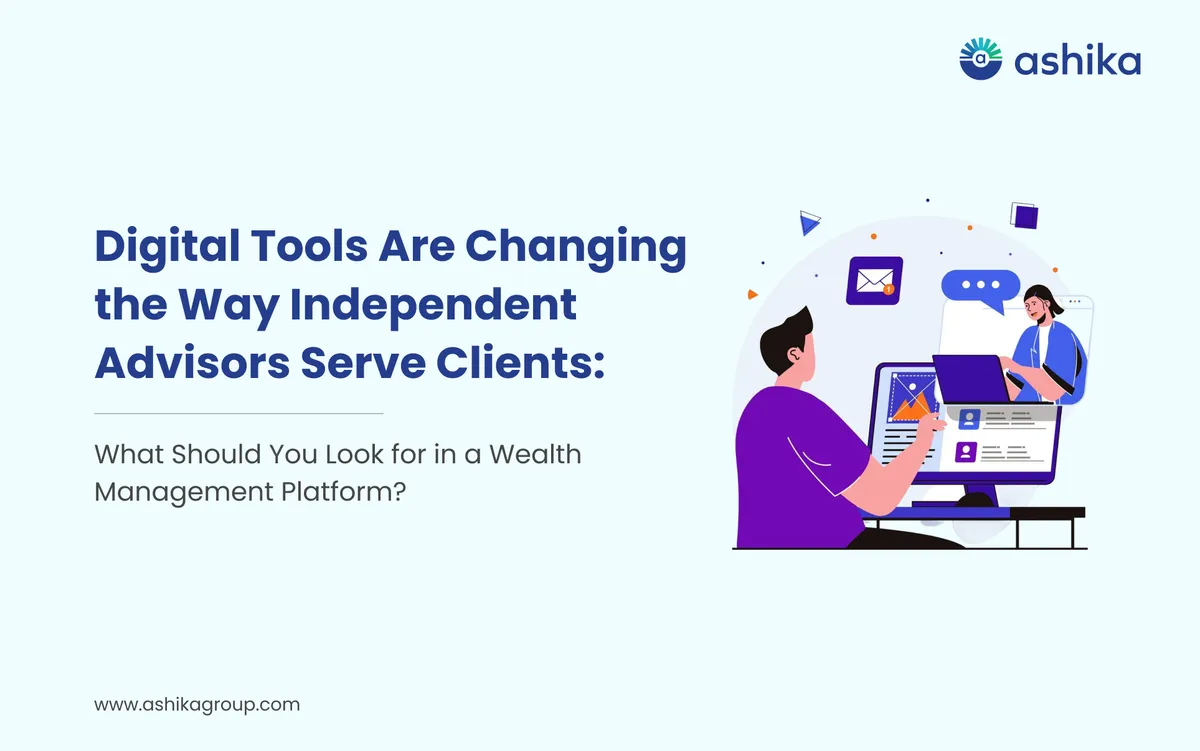
In 2026 a consultant who is still spending their time on spreadsheets, WhatsApp messages and manual portfolio calculations is slowly falling behind those colleagues who have automated these tasks and use the time saved to have real conversations with their clients. The appropriate platform will not take the place of an advisor's judgment; rather it eliminates the friction which prevents capable advisors from concentrating on advising rather than on administrative work. Ashika is designed specifically to do this for independent advisors. The following points outline what to look for in a platform and how Ashika meets each requirement.
Table of Contents
- Why independent advisors can't skip this decision anymore
- Research and analytics: where the real differentiation happens
- CRM and operations: the unglamorous backbone
- Distribution support built for scale
- What larger, established firms do differently
- The fiduciary question that should shape your tech choices
- Building your stack without overspending
- Client support is the piece technology alone can't replace
- What you should do next
- Frequently Asked Questions
Why independent advisors can't skip this decision anymore
Compared to the size of the nation's wealth, the number of registered advisory firms is small. This situation means that each adviser has to compete for an ever-expanding client base against other advisers who have already modernised the way they operate. Since mutual fund participation continues to increase, the level of client activity reaches a point at which, once a particular level of volume is reached, it is impossible to handle by hand. Technology is no longer a desirable option; it has become a basic expectation that clients have when they meet any adviser for the first time.
Ashika provides independent advisors with the tools and support needed to meet that expectation, rather than having to set up its own technology team.
Research and analytics: where the real differentiation happens
It could be argued that the selection of a platform is most important in the area of investment research since it has a direct effect on the quality of advice that clients get. Advisors require research that is both quick and accurate, clear portfolio analytics and output that is ready for use with clients—all without having to pay for and deal with systems that are designed for large institutions rather than for individual firms.
The research support provided by Ashika is based on that need and enables advisors to produce clear and thoroughly explained recommendations as well as to pass on the relevant material directly to their clients.
CRM and operations: the unglamorous backbone
While research tools receive attention, it is CRM and operations support that prevent a growing client base from becoming chaotic. Proper setup aids in client segmentation and the sending of follow-up reminders so that both prospects and existing clients aren't overlooked.
The main thing to note is that operations support addresses a different issue from research. While one helps locate and present the appropriate advice, the other ensures that this advice is consistently given to every client in your book, not just to those who happen to call first. Because Ashika provides advisors with support on both fronts, there is no need to rely on memory or manual tracking.
Distribution support built for scale
For independent advisors who also distribute mutual funds as part of their advisory services, the role of distribution support differs significantly from that of research or a customer relationship management system. It is most important to advisors whose income comes from trail commissions earned through the distribution of mutual funds, rather than from the fee-only model adopted by pure RIAs.
The ecosystem offered by Ashika allows advisors to work with a variety of revenue models, so you can select the one that is appropriate for your practice.
What larger, established firms do differently
It is helpful to consider the way larger independent firms operate in order to see the direction in which advisor technology is moving; many well-established advisory firms now have their own research tools and applications for clients, infrastructure that most small or individual practices are unable to set up themselves.
That is precisely the gap which Ashika is intended to fill. It enables smaller independent advisors to obtain the level of research and client experience that would normally have to be provided by an in-house technology team, something that most sole practitioners are unable to afford building.
The fiduciary question that should shape your tech choices
No matter which platform you select, it should align with the way your practice is actually organized. RIAs that are registered with SEBI act strictly in a fiduciary capacity; they have a legal duty to act in the best interests of their clients and must not accept undisclosed commissions or ongoing payments from product manufacturers. It follows that your research and reporting tools should enable fully transparent, fee-based discussions with clients, not one that is based on promoting products.
If your business makes money by selling mutual funds, then the requirements for your platform should focus on commission tracking and distribution support. Not meeting these requirements at the outset will lead to complicated reporting and compliance issues down the line. When you speak to Ashika, begin by telling her your regulatory category and revenue model so that the arrangement will be suitable for your practice from the very first day.
Building your stack without overspending
The fastest-growing practices aren't necessarily the ones with the most expensive setups. They are the ones that chose the right combination for their size. A single advisor just starting out may only need simple research support and a basic CRM. A larger team looking after dozens of client relationships benefits from a You can begin with just the essentials and then add more features as your client base increases, so you only pay for what your practice actually needs at the present time rather than for what it may need in the future.base grows, so you pay for what your practice needs now, not what it might need someday.
Client support is the piece technology alone can't replace
No matter how advanced a platform may be, it cannot replace the kind of relationship-building that helps retain clients during periods of market volatility. The most successful independent advisory firms combine reliable technology with real, responsive client support, including conducting scheduled reviews, keeping a clear track of goals, and having someone pick up the phone when a client is worried about a market drop.
That is what Ashika's method entails: technology should be used to free up your time so you can focus on the human aspect rather than replacing it, and Ashika's support is intended to help you better serve your clients.
Ready to open yours?
Free account opening · Paperless eKYC · Live in 10 minutes
What you should do next
- Choose the platform that suits you. Begin by studying the fundamentals of research and CRM, and later introduce distribution or reporting support when your client base increases. It is better to choose platforms that have a proven track record and offer responsive support than to go for the attractive marketing promises made by newer companies. Keep in mind that no platform can take the place of genuine client relationship management; use the time that technology saves you for that, not less of it. Use the time technology saves you for that. A suitable platform won't, on its own, make you a better advisor, but it will save you time and provide greater clarity so you can actually become one. When you're looking for a setup that is most appropriate for your practice, you should talk to the team at Ashika at ashikawealth.in.ashikawealth.in.
Frequently Asked Questions
What should independent financial advisors look for in an advisory platform?
Look for reliable research tools, portfolio analytics, CRM, operational support, client reporting and responsive assistance.
How can CRM tools help independent financial advisors?
CRM tools help organise client information, track prospects, manage follow-ups and maintain consistent communication.
Why is investment research important for financial advisors?
Research and analytics help advisors assess investments, understand portfolios and explain relevant information to clients.
Do fee-based advisors and mutual fund distributors need the same platform features?
Not necessarily. Fee-based advisors may prioritise research and transparent reporting, while mutual fund distributors may also need distribution and commission-tracking support.
Can technology replace personal client support?
No. Technology can reduce administrative work, but regular reviews, clear communication and personal guidance remain important for client relationships.
Was this article helpful?
Thanks for your feedback!

 6 min read