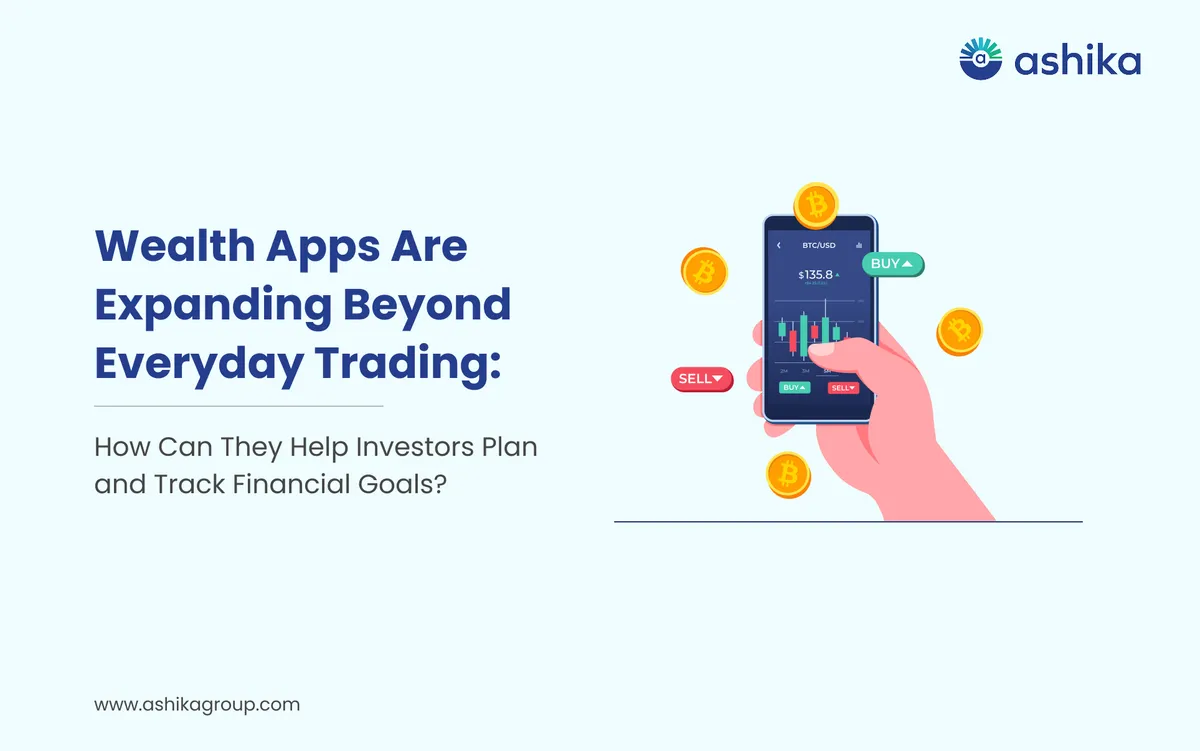
Most people download an investing app for one reason — to buy a stock or start a SIP. But somewhere along the way, the better wealth management apps in India stopped being just transaction tools and became something closer to a full financial control centre. If you're still using your app purely to place trades, you're leaving a lot of value on the table.
Table of Contents
- Why "Just Trading" Isn't Enough Anymore
- The Core Features That Separate a Wealth App from a Trading App
- Planning: Setting a Target Before You Set a Trade
- Investing: Beyond Just Buying and Selling
- Tracking: The Part Most Apps Get Wrong
- Why Discipline Beats Timing, Every Time
- Making Retirement and Long-Term Goals Less Abstract
- The Bigger Shift Underway
- What You Should Do Next
- Frequently Asked Questions
Why "Just Trading" Isn't Enough Anymore
Wealth management, in its true sense, means taking a holistic view of your finances — income, expenses, assets, debts, and investments together, not in isolation. That's a very different job than simply executing a buy or sell order. Yet for years, most investment apps in India were built around exactly that narrow function, leaving the actual planning — how much to save, what to invest toward, whether you're on track for retirement — entirely up to the individual, usually managed through spreadsheets or not managed at all.
This gap matters because research on goal-based investing shows something worth paying attention to: investors following personalised, goal-linked strategies show meaningfully better adherence to their investment plans during market volatility compared to those following generic, benchmark-driven approaches. In plain terms — when your investments are tied to something specific (a home down payment, a child's education, retirement at 55), you're less likely to panic-sell when markets wobble.
The Core Features That Separate a Wealth App from a Trading App
A genuine wealth management platform typically brings together several distinct capabilities under one roof: financial tracking and monitoring across accounts, investment management with actual insights (not just execution), retirement and goal planning tools, and some layer of financial education to help you make sense of it all. This is precisely where Dhanush 2.0 has been built to go further than a plain trading terminal.
Planning: Setting a Target Before You Set a Trade
The starting point of any real financial plan is knowing what you're actually saving for and by when. Dhanush 2.0's NPS and Basket Investing features are built around this idea — instead of picking random stocks or funds, you're working from a goal-first structure. Basket Investing in particular lets you invest in ready-made, theme-based portfolios rather than assembling one stock at a time, which suits investors who know their goal but don't want to spend hours building an allocation from scratch.
Investing: Beyond Just Buying and Selling
Once a plan exists, the actual investing should support it, not distract from it. Dhanush 2.0's AI Screener and Fund Finder help narrow down stocks and mutual funds against specific criteria and goals, rather than leaving you to sift through thousands of listed securities manually. For investors thinking beyond pure equity, the platform also covers ETFs, Bonds, FDs, and an IPO Tracker — meaning diversification across asset classes doesn't require five separate apps, each with its own login and its own learning curve.
Tracking: The Part Most Apps Get Wrong
This is genuinely where most trading-first apps fall short. A stock tracker that shows today's P&L isn't the same as a system that shows whether you're actually on pace for a ₹50 lakh retirement goal five years from now. Dhanush 2.0's Portfolio Analytics and Watchlist features are built to close that gap — giving a consolidated, real-time view of how your entire portfolio is tracking against the market and, by extension, against your own targets, rather than requiring you to piece that picture together manually across statements.
Why Discipline Beats Timing, Every Time
One of the most consistent findings across financial behaviour research is that most people overestimate how much they save and underestimate how much they actually spend — the gap usually hides in forgotten subscriptions, small recurring expenses, and lifestyle costs that crept up gradually with income. The same discipline problem shows up in investing: people who try to time markets tend to underperform people who simply stick to a plan. A GTT (Good Till Triggered) order feature, like the one built into Dhanush 2.0, plays directly into this — letting you set a target or stop-loss once, based on your plan, rather than needing to watch the market constantly and make emotional in-the-moment decisions.
Making Retirement and Long-Term Goals Less Abstract
Retirement planning tends to get pushed to "later" precisely because it feels distant and abstract. A dedicated retirement tracking tool changes that by turning a vague future goal into a calculated, trackable number — how much you need, how much you're contributing, and whether the gap is closing or widening. Dhanush 2.0's NPS integration exists specifically to make this long-horizon planning concrete rather than something you'll "figure out eventually."
The Bigger Shift Underway
The direction the industry is heading in is fairly clear: apps that only execute trades are becoming commodities, while apps that combine planning, investing, and tracking into one coherent experience are becoming the ones investors actually stick with long-term. As India's investing population keeps growing — and demat accounts alone have nearly doubled in just a few years — the appetite for a single platform that does more than just "buy" and "sell" is only going to increase.
Ready to open yours?
Free account opening · Paperless eKYC · Live in 10 minutes
What You Should Do Next
- Define a specific financial goal — not "invest more," but a number and a timeline — before choosing where to put your next rupee.
- Use portfolio tracking tools regularly, not just when markets are volatile, so small drifts from your plan don't turn into big ones.
- Consolidate your investments — equities, funds, bonds, retirement savings — onto a single platform where you can actually see the full picture at once.
- Treat goal-based investing as your default approach, since it's shown to improve discipline precisely when markets get shaky.
Trading is just one part of building real wealth — planning and tracking are what actually get you there. Explore how Dhanush 2.0 brings all three together in one platform, built to support your financial goals from planning through execution.
Frequently Asked Questions
What is the difference between a trading app and a wealth management app?
A trading app mainly facilitates buying and selling securities, while a wealth management app may also offer investment tracking, goal planning and portfolio insights.
How can goal-based investing help investors?
It connects investments to specific financial goals and timelines, which can help investors stay focused during market fluctuations.
Which features should I look for in a wealth management app?
Look for portfolio analytics, investment research, goal-planning tools, watchlists and access to different investment products.
How can Dhanush 2.0 support financial planning and investing?
It offers features such as NPS, Basket Investing, AI Screener, Fund Finder, Portfolio Analytics and access to ETFs and bonds.
Why is regular portfolio tracking important?
It helps you review investment performance, monitor changes in your portfolio and assess whether your investments remain aligned with your goals.
Was this article helpful?
Thanks for your feedback!
 5 min read