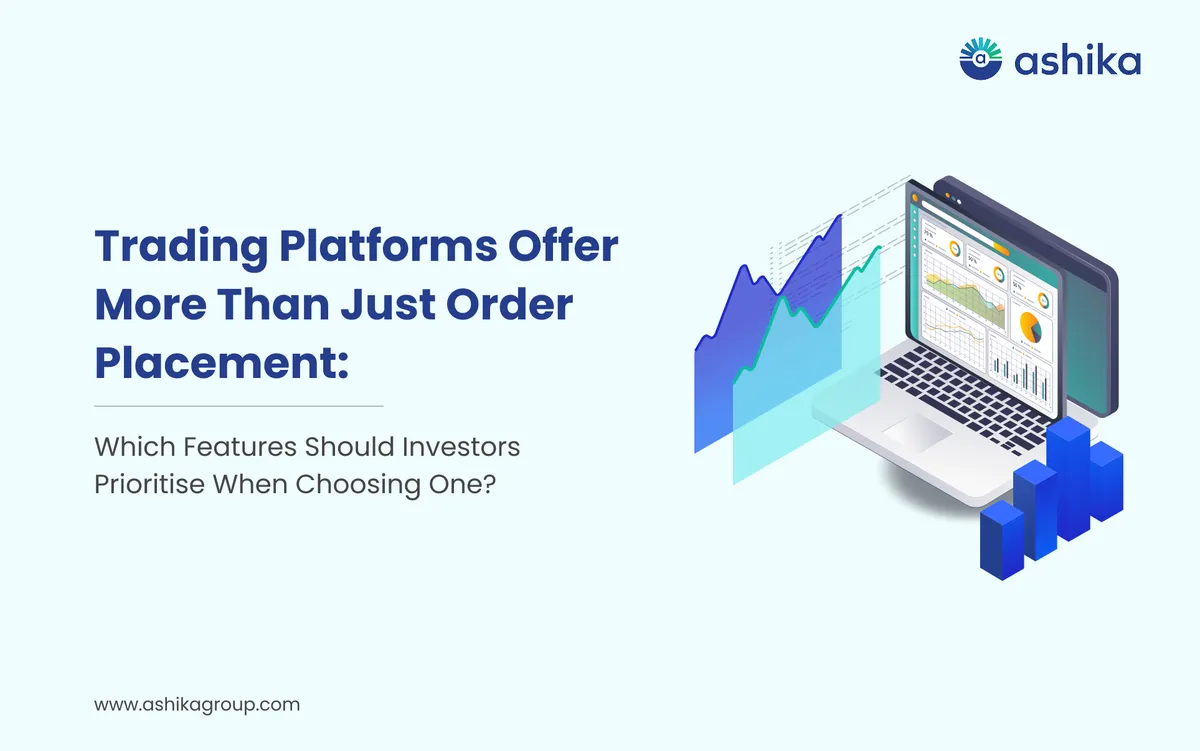
More Indians are now trading and investing than at any time before, and at the same time the number of trading apps in India competing for their attention has surged. All of the platforms assert that they are the best trading platform in India, yet the differences that truly matter—such as execution speed, actual brokerage charges, the depth of research offered, and the range of products—are usually hidden behind marketing. The following are the ten features that actually distinguish a solid online trading platform from one that only looks good in an app store screenshot.
Table of Contents
- 1. The registration with SEBI and the associated regulatory credibility.
- 2. Transparency regarding brokerage and fees
- 3. Access to the entire market through a single account
- 4. Reliable execution and platform stability
- 5. Tools for conducting research and for screening stocks
- 6. Tools for Charting and Technical Analysis
- 7. Tracking of portfolios and analytics
- 8. Advanced Order Types
- 9. A design that is easy for beginners without giving up on depth
- 10. Trust and Customer Support
- What You Should Do Next
- Frequently Asked Questions
1. The registration with SEBI and the associated regulatory credibility.
First of all, you should check that the platform is one that is registered with SEBI and has the appropriate membership with both the NSE and the BSE. This is not merely a matter of ticking a box since using an unregulated or incorrectly registered app does actually put your money and your personal data at real risk, even if the interface appears very attractive. Dhanush 2.0 is operated by Ashika Stock Services Ltd, a company with more than 30 years of experience in the market, so the necessary regulatory arrangements have already been put in place before your very first trade is made.
2. Transparency regarding brokerage and fees
Brokerage fees have a direct effect on your real returns, particularly when you carry out frequent trades. Before deciding on any demat and trading account, carefully examine the equity delivery fees, the intraday and F&O charges, as well as the costs associated with opening or maintaining the account—many applications prominently advertise 'zero brokerage' while hiding other charges in the small print. You should compare the full range of fees, not just the figure that is highlighted.
3. Access to the entire market through a single account
An investment app that is of a good quality should enable you to manage equities, derivatives, mutual funds, IPOs, and an increasing number of commodities and bonds all through a single demat-linked account, rather than requiring you to use a different app for each type of asset. Dhanush 2.0 goes well beyond the level of basic equity trading by offering coverage of MTF, Loans, FDs, Basket Investing, NPS, ETFs, Bonds, and an IPO Tracker on one platform, making it unnecessary to switch between various apps for different products.
4. Reliable execution and platform stability
It is most important for order execution to be both fast and consistent precisely in those situations where it is most difficult to guarantee this — for example, during the market opening, in periods of high volatility, or as a result of major news events. The best platforms keep their service running smoothly and achieve low latency even when the demand is high; a platform that slows down or crashes during a volatile session can still result in actual financial losses, no matter how good its research tools are at other times.
5. Tools for conducting research and for screening stocks
Good research is able to tell the difference between stock market platforms designed for serious investing and those made only for quick trades. You should look for AI stock screeners which allow you to filter the stocks according to both fundamental and technical criteria, not merely by basic price and volume sorting. The AI Screener in Dhanush 2.0 does precisely this by enabling you to filter out thousands of listed stocks against specific criteria in just a few seconds, together with a Fund Finder that helps you narrow down mutual funds in line with your real objectives rather than a general best-seller list.
6. Tools for Charting and Technical Analysis
For active traders who are using technical setups, the most important feature is advanced, customisable charting tools which include a variety of indicators and overlays, even though long-term investors also find clean visual tools useful when looking at entry and exit points. It has become a basic expectation among serious share trading platforms to offer TradingView-style integrations by 2026.
7. Tracking of portfolios and analytics
A platform should provide you with a consolidated, up-to-date view of how your portfolio is actually performing, not just a fixed list of positions. The Portfolio Analytics and Watchlist features in Dhanush 2.0 achieve this by enabling you to monitor your performance in relation to the wider market without having to manually assemble the data from various spreadsheets.
8. Advanced Order Types
In addition to simple market and limit orders, you should consider platforms that provide GTT orders (Good Till Triggered), stop-loss automation, and other types of conditional orders which allow you to set a target or exit point once and then have the system carry out the order — rather than having to watch the market the entire day. Dhanush 2.0 features GTT Orders for this very reason, enabling the translation of research decisions into disciplined, hands-off execution.
9. A design that is easy for beginners without giving up on depth
The most suitable trading applications for beginners are able to cater to both new investors and experienced traders without having to give up on either aspect by offering intuitive dashboards, one-tap order entry, and built-in educational content for newcomers as well as the extensive features that more advanced traders require. A trading platform that is too simple will annoy active traders, while one that is too complicated will scare beginners. Achieving this kind of balance is a real source of distinction.
10. Trust and Customer Support
If there is a problem—such as a failed order, difficulty logging in, or a confusing charge—effective customer support is more important than any list of features. Platforms that have been around for a longer time and offer dedicated relationship support generally deal with such issues better than those that are newer and still building out their support systems. This is particularly important for investors in tier-2 and tier-3 cities, since trust in an unfamiliar investment platform can already be a genuine obstacle.
Ready to open yours?
Free account opening · Paperless eKYC · Live in 10 minutes
What You Should Do Next
- Select two or three trading platforms according to your trading style, how sensitive you are to costs, and the asset classes that you actually intend to use.
- Before opening any account it is necessary to verify the company's SEBI registration and membership on an exchange, no matter how popular the platform is.
- Before committing any significant capital, it is necessary to check the speed of test execution and the stability of the application during a live market session.
- It is better to choose platforms that give access to a variety of product categories than to use several different investment apps.
Choosing the right trading and investment platform isn't about picking the most feature-packed app — it's about picking the one that actually matches how you invest. Explore what Dhanush 2.0 offers if you're looking for a platform built to support both research and execution in one place.
Frequently Asked Questions
How do I choose the right Trading platform in India?
Compare SEBI registration, brokerage charges, available products, research tools, order execution, platform stability and customer support.
Why should I check a Trading platform’s SEBI registration?
It helps you verify whether the broker is authorised to provide the relevant services and operates within the applicable regulatory framework.
What charges should I compare before opening a Trading account?
Check brokerage, account opening and maintenance fees, transaction charges, taxes and other applicable levies.
Which features are useful in a Trading and Investment app?
Stock screeners, charting tools, portfolio analytics, watchlists and conditional orders such as GTT can support research and trade management.
Can one platform be used for both Trading and long-term investing?
Yes. Some platforms provide access to equities, derivatives, Mutual Funds, IPOs, ETFs and other products, allowing users to manage different activities in one place.
Was this article helpful?
Thanks for your feedback!
 5 min read