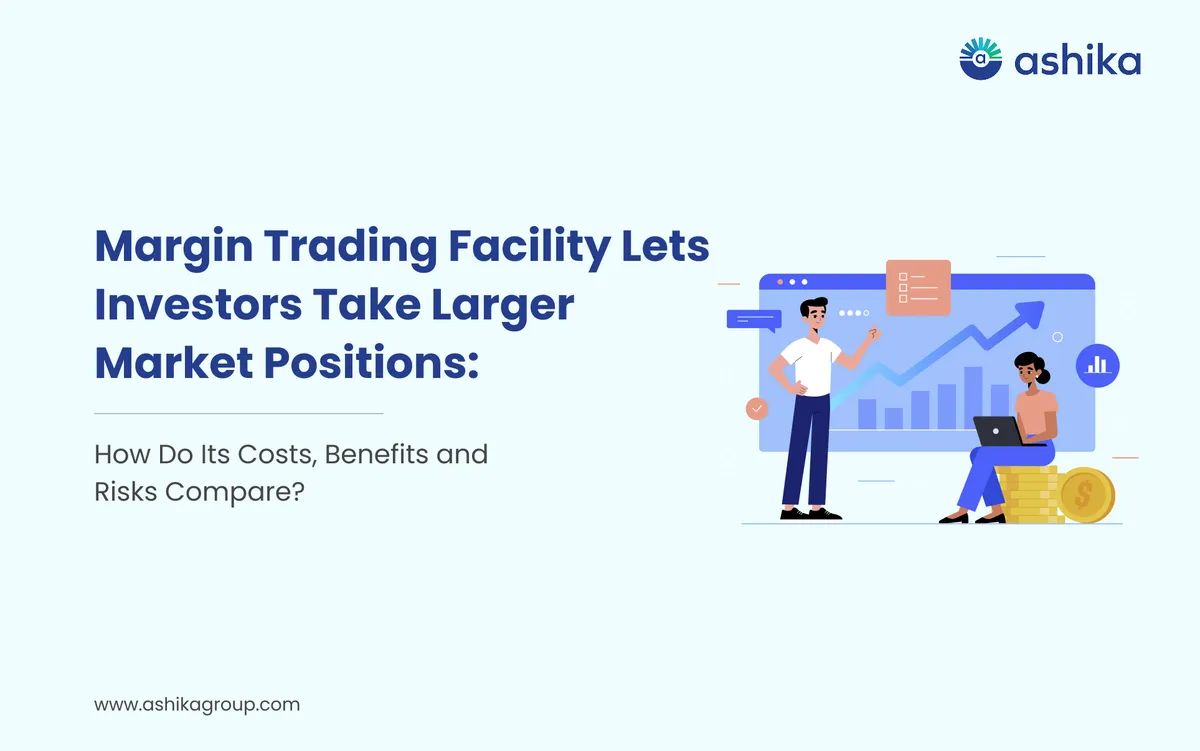
What if you do want to buy shares but still don't want to pay the whole purchase price at once?
The Margin Trading Facility (MTF) is then the solution.
Eligible investors can buy certain securities by paying part of the transaction value themselves, while the broker pays the rest, subject to applicable rules, limits, and charges erved.
Although MTF may increase investors' buying power it also increases the amount of money at risk. It is therefore important to know how MTF works, how much it costs and what could happen if the share price moves against you.
Table of Contents
- What is the Margin Trading Facility?
- How Does MTF Work?
- A Simple Example of MTF
- What Does MTF Cost?
- What are the advantages of MTF?
- What are the risks associated with MTF?
- MTF vs Buying Shares With Your Own Money
- MTF With Dhanush by Ashika
- Before Using MTF, Ask Yourself These Questions
- Frequently Asked Questions
What is the Margin Trading Facility?
The MTF facility allows a broker to provide funds to a qualified client so he or she can buy securities.
Rather than paying the full purchase amount, the investor provides the required margin and the broker pays the balance, based on the relevant framework.
For example, say you want to buy shares worth ₹1 lakh, and the margin requirement is ₹25,000.
I contribute ₹25,000, and the other ₹75,000 is raised via the MTF arrangement.
The precise margin requirement varies by security, applicable regulations, and the broker's terms, so you can't assume all shares can be bought on the same margin.
How Does MTF Work?
The process is rather simple.
Choose a security that is eligible.
Not every security is available under MTF. Brokers provide a list of securities that meet the relevant requirements.
Check the margin requirement.
The broker states the margin, while the investor must provide it.
3. Place the order
When the necessary margin is available, the investor can use the MTF facility to place an eligible buy order.
4. The broker pays the balance
The broker arranges the remaining amount in accordance with the relevant terms.
5. Pay the funding cost that applies
The broker is charged interest or other relevant charges for the amount that the investor provides.
6. Leave the position or settle it.
The investor may sell the shares or else settle the position in accordance with the terms of the facility.
Remember, MTF provides funding, not additional capital at no cost.
A Simple Example of MTF
Imagine you intend to purchase shares worth ₹1,00,000.
If the applicable margin requirement is 25%, you may need to contribute:
₹1,00,000 × 25% = ₹25,000
The MTF arrangement finances ₹75,000.
Now picture the share value increasing to ₹1,10,000.
The position has earned ₹10,000 before costs.
If the share price drops to ₹90,000, then the position will have suffered a loss of ₹10,000.
The loss is based on the value of the shares, not just the ₹25,000 you initially put in.
What beginners need to understand is this.
While MTF boosts purchasing power, it may also increase the effect of a price fall on your own capital.
What Does MTF Cost?
The cost of MTF isn't just the price paid for the shares.
Depending on the broker and applicable terms, investors may have to consider:
- MTF interest or funding charges
- Brokerage
- Securities Transaction Tax (STT), where applicable
- Exchange transaction charges
- GST
- Stamp duty
- Other statutory or transaction-related charges
The cost of funding matters because the broker supplies the money.
For instance, if ₹75,000 is allocated to a post and the relevant funding rate applies for the period the sum remains outstanding, the cost will rise as the post lengthens.
Therefore, the MTF trade should not be judged merely on whether the share price is expected to rise.
The expected return should also be taken into account when assessing the trade.
What are the advantages of MTF?
Greater buying power
A clear benefit is that investors can take an eligible position without paying the full value at the start.
Flexibility
MTF is useful when an investor has spotted an eligible investment opportunity but wants to use only a portion of the required capital at the start.
Potential to use capital more efficiently
An investor might choose not to put the full purchase amount into a single position, but instead use their available capital in a way that suits their strategy and risk tolerance.
Greater buying power does not mean greater opportunity.
That is also equivalent to having more exposure.
What are the risks associated with MTF?
MTF can amplify both gains and losses.
1. Losses can go up fast.
The investor will still have to account for the outstanding funded amount even if the value of the funded shares drops.
It may be necessary to have additional margin
If the position value declines or the margin requirements change, the investor may be required to put up extra funds or securities.
You can square off your positions.
If the necessary margin is not kept, the broker may be entitled to take steps regarding the position, including selling the securities, in accordance with the relevant terms.
4. Funding costs continue
The longer an MTF position is held, the higher the interest or funding costs will be.
5. Market volatility
A sudden change in the share price can cause the risk of an MTF position to change quickly.
The investor education materials highlight the risks involved in margin trading and in highly leveraged positions, including the possibility that losses could exceed the capital which the investor has available in some cases.
MTF vs Buying Shares With Your Own Money
The best way to understand the difference is by looking at an example.
Your exposure will be ₹1 lakh if you buy shares worth ₹1 lakh using all your own money.
With MTF, you can pay only a portion of that amount, while the broker covers the remainder.
This means your capital requirement will be lower, while your market exposure can still be ₹1 lakh.
MTF is not a reduction of market risk.
This applies when a larger position is financed with a smaller initial contribution.
MTF With Dhanush by Ashika
Ashika provides the MTF facility for eligible securities on the applicable terms, limits, and regulatory requirements.
Dhanush provides a margin trading facility with a multiplier of up to 4 times for eligible stocks, enabling investors to take a position with a smaller balance while the rest is supplied through the facility.
Before you use MTF, review the most recent list of eligible stocks, the applicable funding rate, the margin requirement, the brokerage fees, and any other charges on the platform.
The right question isn't just "How much can I buy with MTF?"
It should be:
How much exposure can I tolerate when the market moves against me?
Ready to open yours?
Free account opening · Paperless eKYC · Live in 10 minutes
Before Using MTF, Ask Yourself These Questions
Before taking an MTF position, check:
- Can the stock be made eligible for MTF?
- What margin do I need?
- What constitutes the funding rate?
- For how long do I intend to keep the position?
- What will occur if the share price goes down?
- Can I meet another margin requirement?
- What are the applicable charges?
- What is my exit plan?
These questions can help put the facility into perspective.
MTF can be useful for investors who understand leverage and can manage the associated costs and risks. But it shouldn't be treated as a shortcut to bigger profits.
The more market exposure you take, the more important risk management becomes.
Explore MTF on Dhanush by Ashika and understand the costs, eligibility, and risks before taking a position.
Frequently Asked Questions
What is a Margin Trading Facility (MTF)?
MTF allows eligible investors to buy approved securities by paying a portion of the purchase value, while the broker funds the remaining amount under the facility's terms.
How does MTF work?
The investor provides the required margin, and the broker finances the balance. The investor must pay the applicable funding charges and meet ongoing margin requirements.
What are the charges involved in MTF?
MTF costs may include interest or funding charges, brokerage, STT, exchange transaction charges, GST, stamp duty and other applicable fees. The exact charges depend on the broker and transaction.
What are the risks of using MTF?
MTF increases market exposure and can magnify losses. Investors may also face additional margin calls, continuing interest costs and the possibility of their positions being squared off if margin requirements are not met.
Can investors use MTF through Dhanush 2.0 by Ashika?
Eligible investors can access MTF through Dhanush 2.0 by Ashika, with funding of up to 4 times for eligible stocks, subject to applicable terms and conditions. Check the eligible stock list, margin requirements and funding charges before placing an order.
Was this article helpful?
Thanks for your feedback!
 5 min read