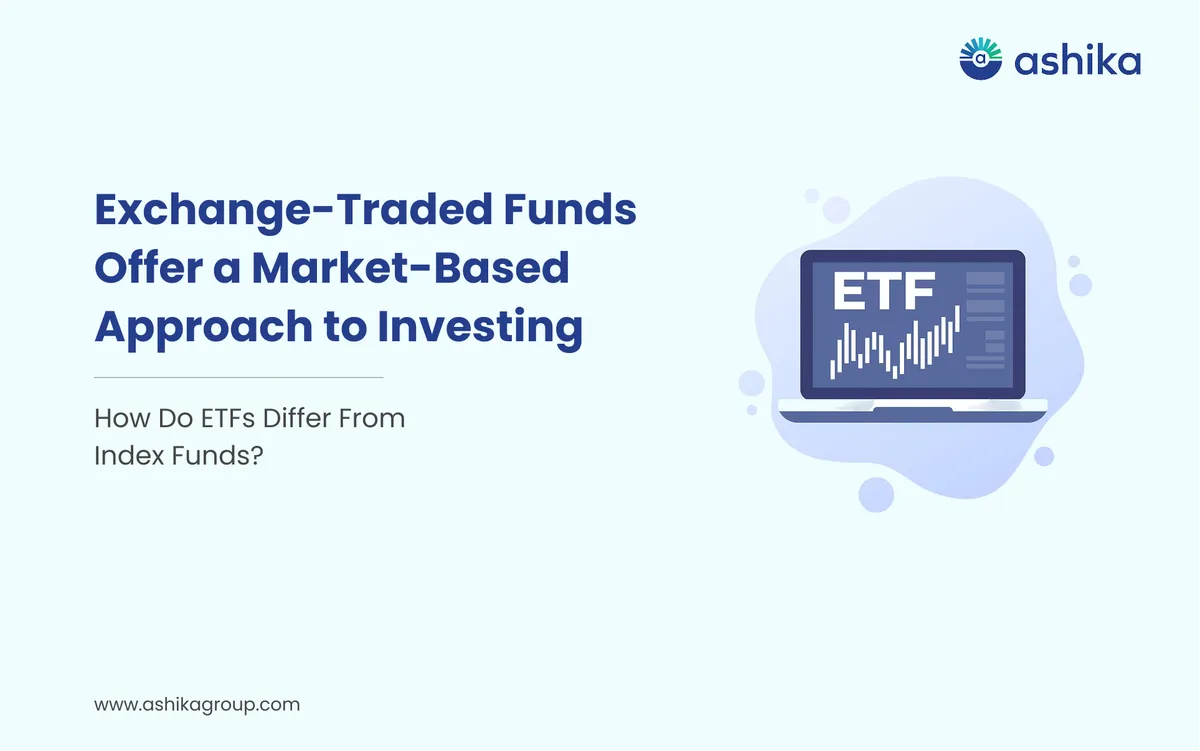
Investors looking for a simple way to diversify their portfolios often come across two similar-sounding options: ETFs and index funds.
Both can track an index such as the Nifty 50 or Sensex, but they work differently. The biggest difference is how they are bought and sold.
An ETF, or Exchange Traded Fund, trades on a stock exchange during market hours, much like an individual stock. An index fund, on the other hand, is a mutual fund that typically allows investors to buy or redeem units at the applicable Net Asset Value (NAV).
Understanding this difference can help investors choose the approach that suits their investment style.
Table of Contents
- What Is an ETF?
- How Does ETF Trading Work?
- What Is an ETF Trading Platform?
- ETF vs Index Fund: What's the Difference?
- What Are the Benefits of ETFs?
- What Should You Check Before Buying an ETF?
- Is an ETF Better Than an Index Fund?
- Buying ETFs Through Ashika Dhanush 2.0
- ETF or Index Fund: Which One Should Beginners Choose?
- Frequently Asked Questions
What Is an ETF?
An Exchange Traded Fund is an investment fund that holds a basket of securities and trades on a stock exchange.
An ETF may track a particular index, sector, commodity or other underlying asset, depending on its structure.
For example, a Nifty 50 ETF aims to track the performance of the Nifty 50 Index by holding securities that represent the index.
Instead of buying each stock separately, an investor can buy units of the ETF through a trading account.
This provides exposure to multiple securities through a single listed investment.
How Does ETF Trading Work?
ETF trading is similar to buying or selling shares.
An investor generally needs:
- A Demat account
- A trading account
- A linked bank account
Once the account is active, the investor can search for the ETF on their trading platform, check its market price, select the quantity and place an order.
The ETF's market price changes during trading hours based on demand and supply.
This is different from a mutual fund, where transactions are generally processed at the applicable NAV.
What Is an ETF Trading Platform?
An ETF trading platform is the digital interface through which investors can buy and sell ETFs listed on a stock exchange.
A trading platform may allow investors to:
- Search for ETFs
- View prices and charts
- Check market depth
- Place buy and sell orders
- Track holdings
- Monitor portfolio performance
Before choosing a platform, investors should also look at brokerage, transaction charges, platform usability and the range of products available.
ETF vs Index Fund: What's the Difference?
ETFs and index funds can follow the same underlying index, but their trading mechanism is different.
| Feature | ETF | Index Fund |
|---|---|---|
| Trading | On stock exchange | Through mutual fund platform |
| Price | Changes during market hours | Based on applicable NAV |
| Demat account | Generally required for exchange trading | Not necessarily required |
| Order execution | Market/limit orders | Fund purchase/redemption process |
| Intraday trading | Possible | Not applicable in the same way |
| Diversification | Depends on underlying index | Depends on underlying index |
For example, an investor wanting exposure to the Nifty 50 could choose either a Nifty 50 ETF or a Nifty 50 index fund.
The underlying exposure may be similar, but the way the investment is bought, sold and priced differs.
What Are the Benefits of ETFs?
Diversification
One ETF can provide exposure to several securities. This can be useful for investors who want to spread their investments rather than buy individual stocks.
Exchange-Based Trading
Since ETFs are listed on exchanges, investors can buy and sell them during market hours at available market prices.
Portfolio Flexibility
Investors can use different order types, such as limit orders, depending on what the trading platform supports.
Variety
There are ETFs covering different indices, sectors and asset classes. Investors can therefore choose products based on their investment objectives.
However, the availability of a particular ETF does not mean it is suitable for every investor.
What Should You Check Before Buying an ETF?
The ETF's name alone does not tell you everything you need to know.
Before investing, check:
Underlying index or asset: Understand what the ETF actually tracks.
Expense ratio: This indicates the fund's operating expenses.
Tracking difference: An ETF may not perfectly replicate the performance of its underlying index.
Liquidity: Check trading volumes and the bid-ask spread.
Market price vs NAV: The ETF can trade at a premium or discount to its underlying value.
Risk: Understand the risks associated with the underlying securities or asset.
These factors can matter when comparing two ETFs that appear similar.
Is an ETF Better Than an Index Fund?
There is no universal answer.
An ETF may appeal to investors who want exchange-based trading and greater control over the price at which they transact.
An index fund may be more convenient for investors who prefer the mutual fund structure and do not want to place exchange orders.
The better choice depends on factors such as investment horizon, trading preferences, costs, liquidity and how the investor wants to manage the portfolio.
Buying ETFs Through Ashika Dhanush 2.0
Investors looking for an online platform to access market products can explore Ashika's Dhanush 2.0.
Through a digital trading platform, investors can track market prices, manage their holdings and access eligible investment products, including exchange-traded instruments.
Before buying an ETF, however, investors should first understand the underlying index, costs, liquidity and risks rather than choosing an ETF simply because its price appears attractive.
Ready to open yours?
Free account opening · Paperless eKYC · Live in 10 minutes
ETF or Index Fund: Which One Should Beginners Choose?
If you prefer buying and selling during market hours, an ETF may suit your approach.
If you prefer a mutual fund structure and don't need intraday exchange-based trading, an index fund may be worth considering.
The important thing is not to choose based only on which product sounds simpler.
Understand how each one works, compare the costs and check whether it fits your investment goal.
The Bottom Line
ETFs and index funds can both provide diversified exposure to a market index, but they operate differently.
An ETF trades on a stock exchange like a share, while an index fund follows the mutual fund structure and transactions are based on the applicable NAV.
Once you understand this distinction, choosing between an ETF and an index fund becomes less about terminology and more about what works for your investment strategy.
Frequently Asked Questions
What is an ETF, and how does it work?
An Exchange Traded Fund (ETF) holds a basket of securities or other assets and trades on a stock exchange. Investors can buy and sell its units through a trading account during market hours.
What is the main difference between an ETF and an index fund?
An ETF is bought and sold on a stock exchange at market prices, which change during trading hours. An index fund is a mutual fund, and purchases or redemptions are processed at the applicable NAV.
Do I need a Demat account to invest in ETFs?
A Demat account is generally required to hold ETF units purchased through an exchange. Investors also need a trading account and a linked bank account to place orders.
What should investors check before buying an ETF?
Check the underlying index or asset, expense ratio, tracking difference, liquidity, bid-ask spread and whether the ETF trades at a premium or discount to its NAV.
Are ETFs better than index funds for beginners?
Neither is universally better. ETFs may suit investors who prefer exchange-based trading and control over order prices, while index funds may suit those who prefer the mutual fund investment process. The choice depends on investment goals, costs and preferences.
Was this article helpful?
Thanks for your feedback!
 6 min read