Intraday calls will often get a lot of attention prior to the market opening with traders looking for potential entry prices, targets and stops to help them with their trade planning. A market call is no guarantee of profit though. Prices can move very quickly and a well thought out view can easily be wrong.
Before you go ahead and act on the intraday calls for today it's important to understand what the call is, how you assess the call and what risks you need to be aware of prior to placing an order.
Table of Contents
What Are Intraday Calls?
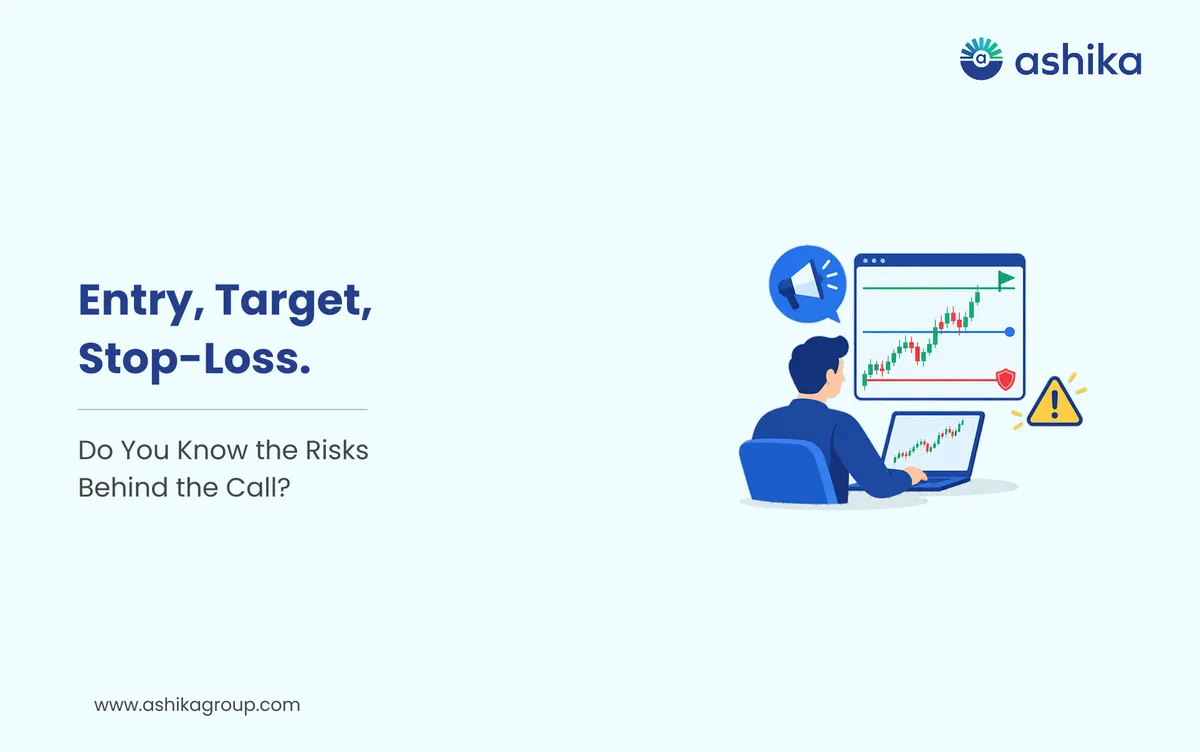
Intraday calls are trading ideas/recommendations for a trade that is opened and closed in the same day. They may identify a stock or index, a possible entry, a target and a stop.
For instance a trade call might be to consider a stock around Rs 500 with a target of Rs 510 and a stop loss at Rs 495. These are just illustrative numbers.
The idea is to define the trade in advance. The stock may never get to the entry level, prices may have already moved past the level we're looking to enter at before our order is executed and the trade may of course hit its stop loss.
Intraday calls can be based on technical analysis, price action, volume, news or a mixture of the above. The reason for the call is more important than the price level itself.
What Should an Intraday Call Include?
Before you even consider a market call you should check that it gives you sufficient information to assess the trade.
Stock or index name: the underlying instrument must be clearly defined. You could have two very similar company names or indeed two different contracts and it's absolutely possible that you could end up with confusion.
Entry level: this is the price at which a trade may be considered. Traders should check whether the price has already moved away from that level.
Target price: the target is an exit level, not a guaranteed return. A trade may well fail to reach it.
Stop-loss: this is the level at which the trader intends to exit in order to limit their losses. In a fast moving market you can quite readily have execution at a different price (especially in the case of a gap or a sharp move).
Time validity: a call for a particular session may well be obsolete at a later date. Traders need to know when it expires and whether the market conditions have changed in the meantime.
A call with no clear rationale, no risk level and no time frame is very difficult to assess.
How Can Traders Assess Market Calls?
Rather than just acting, traders can use a simple checklist to go through an intraday call.
1. Check the Market Trend
Look at the wider market first before you go any further and look at an individual stock. Index moves, sector performance and the wider market picture can all have an impact on an individual share.
A stock which is performing well on its own may still be under selling pressure if the broader market starts to fall. The same applies to a weak stock which may behave very differently when its sector starts to turn around.
2. Understand the Technical Setup
Intraday calls can be support and resistance, breakouts, moving averages or candlestick patterns. The novice trader should be familiar with what these terms mean before using them in any trading decision.
For instance a breakout call might be based on the price making it above a resistance level. If the price then fails to hold that move the setup we were expecting may be dead.
Technical indicators are tools of analysis, not guarantees of where the price is going to go next.
3. Look at Trading Volume
Volume can be used by traders to assess whether a price move is accompanied by actual trading activity. A breakout with significantly higher volume than normal might be of interest, but volume by itself doesn't tell you that the price will continue in that direction.
It should be looked at in conjunction with price action, the state of the market and the rationale for the trade.
4. Review the Risk-Reward Relationship
Suppose an illustrative call is for an entry at ₹500, a target of ₹510 and a stop loss at ₹495.
The potential gain is Rs 10/share, the risk is Rs 5/share (before charges and execution differences) which gives a potential reward to risk ratio of 2:1.
The ratio does not equate to a 2:1 chance of the trade being successful though. The actual outcome will be determined by execution, the movement of the market and whether the target or stop loss is actually hit.
Traders should also bear in mind the broker's charges, the tax implications and all other relevant charges.
Why Should Traders Be Careful With Daily Calls?
Intraday trading involves risks which aren't always obvious when a call comes in as a short list of prices.
Market news can lead to sharp price moves. There can be periods of low liquidity in certain stocks which makes it difficult to get in or out at the price you're hoping for. Stop losses in fast markets may not hit the exact price you'd like them to.
Another issue is overtrading. Getting a number of calls in a day doesn't mean you have to take every opportunity. Excessive trading will increase your transaction costs and make risk management more difficult.
Traders should be wary of any claims such as "guaranteed profit", "sure shot call" or of a promise of a fixed daily return. No market call can remove market risk.
Where Does Research Fit In?
Market calls should be regarded as inputs to your analysis rather than as something you just go and do. You should look at the price charts, you should look at the company news, you should look at the market news, you should look at the relevant technicals and then decide for yourself whether that setup is one that you'd actually go and trade.
Platforms like Ashika Dhanush 2.0 will provide market related information and tools which you can go and look at as you're assessing market activity. You'll need to check the platform to see what specific research/trading tools are available. Any recommendation should be evaluated on its merits and the source and any applicable regulatory disclosures should be checked.
Ready to open yours?
Free account opening · Paperless eKYC · Live in 10 minutes
Conclusion
Intraday calls for today may well help you to identify some potential setups, but they need to be looked at carefully. It's far more useful to understand the entry, the target, the stop loss, the time validity and the reasoning behind the call than it is to just take a price level.
A disciplined approach is to set a risk limit, check the market and accept that not every trade is going to work. If a call is unclear or the risk is beyond your comfort level then of course you don't have to take the trade.
Frequently Asked Questions
What should I check before taking an Intraday call?
Check the stock or index, entry price, target, stop-loss, time validity and the reasoning behind the call. Also assess the broader market trend and whether the price is still near the suggested entry.
Should I enter a trade if the stock has already crossed the recommended entry price?
Not automatically. The original setup may no longer be valid if the price has moved significantly. Check whether the call is still active rather than chasing the price.
Can a stop-loss guarantee that I won't lose more than the amount I planned?
No. In a fast-moving or illiquid market, an order may execute at a different price from the stop-loss level, resulting in a larger loss than expected.
How do I know if an intraday call has a good risk-reward ratio?
Compare the potential loss between the entry and stop-loss with the potential gain between the entry and target. A favourable ratio does not guarantee that the trade will succeed.
What should I do if an Intraday call doesn't reach its target?
Follow the trade's stated exit conditions and reassess the setup. Avoid holding a losing position or extending the target simply in the hope that the price will recover.
Was this article helpful?
Thanks for your feedback!

 6 min read