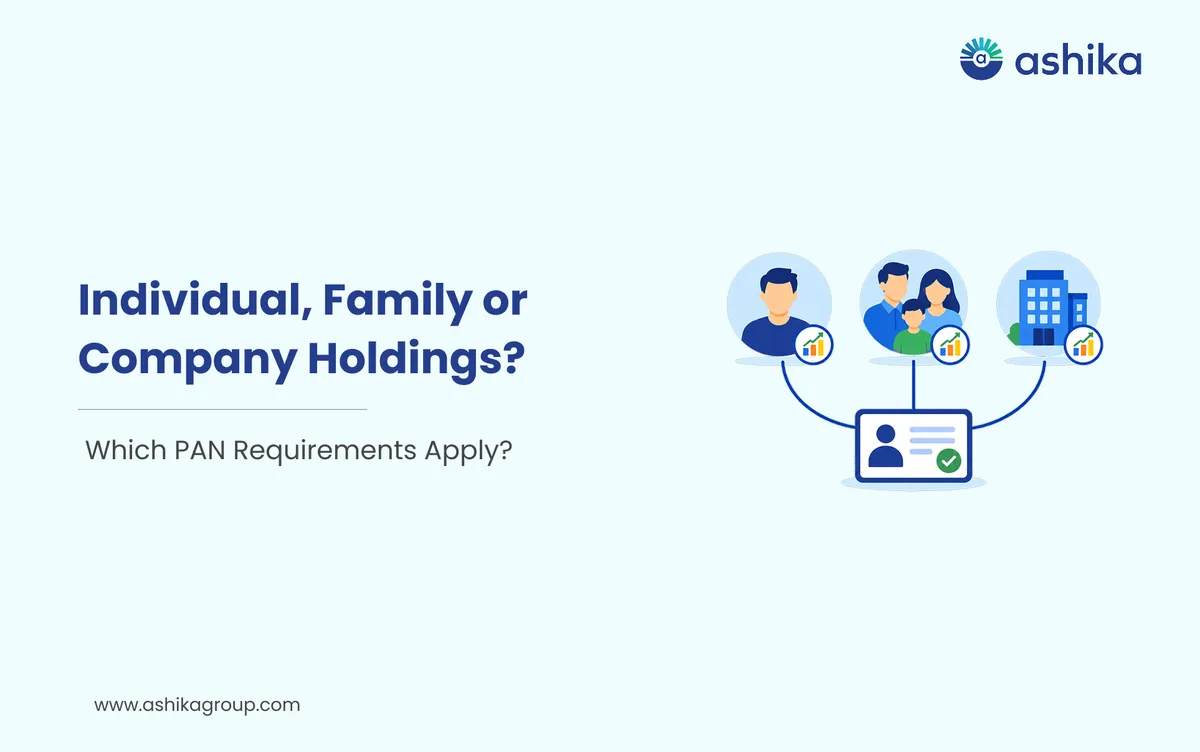
A Demat account isn't necessarily in the name of just one person. It can be held jointly by family members, in the name of a HUF or it can be in the name of a company. The PAN is of course central to identity verification and to the opening of the account but the documentation and the ownership details required will vary depending on the type of account.
For anyone looking to open or manage a Demat account the differences are important to understand in order to avoid KYC delays and documentation errors.
Table of Contents
1. Joint Demat Accounts: PAN for Every Holder
A joint Demat account enables two or more people to hold securities in tandem. In India a single individual Demat account can typically have up to three holders (one primary and two joint holders).
PAN requirements: Each holder must furnish their PAN and complete the relevant KYC verification. The DP may also require identity and address proofs, photographs, signatures and other supporting documents.
The order of the names does matter. The first named holder is generally the primary holder for account purposes. All holders must ensure that their names and personal details match those on the records that will be used for verification.
For instance if two family members wish to hold shares jointly then both of their PANs would be required. One person's PAN would not be sufficient to stand in for the other holder's.
Another key point is ownership. Securities held in individual name and those held in joint names generally cannot be combined into a single Demat account if the ownership pattern is different. A separate account may be required for each different ownership pattern.
2. HUF Demat Accounts: PAN of the HUF and Karta
A Hindu Undivided Family (HUF) is a separate taxable entity under the Income Tax Act. It can make eligible investments via an HUF Demat account which is managed by the Karta.
PAN requirements: The HUF will require its own PAN (separate from the Karta's individual PAN). The DP will generally require the PAN details of both the HUF and the Karta along with identity proof and supporting documents.
Depending on the DP's process the supporting documentation will typically consist of the HUF's bank proof, the Karta's ID and address proof, an HUF declaration or deed where applicable, details of the family members/coparceners and the various account opening forms.
The account name should match the relevant HUF records and PAN documents. The Karta will need to complete the requisite verification and sign in the capacity as specified by the DP.
HUF account rules have also changed. Depository guidelines have now allowed HUF Demat accounts to be opened jointly with up to two individual holders (subject to the normal conditions). The account structure, nomination restrictions and the way the account operates can vary from depository to depository and DP to DP. Investors should check the current rules with their depository before applying.
An HUF account must not be confused with a normal joint account between family members. The HUF is a separate entity in terms of ownership and tax identity from the individual PANs of its members.
3. Company Demat Accounts: Entity PAN and Authorisation
Companies can open Demat accounts (to hold securities in their own name) subject to the relevant legal and account opening requirements. These are of course distinct from the personal Demat accounts of directors, shareholders and employees.
PAN requirements: The company must provide its own PAN. The DP will also carry out KYC checks on the entity and verify the individuals authorised to open or operate the account.
Common documents requested for a corporate Demat account include:
- Company's PAN card and incorporation certificate.
- Memorandum and Articles of Association (as applicable).
- Board resolution to authorise the opening of the account and to identify the authorised signatories.
- Registered office address proof and company contact details.
- KYC documents and PAN details of the authorised person(s), director(s) or beneficial owner(s) as required.
- Bank account proof in the company's name.
- Other declarations or documents as may be required by the DP.
The precise list will vary depending on the company's legal structure, the procedures of the securities intermediary and the relevant regulatory requirements. The company should also ensure that its constitution and internal authorisations allow for the proposed investment activity.
A director's personal PAN does not in any way take the place of the company's PAN. Equally, securities of the company should not be held in a director's personal Demat account simply because that individual is the director of the company.
4. Common Mistakes to Avoid
Regardless of the account type, a few checks can make the opening process smoother:
Use the correct PAN: it must be the PAN of the actual account holder or entity. Joint holders, HUFs and companies all have different requirements in this respect.
Mismatched names: check the spelling and all other details against the PAN, the bank records and the supporting documents prior to submission of the application.
Missing authorisation: HUFs will of course have to comply with the relevant Karta requirements, whereas companies will generally require a valid board resolution and the details of an authorised signatory.
Assume that all DPs will be following the same checklist (the core regulatory requirements will be the same across the market, the collection of documentation and the way they operate may differ). Always check with your chosen DP to confirm the current version of the checklist.
Ready to open yours?
Free account opening · Paperless eKYC · Live in 10 minutes
5. Before Opening Your Demat Account
Start by establishing who the legal owner(s) of the securities are (individual, multiple joint holders, HUF or company). Then gather the relevant PAN details, KYC documents, bank proof and authorisation documents.
Investors using a platform such as Ashika's Dhanush should check the account opening requirements with the relevant team prior to submitting their documents. It's useful to check the ownership structure at that stage to avoid any delays and to reduce the number of corrections that may be required later on.
Frequently Asked Questions
If I open a joint Demat Account with a family member, do both of us need to submit our PAN cards?
Yes. Every account holder must provide their own PAN and complete the required KYC verification. One holder's PAN cannot be used for everyone.
Can I use my personal PAN to open a Demat Account in the name of my HUF?
No. An HUF needs its own PAN, separate from the Karta's individual PAN. The DP will generally require the PAN and KYC details of both.
Can an HUF Demat Account be held jointly with individual family members?
Yes. Depository guidelines permit HUF Demat Accounts to be held jointly with up to two individual holders, subject to applicable conditions. Check the current requirements with your DP.
Can a company open a Demat Account using its director's PAN?
No. The company must provide its own PAN. The PAN and KYC details of authorised signatories and other relevant individuals may also be required.
Can I transfer shares from my individual Demat Account to a joint or HUF account without any issue?
Not necessarily. The ownership pattern must match for a straightforward transfer. A change from individual to joint or HUF ownership may require a separate process and can have legal or tax implications.
Was this article helpful?
Thanks for your feedback!

 7 min read