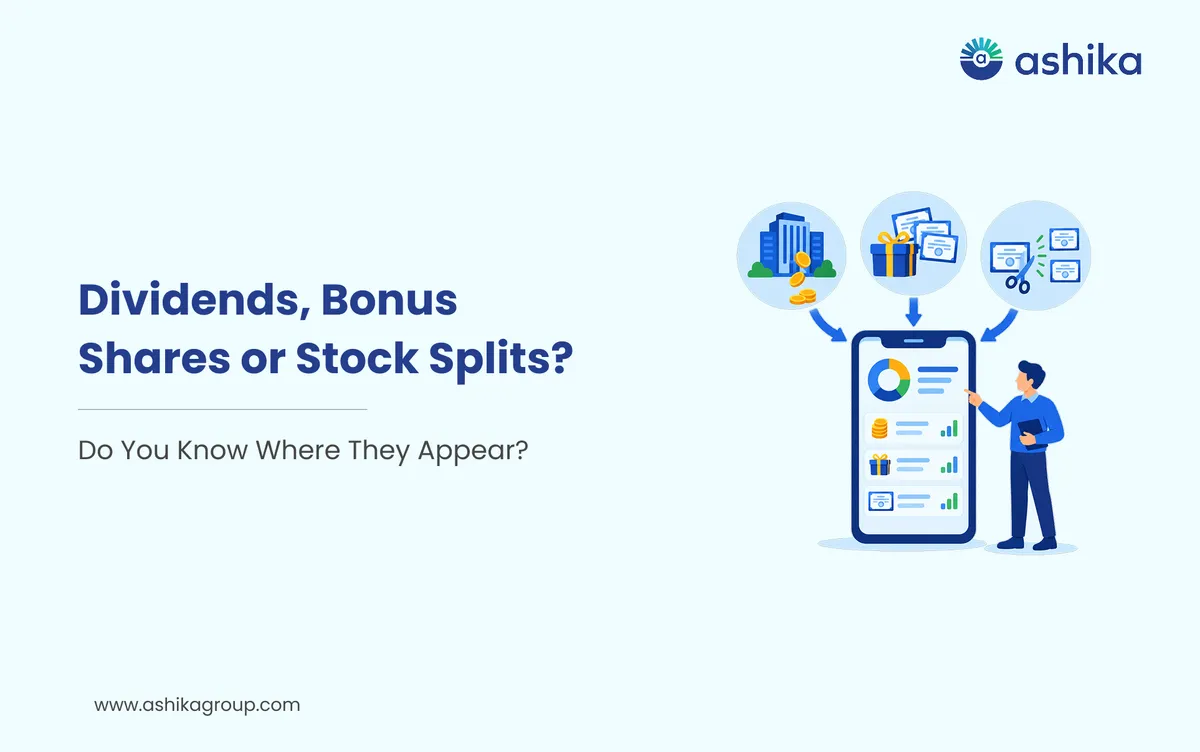
When you invest in shares your returns are not just from buying a share at one price and selling it at a higher price. Companies can also pay you returns in the form of dividends, bonus shares and stock splits. These are all corporate actions and each of them will have a different effect on your investment.
If you're using an equity trading platform in India you may well see these changes in your portfolio or in your Demat holdings. The catch is that not all of the benefits will show up in your Demat account in the same way. Dividends will typically be credited to your linked bank account whereas bonus shares and split shares will be reflected in your Demat account.
Understanding how these corporate actions work will help you to track your investments and ensure you have received the benefits to which you are entitled.
Table of Contents
- What Are Corporate Actions?
- 1. How do dividends get into your bank account?
- 2. How are bonus shares credited to your Demat account?
- 3. What happens to your shares in a stock split?
- 4. Important Dates You Should Know
- 5. How to Check Corporate Action Benefits on Your Trading Platform
- Final Thoughts
- Frequently Asked Questions
What Are Corporate Actions?
Corporate actions are decisions taken by the company which have an effect on its shareholders or on the securities it has issued. These may be the distribution of profits, the issue of further shares or a change in the face value of the shares.
Dividends, bonus issues and stock splits are all fairly common corporate actions in the equity market. The details of each of these are announced via the stock exchange with the relevant dates and the terms of the benefit.
Once the company announces a corporate action the relevant information is passed on to the depositories and other market intermediaries. The depositories maintain the shareholder records and facilitate the credit/adjustment of the eligible securities.
1. How do dividends get into your bank account?
A dividend is a portion of a company's profits which it pays out to its eligible shareholders. It's typically declared as a fixed amount per share.
For example if a company declares a dividend of Rs 5 per share you'd be entitled to Rs 500 (on 100 eligible shares) prior to any tax.
Where does the dividend appear?
Dividends are not credited to your Demat account. They are paid out by the company (or its registrar and transfer agent) directly into your registered bank account via the bank details on file against your investment.
To get the dividend you must be eligible on the relevant record date. It's therefore vital that your bank details are up to date with your broker or DP.
If a dividend doesn't appear in your bank account then check the payment date, your registered bank details and any communication from the company or its RTA.
2. How are bonus shares credited to your Demat account?
A bonus issue is when a company issues extra shares to existing shareholders without them having to pay for those shares. The number of bonus shares you get will be in accordance with the ratio announced.
For instance a company might announce a 1:1 bonus issue. That means you get one further share for every share you currently own. If you own 50 eligible shares you might therefore get another 50 shares, bringing your total to 100.
How does the credit actually occur?
Once the company has finalised the eligible shareholders on the record date the bonus shares are credited to their Demat accounts via the corporate action process. You normally don't need to apply separately for a standard bonus issue.
The extra shares may take a while to show up in your broker's portfolio following the announcement date. You can check your Demat statement or your Consolidated Account Statement (CAS) to confirm the credit has been received.
Remember that receiving bonus shares won't automatically increase the total market value of your investment. The share price will usually adjust to take account of the increased number of shares but the actual market price could well be different due to demand and supply and all the other normal market forces.
3. What happens to your shares in a stock split?
A stock split is when a company takes its existing shares and splits them into a larger number of shares by reducing the face value. It will change the number of shares you have, but won't in any way increase the value of your investment.
For instance, suppose a company announces a 1:2 split whereby one share of face value ₹10 is split into two shares of face value ₹5 each.
If you had 100 shares prior to the split you'd have 200 shares afterwards.
The company will announce the split ratio and record date. Once the corporate action has been processed the new share quantity will appear in your Demat account. Your broker's trading platform may take a little longer to update the share quantity.
A split is different from a bonus issue. A bonus issue is the distribution of additional shares. A split is a change in the face value and number of shares.
4. Important Dates You Should Know
To get your corporate action benefits you need to be aware of the dates that the company will be announcing.
- Announcement date: The company announces the corporate action and its terms.
- Ex-date: The date from which a stock trades without the benefit of the announced corporate action.
- Record date: The date on which the company looks at its share register to determine who the shareholders are.
- Payment or credit date: The date on which the dividend is paid or the additional shares are credited (depending on the corporate action).
Under the standard T+1 settlement cycle, you'd normally have to buy the shares prior to the ex-date in order to get the benefit. Settlement holidays or delivery issues can of course impact your eligibility. Always check the company's announcement and the relevant exchange dates prior to making your decision. NSE India NSDL FAQ
5. How to Check Corporate Action Benefits on Your Trading Platform
An equity trading platform makes it easier to keep an eye on your holdings but the portfolio display within the app and the official Demat records may not be in sync at any one point in time.
You can follow these steps:
- Check company announcements: Look for the corporate action details and record date on the NSE or BSE website.
- Check your eligibility: Make sure you held the shares on the relevant eligibility date.
- Check your portfolio: Log into your trading platform and have a look at the new share quantity.
- Verify your Demat statement: Check your CAS or account statement for any credits relating to bonuses or splits.
- Check your bank statement: For dividends, verify the payment in the bank account linked to your Demat account.
If the benefit has disappeared after the processing time frame that was announced, get in touch with your broker or DP. In the case of any dividend related issues you may also need to go to the company's RTA.
Ready to open yours?
Free account opening · Paperless eKYC · Live in 10 minutes
Final Thoughts
Dividends, bonus shares and stock splits are all different ways in which a company can affect your holdings. Dividends are typically paid into your linked bank account. Bonus shares and split adjusted quantities are reflected in your Demat account.
When you're using an equity trading platform in India it's a good idea to keep a check on company announcements, record dates and your account statements. Having your bank and KYC details up to date will also help you to get the benefits to which you're entitled without any undue delay.
Frequently Asked Questions
If I sell my shares after the ex-date but before the dividend payment date, will I still receive the dividend?
Yes. If you were eligible on the relevant record date, selling the shares after the ex-date generally does not affect your dividend entitlement.
Why have my bonus shares not appeared in my Demat Account immediately after the record date?
Bonus shares are credited after the company completes the corporate action process. Check the announced credit timeline and your Demat statement if the shares are delayed.
Do bonus shares increase the total value of my investment?
Not automatically. A bonus issue increases the number of shares you hold, but the market price generally adjusts to reflect the additional shares.
After a stock split, do I need to buy or apply for the additional shares?
No. The split is processed as a corporate action, and your existing holdings are adjusted according to the announced ratio. The revised quantity is credited to your Demat Account.
What should I do if a declared dividend does not reach my bank account?
Check your eligibility, payment date and registered bank details first. If the payment is still missing, contact the company's registrar and transfer agent (RTA) or follow the company's prescribed process.
Was this article helpful?
Thanks for your feedback!
 7 min read