Choosing your first stocks can be a bit of a confusing proposition, particularly when you come across the terms large cap, mid cap and small cap. These are all just descriptions of the company based on its market capitalisation (i.e. the total market value of its shares). Knowing the difference can be a useful thing in terms of assessing businesses, comparing the different investment opportunities and so on.
If you're looking at stocks via an equity trading platform in India then it's a good idea to understand how the various categories work. They all have different characteristics and the risk involved will vary from company to company, depending on the company's own situation and the state of the market.
Table of Contents
- What are Large-Cap, Mid-Cap and Small-Cap shares?
- Large-Cap Shares: Established companies with greater market presence
- Mid-Cap Shares: Businesses with room to expand
- Small-Cap Shares: Smaller businesses with different risk considerations
- Understanding the differences before you invest
- How to choose your first stocks on an Equity Trading Platform in India
- How can an Equity Trading Platform help?
- Final thoughts
- Frequently Asked Questions
What are Large-Cap, Mid-Cap and Small-Cap shares?
Market cap is simply share price times the number of shares outstanding.
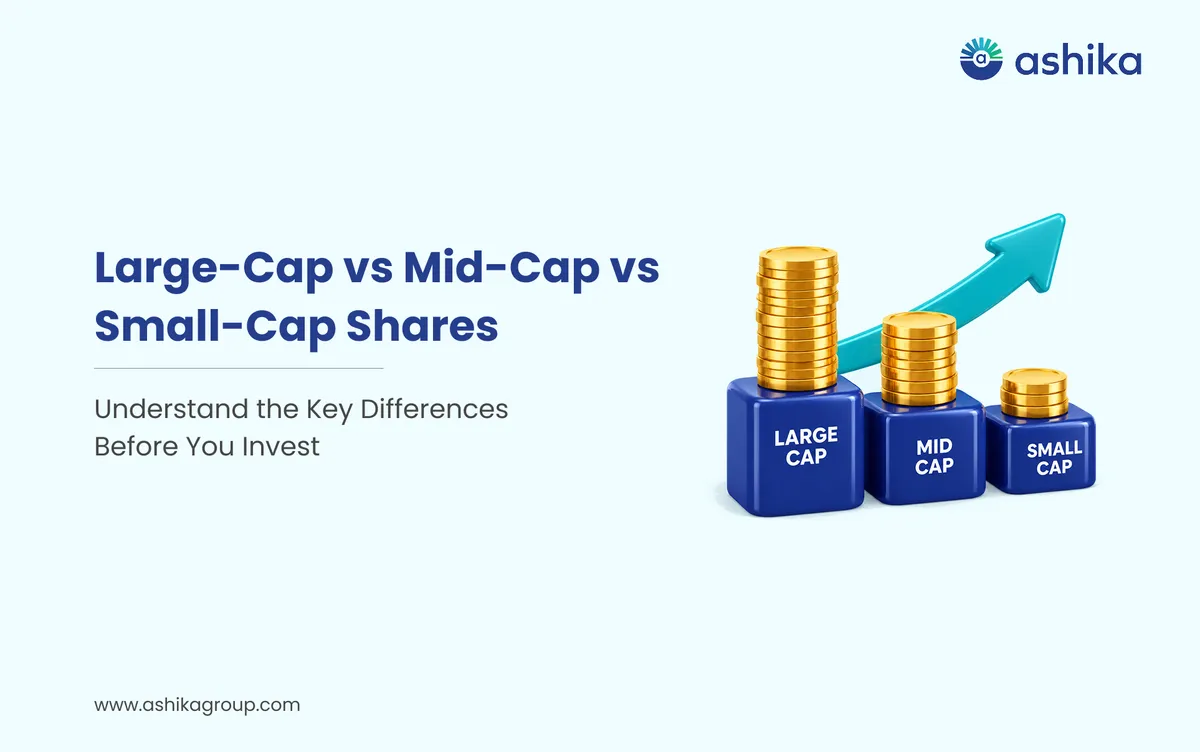
In India companies are split into large cap, mid cap and small cap on the basis of their full market cap rankings. According to the SEBI framework:
- Large-cap companies: Ranked from 1st to 100th by full market capitalisation.
- Mid-cap companies: Ranked from 101st to 250th.
- Small-cap companies: Ranked 251st onwards.
These classifications are of use to investors in terms of understanding the relative size of the listed companies. A company's market cap category however does not in any way tell you whether its shares are undervalued, overvalued or indeed appropriate for a particular investor.
Large-Cap Shares: Established companies with greater market presence
Large cap companies will have an established presence in their industry, established businesses and a large market cap. They may operate in a number of different regions and/or business segments and will generally have a longer track record.
For the novice, large caps are probably easier to research as there's a vast amount of information available on the well-established companies. Their shares may also have higher volumes than those of the smaller companies, though the liquidity will vary from stock to stock.
Before you even think about investing, you need to look at the company's revenue, its profitability, its debt levels, its cash flows and its business outlook. A well known brand or a large market cap in itself doesn't make a stock a good investment.
Mid-Cap Shares: Businesses with room to expand
Mid caps are companies that fall somewhere in between large caps and small caps in terms of market cap. Some of them are in the process of expanding their operations, moving into new markets or increasing their market share within an industry.
These businesses are ones which can attract investors looking for companies with potential for further growth. Their performance is likely to be more sensitive to shifts in demand, competition, the cost of borrowing and the wider economic climate.
When looking at a mid cap stock you should look at its financial performance over a number of years. Is the revenue growth being underpinned by improved profitability and cash flows? It's also worth looking at the company's competitive position, the track record of the management and their plans for growth.
Small-Cap Shares: Smaller businesses with different risk considerations
Small caps have a lower market cap than the large caps and the mid caps. They may be in a very niche area of business, may be serving a very small market or may simply be at an early stage of growth.
Some small cap businesses may have scope to grow but they can also be in a difficult position with limited resources, intense competition and unpredictable results. Their shares are likely to be more volatile and with lower volumes it can be difficult to get in or out at the price you want.
If you're looking at small caps then pay particular attention to the company's balance sheet, debt, cash flow, the promoter background and the business model. Don't make any decisions on the basis of a recent share price rally or market gossip.
Understanding the differences before you invest
The key difference between the two categories is the size of the companies, though their investment characteristics can differ in other respects as well.
Large cap firms are generally more mature, mid cap can be in the process of growth and small cap firms can be quite small or quite specialist. That said those are just generalisations.
A company's financials, management, industry and valuation are all important irrespective of its market cap. A large cap can be a very expensive stock as much as a small cap can have problems. A mid cap can have excellent financials and yet its share price can still be all over the place.
Rather than pick stocks on the basis of their sector alone, look at the business and understand the risks.
How to choose your first stocks on an Equity Trading Platform in India
Before you place your very first order, take the time to get to know the company you're considering. Here are a few things to bear in mind as you do your research:
1. Understand the business: Get to know what the company sells, who its customers are and how it makes its money. If you understand the business model then it's a lot easier to follow the company's performance.
2. Review financial statements: Look at revenue, net profit, debt and cash flow. Compare the company’s performance over multiple years instead of relying on a single quarter.
3. Check the valuation: Look at the valuation metrics i.e. the P/E and the P/B. Compare those with the companies that are in a similar position. Remember that no single ratio will tell you whether a share is correctly valued.
4. Study the industry: Changes in regulations, technology, competition and consumer demand can influence a company’s future performance.
5. Consider your risk tolerance: Your financial goals, investment horizon and ability to handle market fluctuations should influence the stocks you research.
6. Don't invest on the basis of tips: Nothing in the form of social media posts, market rumours or short term price action should ever be the basis for an investment decision.
How can an Equity Trading Platform help?
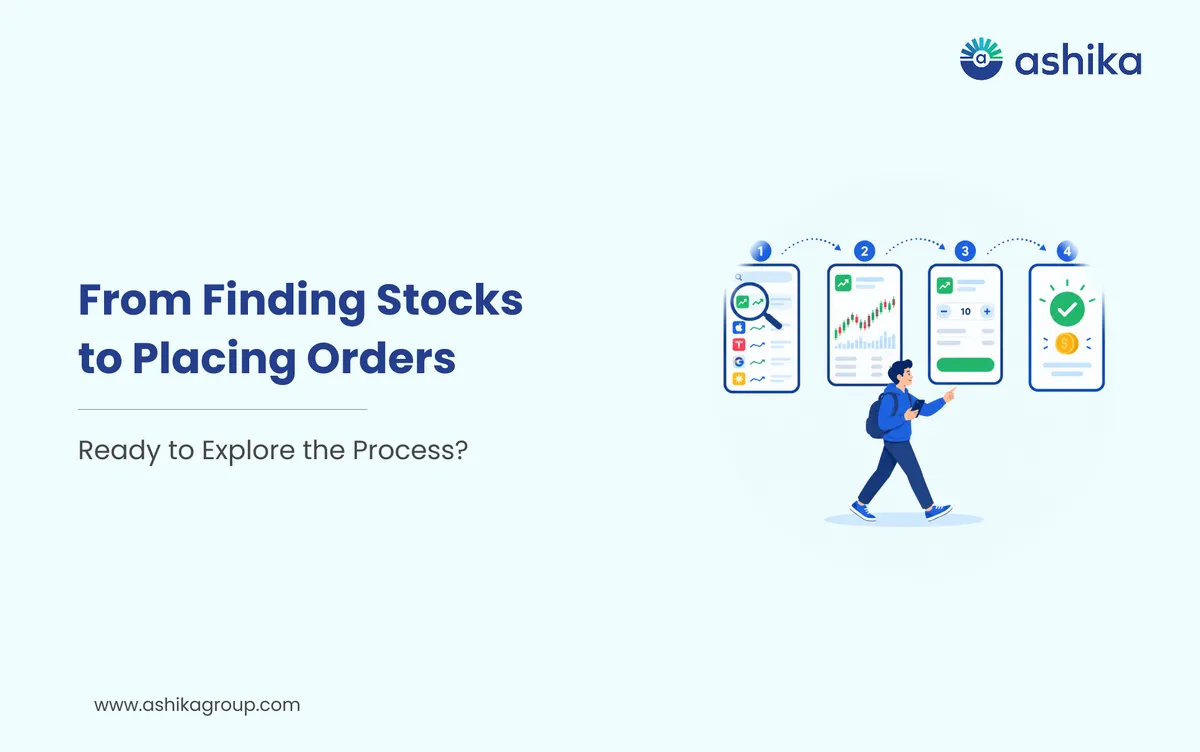
An Equity Trading platform gives you access to stock market data and the facilities to place buy and sell orders. Depending on the platform you're using you may also be able to view your watchlists, look at charts, track the market and get company information.
For example Ashika's Dhanush 2.0 app gives you access to a range of stock market tools including an AI Screener, price alerts and market data. All of these can assist in your research and help you keep track of your stocks. The onus of the investment decision and the evaluation of the investment still lies with you.
Before you use any platform you need to understand the brokerage, the statutory charges, the features available and the order types. You need to be absolutely clear on how to place, modify and cancel an order before you put any money into the market.
Ready to open yours?
Free account opening · Paperless eKYC · Live in 10 minutes
Final thoughts
Large cap, mid cap and small cap shares are shares of companies of different sizes in the market. Each of those categories has its own attributes, but market cap on its own doesn't tell you anything about the quality of the company or whether it's an appropriate investment.
If you're picking your first stocks then start by getting to know the businesses, look at their financials and assess the risk. Use an equity trading platform to get access to the market information and to trade, but don't make your investment decisions on the basis of tips or the latest price movement.
Building up your knowledge bit by bit will go a long way to enabling you to get to the point of stock market investing with a far greater degree of clarity.
Frequently Asked Questions
Can a company move from the small-cap category to mid-cap or large-cap?
Yes. The categories are based on full market capitalisation rankings and are reviewed periodically. A company can move between categories as its market capitalisation changes relative to other listed companies.
Are large-cap shares always less risky than small-cap shares?
Not necessarily. Large-cap companies may have more established businesses, but their shares can still face significant price fluctuations and business risks. Risk depends on the individual company and its valuation, among other factors.
Can a small-cap company be financially stronger than a large-cap company?
Yes. Market capitalisation measures a company's size, not its financial health. A smaller company may have stronger cash flows, lower debt or better profitability than a larger one.
Which financial figures should I check before buying my first stock?
Start with revenue, net profit, debt and cash flow over multiple years. Also examine the company's valuation, competitive position and business outlook rather than relying on a single financial ratio.
Does a stock's large-cap, mid-cap or small-cap classification tell me when to buy it?
No. Market-cap classification only indicates the company's relative size. It does not establish whether its share is fairly valued or suitable for your financial goals and risk tolerance.
Was this article helpful?
Thanks for your feedback!
 6 min read