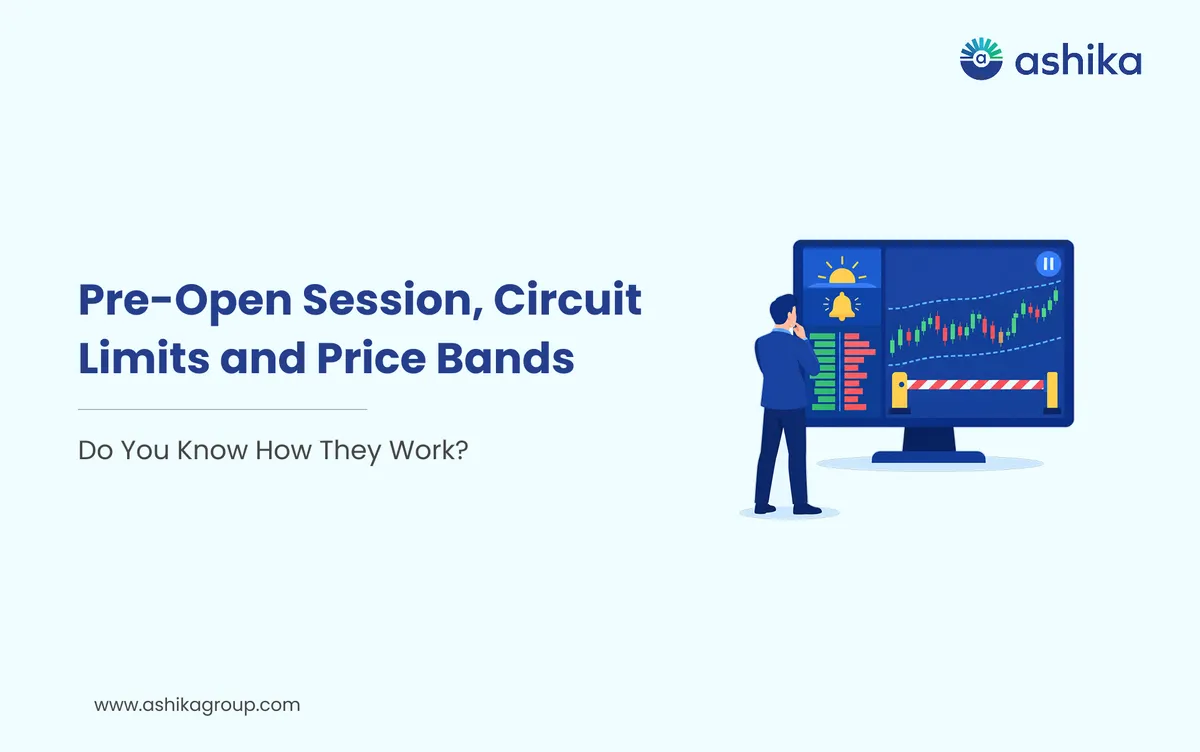
When you start trading in the Indian market you'll very quickly come across the situation where a stock will open at a different price to its previous close. You'll also come across the situation where a stock will just stop moving at a particular price or your order will be rejected as it's outside the allowable range.
These are all situations related to three very important market concepts: the pre-open session, circuit limits and price bands.
Understanding how they work can help you to make sense of the price action and the order behaviour on an online stock trading platform.
Table of Contents
What is the Pre-Open Session?
The pre-open session is a very short trading window prior to the regular equity market opening. It's used by the exchanges to work out an appropriate opening price for eligible stocks based on the buy and sell orders that are in the system.
On the NSE the regular pre-open session runs from 9:00 to 9:15 on trading days and is split into three stages:
- Order entry: Investors can place, amend and cancel eligible orders.
- Order matching: The exchange establishes the opening price and then matches the orders.
- Buffer period: Market moves into the regular session.
The opening price is determined via a call auction, taking into account the available buy and sell orders.
For example, if a stock closed at ₹100 on the previous day, prior to the market opening there will be a number of buy orders placed at various prices and a number of sell orders as well. The exchange will then apply the relevant matching rules to arrive at an opening price.
The stock could open at ₹103, ₹98 or some other price depending on the order book. The previous closing price in no way guarantees the opening price on the next day.
Important: The pre-open session is not available for every stock or every market segment. You need to check your trading platform and the relevant exchange rules to establish which securities are eligible.
What Are Circuit Limits?
Circuit limits (also known as price bands) limit how far a stock's price can move during a session.
They're there to help with the sharp price moves and to provide a framework for trading when the price is moving sharply.
For example, if a stock has a 10% price band and its previous closing was at ₹100, its price range for the day would be:
- Upper circuit: ₹110
- Lower circuit: ₹90
The stock generally won't be able to trade beyond those limits during that session unless the relevant exchange rules permit a change to the band.
If the stock hits ₹110 it's at the upper circuit. If it hits ₹90 it's at the lower circuit.
What happens when a stock hits the upper or lower circuit?
When a stock hits the upper circuit there can be a lot of buying demand and very little selling volume. People will be placing buy orders but there may not be sufficient supply to cover them.
Similarly when a stock hits its lower circuit there may be more selling pressure than there is buying quantity available. Investors attempting to sell may find their orders remain pending as there are no buyers.
For instance, if a stock has an upper circuit of Rs 110 and it hits Rs 110, and there are no sellers to match your buy order, your order will remain pending.
Hitting a circuit doesn't mean every order will be filled at that price. Execution is dependent on the orders that are actually available and the exchange matching rules.
What Are Price Bands?
Price bands are the permitted price range for a security during a session.
Depending on the security and the relevant exchange rules, daily price bands can be 2%, 5%, 10% or 20%. Some securities (including eligible stocks with derivatives contracts) will be subject to a different price control mechanism.
The exchange decides what the price band is. It's not something the investor or the trading app selects.
For instance, if a stock is at ₹200 and has a 5% price band, its price range for the next session would be:
- Upper price band: ₹210
- Lower price band: ₹190
Orders placed outside of the relevant range may be rejected by the exchange.
How do these rules impact your online stock trading app?
Your trading app will show you the market and you'll be able to place orders, but it's the exchange rules that will dictate whether those orders are accepted and executed.
Here are a few things beginners should remember:
1. Check the stock's price band. Before you place the order, have a look at the price band that's available on your platform.
2. Understand the types of order. A limit order enables you to specify the price at which you're willing to buy or sell. A market order is one that will be executed at the best available market price (subject to any applicable restrictions).
3. Avoid assuming that an order will execute immediately. An order may remain pending if there are no matching buyers or sellers.
4. Be careful with sharp price movements. A stock reaching upper or lower circuit may reflect strong demand or selling pressure, but it does not automatically indicate whether the stock is suitable for investment.
5. Review exchange announcements. Price bands and trading conditions may change under applicable exchange rules.
Ready to open yours?
Free account opening · Paperless eKYC · Live in 10 minutes
Final Thoughts
The pre-open session is used to establish the opening prices, with circuit limits and price bands dictating the allowable price movement of a security.
For a beginner in online stock trading, getting to grips with these concepts will go a long way to helping you understand what the opening prices mean, what pending orders are and why you might suddenly find yourself with a trading restriction.
Before you place an order, check the stock's market data, make sure you understand the order type you're using and bear in mind that market prices can change very quickly.
Frequently Asked Questions
Can a stock open higher or lower than its previous closing price?
Yes. The pre-open session uses eligible buy and sell orders to determine the opening price. Depending on demand and supply, the stock may open at a different price from its previous close.
Can I buy a stock when it hits the upper circuit?
You can place a buy order if the exchange permits it, but execution depends on available sellers and order priority. If there are no matching sell orders, your order may remain pending.
Why is my sell order not getting executed when a stock hits the lower circuit?
At the lower circuit, selling orders may exceed available buying interest. Without matching buyers, your sell order may remain pending even if it has been placed successfully.
Are price bands the same for every stock?
No. Exchanges prescribe different price bands depending on the security and applicable trading rules. Some securities, including eligible stocks with derivatives contracts, follow a different price-control mechanism.
Can I place an order outside a stock's upper or lower price band?
You can attempt to place it, but the exchange may reject an order priced outside the permitted range. Check the applicable price band on your trading platform before placing an order.
Was this article helpful?
Thanks for your feedback!
 7 min read