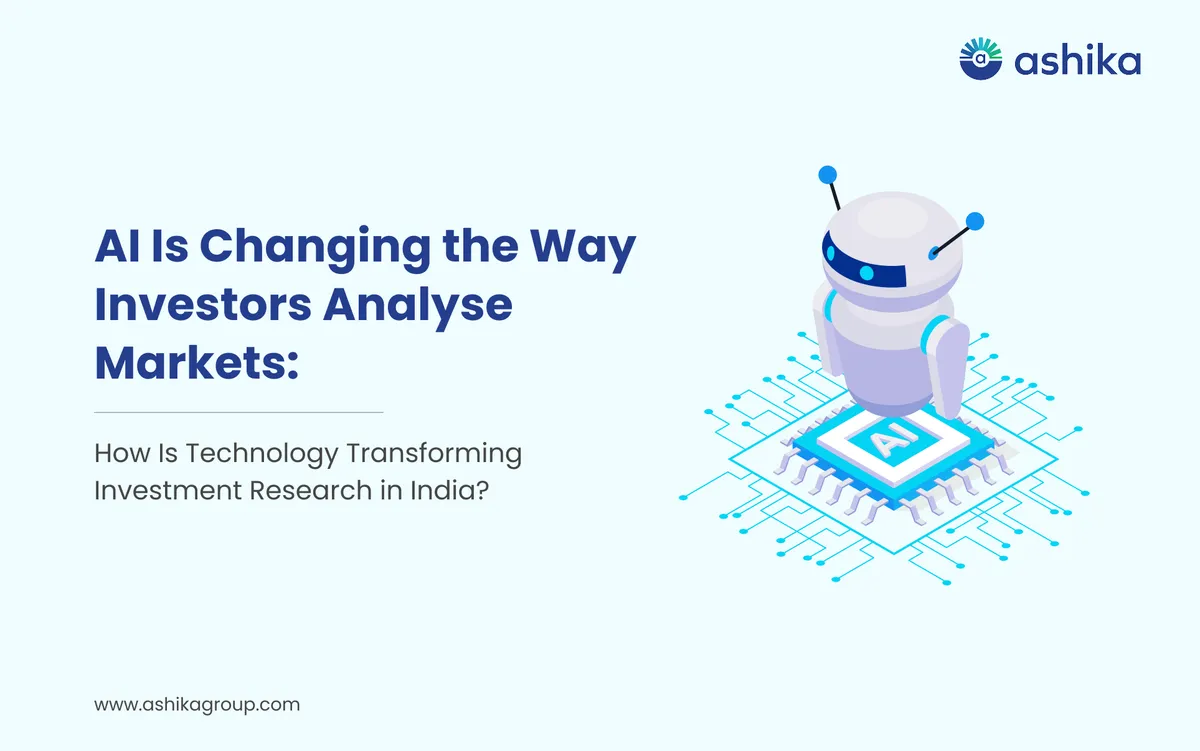
Five years ago, an ordinary investor who was carrying out "research" would have simply read a broker's tip sheet, watched a YouTube video, and perhaps used a basic screener with a few ratio filters. Nowadays the same person can analyse sentiment from an earnings call, obtain an AI-produced summary of a hundred-page annual report, and get a factor-based portfolio score—all within the time it takes to have a breakfast. That's no minor improvement; it represents a real change in who has access to proper market research and for what reason.
Table of Contents
- Why the Access Gap Got So Wide in the First Place
- What "AI Research" Actually Looks Like Now
- Reading the Room, Not Just the Balance Sheet
- Portfolios Built Around You, Not a Template
- Where This Still Falls Short
- Speed Isn't the Same as Good Judgement
- How to Actually Use This Shift
- Where This Is Headed
- What You Should Do Next
- Frequently Asked Questions
Why the Access Gap Got So Wide in the First Place
By mid-2026, India had reached 14 crore demat accounts, which is about double the figure from just four years earlier. The number of market participants has increased from below 2 crore before the pandemic to over 12 crore at present. However, the figure that actually shows why AI stock analysis tools have become necessary rather than optional is that the number of SEBI-registered research analysts and investment advisors is still under 2,600. With millions of new investors and only a few thousand qualified human beings to guide them, the maths simply can't work without technology stepping in to fill the gap.
What "AI Research" Actually Looks Like Now
Set aside the vague marketing terminology for a moment and consider exactly what these platforms are actually doing. Multibagg AI has indexed more than 100,000 corporate documents—such as annual reports, concall transcripts, investor presentations, and exchange filings—and links this data to price movements and changes in sentiment. No human analyst could possibly go through that amount of disclosure in a lifetime, not to mention keeping it up to date every day. Trendlyne adopts a somewhat different approach by means of its 'Scores' system, which carries out durability, valuation, and momentum analysis on a stock at the same time, along with AI screeners that immediately display companies that meet criteria such as having an ROE above 20% or no debt.
The AI Screener that is part of Dhanush 2.0 is based on the same principle, enabling an investor to filter thousands of listed stocks by their fundamental and technical criteria in just a few seconds instead of having to go through the exchange data manually. When combined with a live Watchlist and Portfolio Analytics which monitor how the investor's holdings are actually performing compared to the market, the same AI-powered filtering technique that has been used by institutional trading desks for years also becomes something that a retail investor can access from their phone.
Reading the Room, Not Just the Balance Sheet
Previously, sentiment analysis was based entirely on the institutional side. It wasn't something that a individual investor could manually carry out on a large scale when it came to examining the tone of hundreds of news items and management meetings. Nowadays, there are tools which assess the market's mood directly from the tone of earnings calls and the comments made by management, and they show how previous changes in sentiment have in fact affected a stock's price. Some of the platforms go beyond this by determining whether a particular piece of market news is bullish, bearish, or neutral for a particular sector — a task which used to have to be carried out by a dedicated research desk.
Portfolios Built Around You, Not a Template
The importance of a personalised approach is just as great as that of the speed of raw research. Rather than offering the same generic model portfolio to all customers who register, ET Money Genius bases its asset allocation recommendations on a person's own goals and their level of risk tolerance. Smallcase pursues a different but related concept by allowing investors to buy into stock baskets curated by research firms using AI and focused on particular themes, so that the 'one-size-fits-all' approach of mutual funds is no longer the only way to achieve thematic exposure.
The same approach is used by Dhanush 2.0 in its Basket Investing feature, offering investors ready-made portfolios based on different themes rather than requiring them to select stocks one by one, and its Fund Finder assists users in narrowing down mutual funds according to their own goals rather than just referring to a general best-seller list. For investors who wish to look at asset classes other than equities, all the platform's IPO Tracker, ETFs, Bonds and NPS modules are available within the same app, so there's no need to switch between five different platforms when carrying out research and transactions.
Where This Still Falls Short
This doesn't imply that AI has solved the problem of investing, and it's important to be clear about the areas where there are still gaps. While general-purpose AI models are truly capable of summarising and drafting — many investors now use them every day for these purposes — for the Indian market in particular, a tool has to be specifically developed to handle NSE and BSE filings, Indian concall formats, and India's disclosure requirements. If you feed a generic global AI model an Indian stock ticker, it will miss the kind of context that a platform focused on India would not. What is needed are tools that genuinely combine rapid processing with data that is based on the Indian market — not a US-focused model that has merely had an Indian stock symbol entered into it.
Speed Isn't the Same as Good Judgement
The aspect that is often overlooked in all the excitement is that what AI actually provides is time and wider coverage, not decision-making. Emotional and instinctive decisions are believed to cost Indian retail investors between 2 and 3 percentage points of their annual returns — a significant difference that data-driven screening truly helps to bridge by eliminating bias from the initial stage. Since AI can process a greater amount of filings and price data than any individual could manually examine in a week, it has this advantage. Yet it still doesn't decide for you how much to invest, doesn't know your real risk tolerance, and won't understand your particular financial objectives unless you tell it. That aspect of investing remains completely within the realm of human judgment and probably always will.
How to Actually Use This Shift
The important point isn't to choose a single AI tool and then trust it without question. Instead, you should use such tools to handle the dull and time-consuming aspects of research——namely the initial screening, the review of filings, and the scanning of sentiment——so that you have more time available to deal with the part that really requires a human mind, namely making decisions about what aligns with your goals, your timeline, and the level of risk you are actually willing to take. Tools such as GTT Orders on Dhanush 2.0 also assist in turning the research into disciplined action by setting a target or a stop-loss once the screener has completed the filtering, rather than having to watch the market all day to act based on your own analysis.
Where This Is Headed
It's now very clear what the outcome will be. With an increasing number of Indian investors joining the market—and considering how rapidly demat account growth has been, the trend is not going to slow down—the platforms which offer real India-specific data depth together with AI-powered speed will continue to outperform both conventional research methods and standard global tools. The investors who will gain the most won't be those who blindly trust AI, but rather those who use it to arrive at better questions more quickly.
Ready to open yours?
Free account opening · Paperless eKYC · Live in 10 minutes
What You Should Do Next
- You can use AI screening tools such as the one included in Dhanush 2.0 to rapidly narrow down your area of research, but you must check any important findings against the original filings before taking any action on them.
- It is better to use platforms that are specifically designed for the Indian market—such as those providing filings on the NSE or BSE and Indian conference calls—than to apply generic global AI tools too loosely to Indian stocks.
- Even when considering a portfolio allocation suggested by an artificial intelligence, including that of a basket-style investment approach, it should be viewed only as an initial idea and not as a final decision, in particular when it comes to your own level of risk tolerance.
- Include AI-assisted research as a tool within your main ₹1 crore SIP investment plan, rather than using it in place of proper financial planning.
The speed at which investors can carry out market research has truly been altered by technological advances, but the factors that actually contribute to a sound long-term investment choice remain the same. Here's an look at how Dhanush 2.0 combines AI-driven research, screening, and execution within a single platform, a platform designed to aid that decision-making process rather than take its place.
The following should be noted: There are risks involved in investing in the securities market and investors should read all the relevant documents thoroughly before making an investment. The registration awarded by SEBI and the certification from NISM in no way guarantee the performance of the intermediary or give any assurance of returns to investors.
Frequently Asked Questions
How is AI changing stock market research in India?
AI helps investors analyse company filings, earnings calls, market sentiment and stock data more quickly.
What is an AI stock screener?
It filters stocks using selected fundamental or technical criteria, helping investors narrow down companies for further research.
Can AI tools predict stock market movements accurately?
No. AI can analyse data and identify patterns, but it cannot reliably predict market movements or guarantee returns.
How can Dhanush 2.0 help with AI-powered investing?
Its AI Screener helps filter stocks, while Watchlists, Portfolio Analytics, Basket Investing and Fund Finder support different stages of investment research and tracking.
Should investors rely entirely on AI-generated investment research?
No. Investors should verify important findings against original disclosures and consider their financial goals and risk tolerance before making decisions.
Was this article helpful?
Thanks for your feedback!
 7 min read