The stock market does not move in one direction continuously.
At times, prices continue to rise and investor sentiment is positive; at other times, markets decline over a long period and uncertainty sets in; there are also stages when prices move within a fairly narrow range without a clear upward or downward trend.
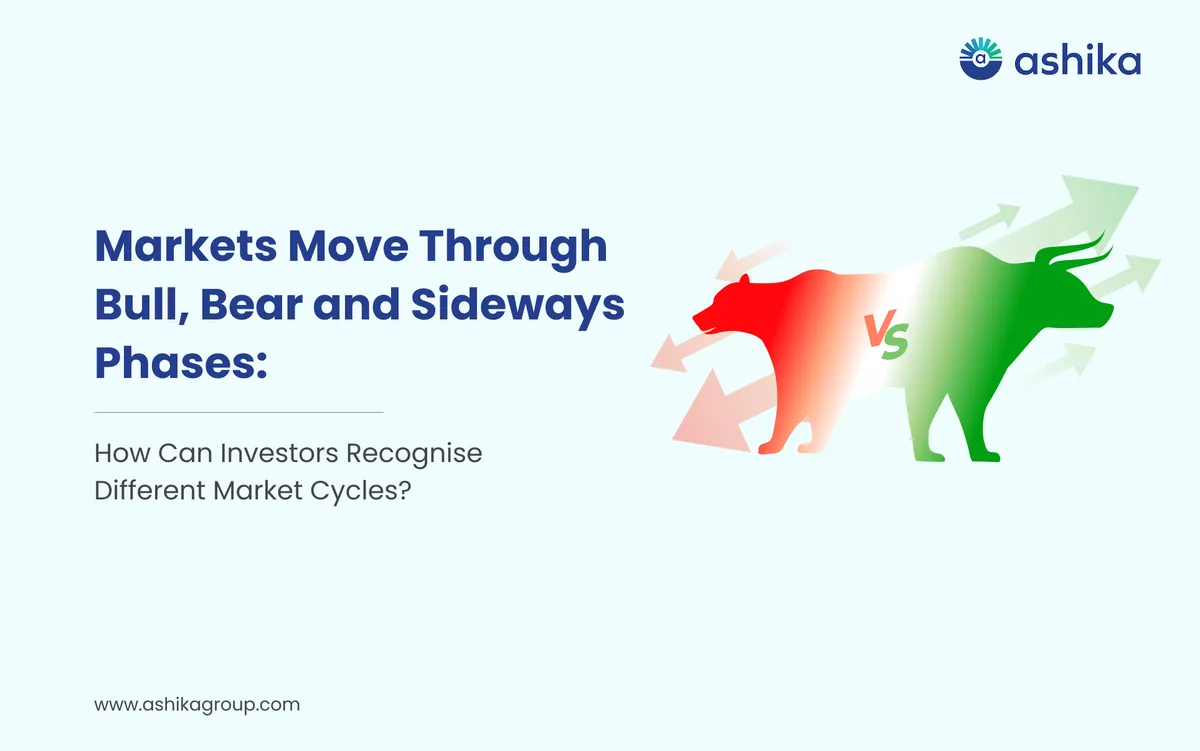
They are usually referred to as Bull, Bear, and Sideways markets.
Since they understand these various phases of the market, investors will be able to appreciate price changes more clearly and avoid making decisions based solely on short-term market noise.
Table of Contents
- What Is a Bull Market?
- What Is a Bear Market?
- What Is a Sideways Market?
- How Can You Identify the Market Cycle?
- How Should Investors Approach Different Market Phases?
- Market Cycles and Long-Term Investing
- Using Market Information With Dhanush by Ashika
- A Simple Way to Think About Market Cycles
- Frequently Asked Questions
What Is a Bull Market?
A bull market is a phase in which asset prices are usually rising and investor sentiment is positive.
You could observe greater buying interest, more favourable expectations, and increased confidence regarding future economic or corporate performance.
For instance, if a broad market index keeps reaching higher highs and higher lows over a long period, investors might say the market is in a bullish phase.
That does not mean that in a bull market prices go up every single day.
Corrective adjustments, profit booking and short-term declines can still occur.
The main point lies in the wider trend.
In a bullish phase, investors might concentrate on companies which have good earnings prospects, on sectors that benefit from economic growth and on businesses that seem well-positioned for the current market environment.
What Is a Bear Market?
A bear market is generally linked to a sustained decline in asset prices and investor sentiment.
A negative phase may result from worries about economic growth, corporate earnings, interest rates, geopolitical developments, or other factors.
Declining prices can also affect investor confidence, creating a situation in which uncertainty prompts selling, which in turn puts further pressure on prices.
It should be noted that a bear market does not imply that all shares will fall by the same amount; some companies or sectors perform better than others.
For a long-term investor, the main question is usually not simply "Is the market falling?"
It is:
What has happened to the long-term investment prospects for the asset that I own?
What Is a Sideways Market?
A sideways market, also called a range-bound market, occurs when prices move within a relatively defined range without establishing a strong long-term upward or downward trend.
For instance, an index might keep on moving back and forth between a support level and a resistance level.
In that type of market, investors could have trouble spotting a clear trend.
Rallies may occur, and so may declines, but neither side can secure lasting control.
Sideways markets may take place when investors are awaiting a major economic announcement, corporate results, a policy decision or some other market trigger.
How Can You Identify the Market Cycle?
It is impossible for any single indicator to definitively show you the phase the market is entering.
Rather, investors may consider several factors.
1. Look at the broader trend
Begin with the movements of the major indices rather than concentrating on a single stock.
Are prices generally forming higher highs and higher lows, lower highs and lower lows, or moving within a range?
The broader trend can provide useful context.
2. Watch trading volumes
Price movement accompanied by strong trading activity can sometimes provide additional information about market participation.
However, it is not correct to understand volume by itself.
Keep an eye on the earnings and economic data.
Market expectations can be affected by corporate earnings, inflation, interest rates, GDP growth, and employment data.
A change in expectations may at times cause market sentiment to shift.
4. Pay attention to investor sentiment
Market movements are affected not just by figures but also by people's expectations.
When optimism becomes extremely high, investors may start pricing in very positive outcomes. Similarly, excessive pessimism can influence valuations during periods of uncertainty.
How Should Investors Approach Different Market Phases?
There is no single strategy that works perfectly across every market cycle.
It is tempting during a bull market to buy stocks just because the prices are going up; however, investors ought to keep in mind the valuations, the business fundamentals and their original investment objectives.
During a bear market, fear can lead to decisions based purely on falling prices. Investors with a long-term horizon may instead review whether the fundamentals of their investments have changed.
During a sideways market, patience can become particularly important. Repeatedly buying and selling based on small price movements can increase transaction costs and the risk of poor decisions.
The appropriate method will vary according to the investor's time horizon, financial objectives, and level of risk tolerance.
Market Cycles and Long-Term Investing
One of the biggest mistakes beginners make is trying to predict every market turn.
Market cycles are only obvious in hindsight. A period that looks like a temporary correction can develop into a longer decline, while a weak market can eventually recover.
This is why asset allocation and diversification can matter more than trying to perfectly time every cycle.
Investors should also distinguish between the market's short-term direction and their own investment timeline.
Someone investing for a long-term financial goal may have a very different approach from someone trading over a few days.
Using Market Information With Dhanush by Ashika
Investors using Dhanush by Ashika can access market information and research tools to follow stocks, indices and broader market developments.
The platform brings different investment and trading services together, allowing investors to monitor the market while making decisions based on their own objectives and risk profile.
But no platform can predict every market cycle.
The more useful approach is to use available information to understand what is happening rather than reacting to every daily move.
Ready to open yours?
Free account opening · Paperless eKYC · Live in 10 minutes
A Simple Way to Think About Market Cycles
Remember three words:
Bull = Rising trend
Bear = Falling trend
Sideways = Range-bound trend
But identifying the market phase is only the beginning.
Before making an investment decision, consider the company's fundamentals, valuation, your investment horizon, diversification and ability to handle volatility.
Markets will move through different phases. Your investment strategy does not necessarily have to change every time the market does.
Stay informed with Dhanush by Ashika, and focus on understanding the market cycle rather than trying to predict every turn.
Frequently Asked Questions
What is the difference between a bull and a bear market?
A bull market is characterised by a sustained upward trend in prices and positive investor sentiment, while a bear market involves a prolonged decline in prices and weaker sentiment.
What is a sideways market?
A sideways market occurs when prices move within a relatively defined range without establishing a clear upward or downward trend.
How can investors identify the current market phase?
Investors can study broader market trends, trading volumes, corporate earnings, economic indicators and investor sentiment. No single indicator can reliably identify a market phase on its own.
How should investors approach a bear market?
Investors should review their holdings and assess whether the underlying business fundamentals or their long-term investment goals have changed. Decisions based only on fear or short-term price declines may not be appropriate.
Can Dhanush by Ashika help investors track market movements?
Dhanush by Ashika provides access to market information and research tools that investors can use to monitor stocks, indices and market developments. These tools support research but cannot predict market movements or guarantee returns.
Was this article helpful?
Thanks for your feedback!
 7 min read