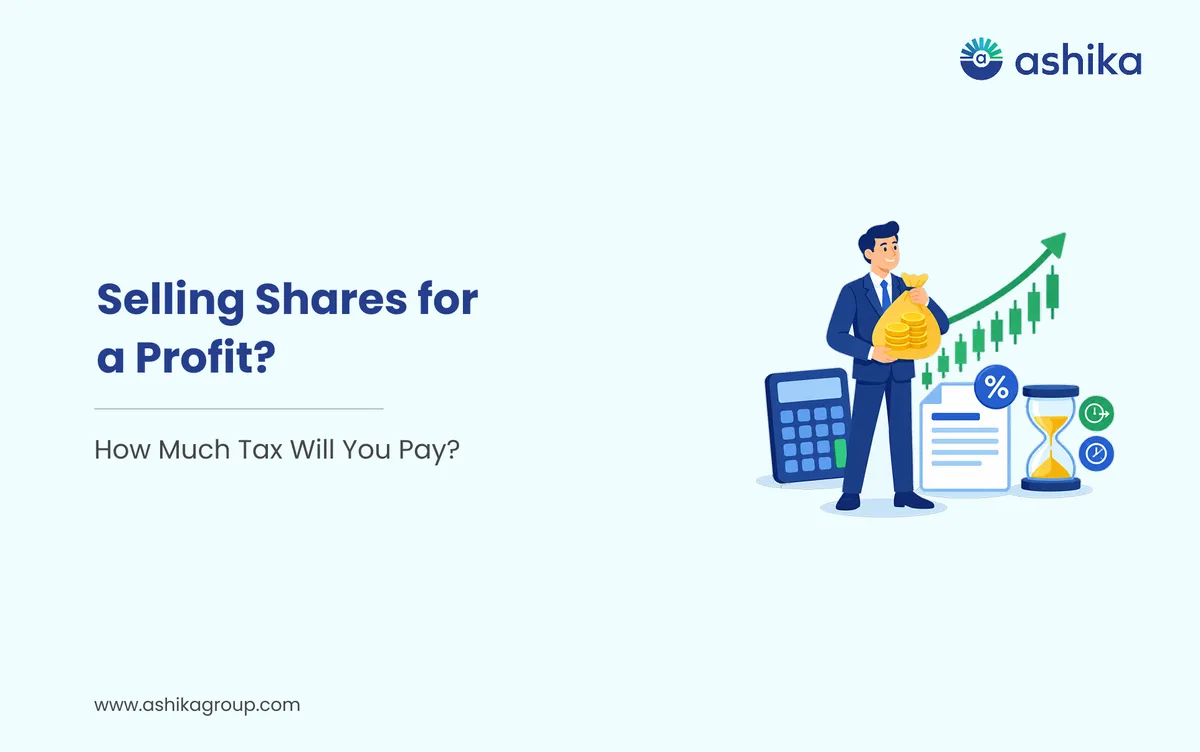
Investing in shares can be a way of generating returns. The sale of shares at a profit may however give rise to a tax liability. The tax on the profit from the sale of shares in India is calculated on the basis of a number of factors including the holding period, the nature of the transaction and whether or not the relevant conditions are satisfied.
Understanding the difference between short term and long term capital gains can help an investor to plan their investments and be in a position to deal with their income tax when it comes to filing.
Table of Contents
What is Capital Gains Tax on Shares?
Capital Gains Tax is the tax on the profit which arises when a capital asset is sold or transferred. If an investor sells shares for more than they paid for them the difference may be treated as a capital gain.
For instance if an investor purchases listed shares for Rs 50,000 and then sells them for Rs 70,000 the profit is Rs 20,000 (prior to adjustment for eligible transaction costs).
The tax treatment of the gain will be very much dependent on the holding period and the relevant provisions of the Income-tax Act.
What is Short Term Capital Gains Tax?
Short term capital gains (STCG) are those which arise on the sale of shares in the period specified under the rules for short term assets.
For listed equity shares in India, shares held for 12 months or less prior to sale are normally treated as short term capital assets.
For qualifying listed equity shares sold through a recognised stock exchange where the STT conditions are satisfied, short term capital gains are generally taxed at 20% under section 111A for transfers on and after 23 July 2024. The applicable surcharge and health and education cess will also be applicable.
Example of Short-Term Capital Gains
Suppose an investor purchases listed shares for Rs.1,00,000 and sells them after 6 months for Rs.1,20,000.
The capital gain is:
₹1,20,000 − ₹1,00,000 = ₹20,000
If it qualifies under section 111A the gain is generally taxed at 20% (prior to the applicable surcharge and cess).
Short term gains can also be achieved via frequent buying and selling (although the tax treatment of intraday trading and a host of other transactions may be different). It's not true that every profit made in the stock market is capital gains.
What is Long Term Capital Gains Tax?
Long term capital gains (LTCG) are where shares are held for a period in excess of the relevant threshold prior to sale.
For listed equity shares the holding period will normally have to be in excess of 12 months for the gain to be a long term gain.
Qualifying long term capital gains under section 112A (e.g. gains from eligible listed equity shares where the STT conditions are met) are generally taxed at 12.5% on the aggregate gains in excess of ₹1.25 lakh in a financial year (before any surcharge or cess).
Example of Long-Term Capital Gains
Suppose an investor purchases listed shares for Rs.2,00,000 and sells them after 18 months for Rs.3,80,000.
The capital gain is:
₹3,80,000 − ₹2,00,000 = ₹1,80,000
If the gain is eligible under Section 112A then the first ₹1.25 lakh of the eligible aggregate LTCG is not taxable under that section. The balance of ₹55,000 is normally taxed at 12.5% (before surcharge and cess).
The ₹1.25 lakh is the threshold for eligible aggregate gains in the year (not on a per stock basis).
Short-Term vs Long-Term Capital Gains: Key Differences
| Factor | Short-Term Capital Gains | Long-Term Capital Gains |
|---|---|---|
| Holding period for listed equity shares | 12 months or less | More than 12 months |
| Relevant tax provision | Section 111A, if eligible | Section 112A, if eligible |
| General tax rate for qualifying listed equity | 20% | 12.5% above ₹1.25 lakh annual threshold |
| Applicable conditions | Includes STT conditions | Includes STT conditions |
The rates and thresholds set out above apply to qualifying transactions under the relevant provisions. Other share transactions will have a different tax treatment.
How is Capital Gains Tax calculated?
Capital gains are generally calculated by taking the sale consideration and deducting from it the cost of acquisition and any eligible transfer costs.
Investors should keep their purchase and sale contract notes, their broker statements and the relevant transaction records. With respect to shares held in a Demat account you'll need to check the holding period and the cost of acquisition very carefully, especially where the shares were acquired in a number of transactions.
The tax calculation will also be subject to adjustment in certain circumstances (for example in the case of a corporate action or shares acquired prior to a particular change in the tax rules).
How can an investor report capital gains?
Capital gains from shares are reported in the income tax return via the appropriate ITR form and schedule. The form to be used will be determined by the taxpayer's other sources of income and the nature of the transactions.
Investors should cross check their broker's capital gains statement against their own records and make sure the details are correct before they file. If they are also deriving income from intraday trading or from futures and options then the tax treatment will be different to that of the capital gains on delivery shares.
Ready to open yours?
Free account opening · Paperless eKYC · Live in 10 minutes
Conclusion
Capital gains tax on shares in India is dependent on the holding period, the nature of the transaction and the relevant tax provisions. It is absolutely essential to know whether the gain is short term or long term in order to work out how it will be taxed and what records you will need to maintain.
Investors can use platforms such as Ashika Dhanush 2.0 to get the market information. Of course they'll have to be aware that for tax reporting purposes you do need the actual transaction records and you do need to be aware of the tax rules that apply.
Frequently Asked Questions
If I sell shares after 11 months instead of 12, will the profit be treated as short-term capital gains?
Yes. Listed equity shares held for 12 months or less are generally classified as short-term capital assets. To qualify as long-term, they must be held for more than 12 months.
Does the 20% STCG tax apply to every profit I make from selling shares?
No. The 20% rate under Section 111A applies to eligible short-term gains from listed equity shares where the prescribed STT conditions are met. Other transactions may have different tax treatment.
If my total long-term capital gains are ₹1.5 lakh in a financial year, do I pay tax on the entire amount?
No. For eligible gains under Section 112A, the first ₹1.25 lakh is not taxable under this provision. The remaining ₹25,000 is generally taxed at 12.5%, before applicable surcharge and cess.
How is the holding period calculated if I bought the same share at different times?
Each purchase has its own acquisition date and cost. The holding period and capital gain are generally calculated separately for the shares acquired in each transaction.
Can I use my broker's capital gains statement directly while filing my income tax return?
Use it as a reference, but cross-check it against your contract notes and transaction records. Corporate actions, different purchase dates and other adjustments may affect the final calculation.
Was this article helpful?
Thanks for your feedback!
 5 min read