
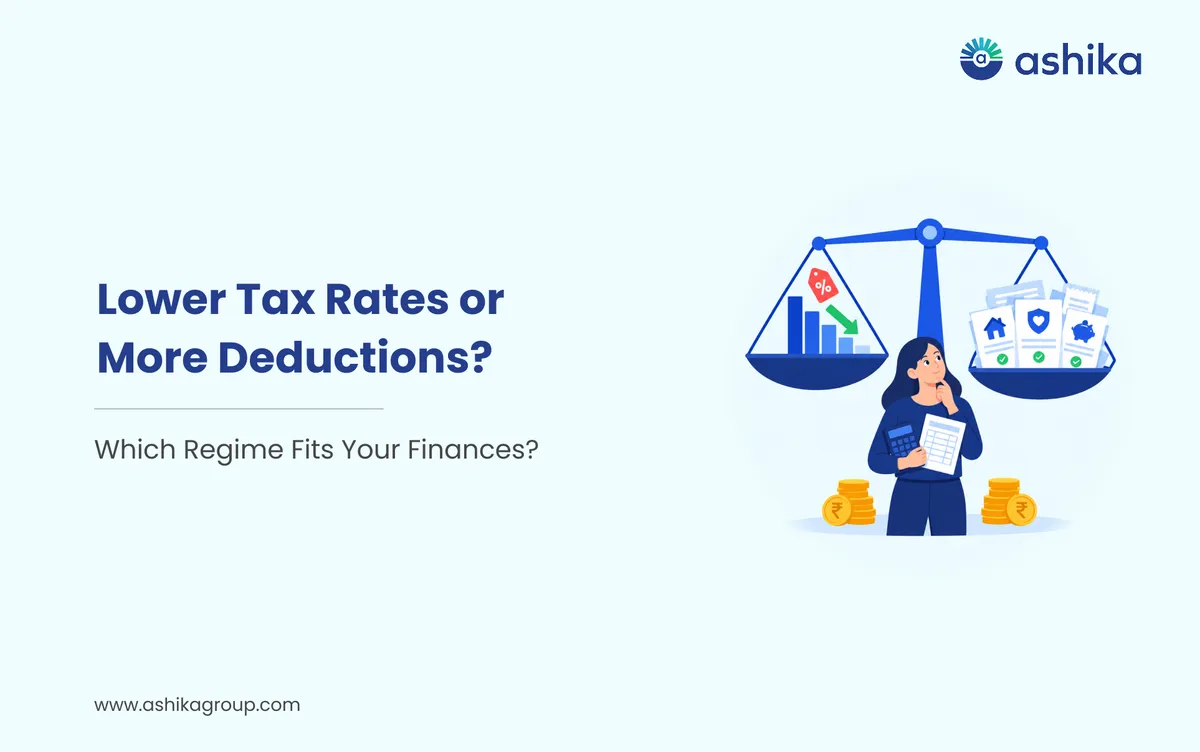
Choosing between the old regime and the new regime is a key element of income tax planning in India. The choice you make will depend on your salary, your eligible deductions and exemptions and your overall financial situation. The new regime has lower tax rates across the income slabs but the old regime allows you to claim a number of deductions and exemptions which can in turn reduce your taxable income. It's essential to compare both regimes prior to filing your ITR to get a clear picture of which one will result in the lower tax liability.
Table of Contents
What is the Old Tax Regime?
The old regime permits a number of deductions and exemptions in the computation of taxable income. These include the various deductions under Section 80C for eligible investments, the deduction under Section 80D for health insurance premiums and the various exemptions such as HRA (House Rent Allowance) subject to the relevant conditions.
For instance, a taxpayer may reduce their taxable income via investments in the Public Provident Fund (PPF), the Employees' Provident Fund (EPF) or tax saving Equity Linked Savings Schemes (ELSS). Eligible home loan interest and other deductions may also be available.
The old regime generally has higher income tax slab rates than the new regime. Its potential benefit will be down to how much you can claim through the various deductions and exemptions available. Just making investments for the purpose of tax saving doesn't necessarily mean that the old regime is the better one.
What Is the New Tax Regime?
The new regime has revised income tax slabs and generally lower rates with fewer deductions and exemptions. It is the default regime for eligible taxpayers (although they can opt for the old regime where permitted).
For FY 2025-26 (AY 2026-27) the new regime has a zero rate on income up to ₹4 lakh, with progressively higher rates on the various income slabs. A resident individual with eligible total income up to ₹12 lakh may also be eligible for a rebate under Section 87A (subject to the relevant conditions). Special rate income is dealt with separately.
The new regime can be attractive to those who have very few eligible deductions or who simply prefer a simpler calculation. Salaried persons and pensioners may also claim a standard deduction of up to ₹75,000 under the new regime (subject to the rules that apply to their income).
Which Factors Should You Compare?
1. Your Annual Income
Start with your annual taxable income (rather than just comparing tax rates in isolation). That would be your salary plus any eligible allowances plus any interest income and any other taxable income. Your income will determine which slabs you fall into and whether you're eligible for a rebate.
Remember that a rebate is not the same as a deduction. A deduction reduces your taxable income, a rebate reduces the amount of income tax you actually pay after the tax has been calculated.
2. Eligible Deductions and Exemptions
Check what you can legitimately claim under each regime. Under the old regime your allowable deductions would have been Section 80C investments, Section 80D health insurance premiums and a number of other qualifying expenses. HRA exemption would also be available to you in the appropriate circumstances.
Under the new regime, many of the deductions and exemptions are not available. There are however some benefits that will still be available, namely the standard deduction and eligible employer contributions to the NPS.
Compare the deductions you're already entitled to rather than going out and buying products just to reduce your tax bill.
3. Your House Rent and Home Loan Situation
If you're in rented accommodation and getting HRA, check whether you're entitled to an exemption under the old regime. Likewise if you have a home loan then compare the deductions available for interest on the loan (where eligible) and the deductions available for principal repayment.
These benefits are subject to certain conditions and are not available in all cases. The new regime does place restrictions on a number of housing related deductions (including the interest on a loan for a self occupied property).
4. Your Investment and Insurance Plans
Tax saving investments can have an effect on the comparison. If you're already investing in eligible instruments (EPF, PPF, ELSS etc) or paying eligible health insurance premiums then you'll have already claimed the relevant deductions under the old regime.
An investment should be one that fits your financial objectives, your liquidity needs and your risk appetite rather than simply one that offers the best tax calculation. You need to compare the tax benefit against the lock-in period, the costs and the investment risks of the product.
5. Your Final Tax Liability
The most useful comparison is the estimated tax payable under each regime after allowance for eligible deductions, rebates and all other relevant provisions.
Use the Income Tax Department's official tax calculator to work out both amounts. Include the applicable surcharge and cess where applicable and make sure you're using the rules for the correct year.
Can You Switch Between the Two Regimes?
Eligible taxpayers with no business or professional income can generally choose between the regimes each year when they're completing their return (subject to the relevant filing rules). Taxpayers with business or professional income are subject to further conditions if they wish to opt out of the new regime and switch back.
If you're a salaried person the notification you give to your employer of your intended regime will be what determines the tax that's deducted from your salary throughout the year. The declaration to your employer is not in itself the formal choice that you make in your ITR.
Ready to open yours?
Free account opening · Paperless eKYC · Live in 10 minutes
Make an Informed Comparison
The old regime could be worth looking at if you're entitled to a large number of deductions and exemptions. The new regime may be the better option for those with fewer deductions/exemptions and who are happy with the new slab structure. It's not necessarily the case that one is better than the other for all taxpayers.
Before you make your decision, work out your tax under both regimes, check the current rules and bear in mind your overall financial situation. The Income Tax Department has a number of tools which will allow you to compare the two figures. An investment platform such as Ashika Dhanush can be of assistance in tracking your investments, but the choice of regime should be one which you make on the basis of your own eligibility and your own tax calculation.
Frequently Asked Questions
If my salary is below ₹12 lakh, do I still need to compare the old and new tax regimes?
Yes. Eligible resident individuals may claim a rebate under Section 87A under the new regime, subject to conditions. However, your other income, deductions and eligibility can affect the comparison.
Is investing ₹1.5 lakh under Section 80C enough to make the old tax regime better?
Not necessarily. The benefit depends on your total eligible deductions and exemptions, income and resulting tax liability under both regimes.
Can I claim HRA exemption and home loan deductions together under the old tax regime?
You may be eligible for both, subject to the respective conditions. The amount you can claim depends on factors such as your rent, salary, property status and home loan details.
If I have already told my employer that I want the new tax regime, can I choose the old regime while filing my ITR?
Generally, yes, if you do not have business or professional income. Your declaration to your employer determines salary TDS, but it is not your final regime selection when filing your ITR.
Do I need to make fresh tax-saving investments to benefit from the old regime?
Not necessarily. First check the deductions you already qualify for through existing investments, insurance premiums and eligible expenses. Avoid making investments solely to reduce your tax liability without considering their suitability and lock-in conditions.
Was this article helpful?
Thanks for your feedback!
 5 min read