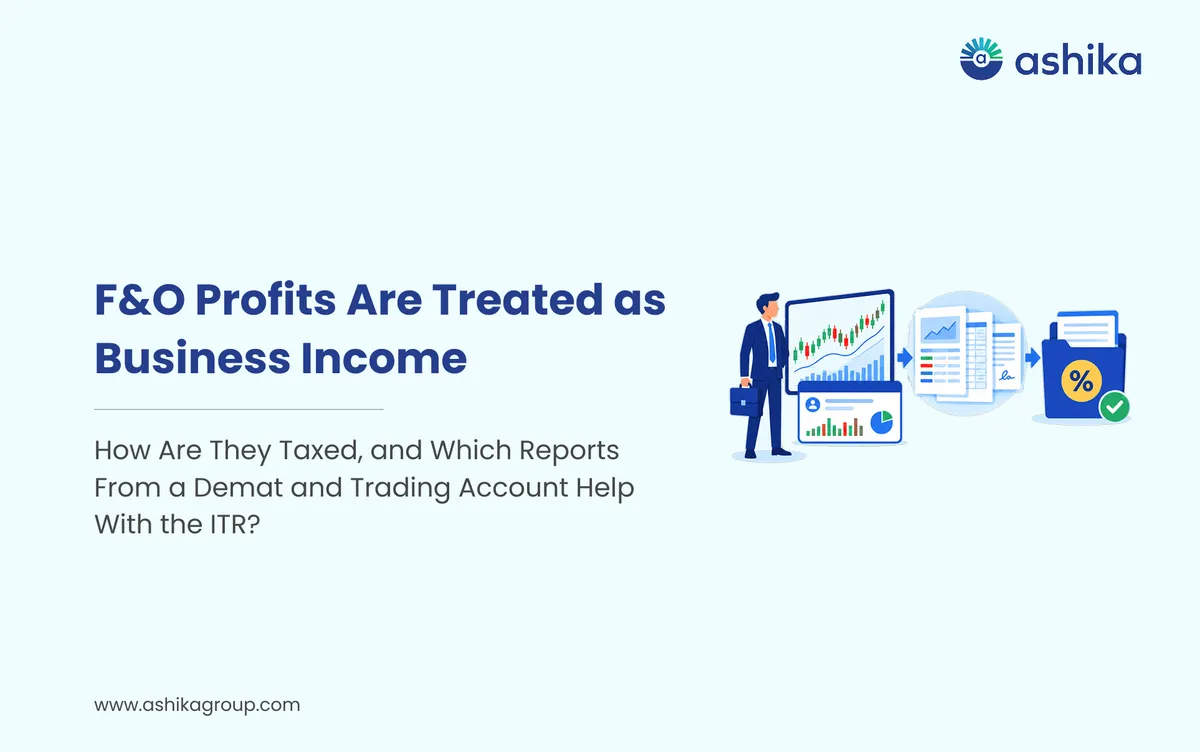
Trading in Futures and Options (F&O) can result in a profit or a loss. The taxation of such transactions is just as important as the potential for profit or loss. The income arising from eligible exchange traded F&O transactions is normally treated as business income for the purposes of the Indian income tax rules rather than as income from the sale of shares held for investment.
For the trader filing an ITR the key things to do are report the trading results, work out the turnover, identify the allowable expenses and of course know what the tax audit requirements are. The reports that are available via your Demat and trading account services will go some way to helping you put the information together.
Table of Contents
- 1. How are F&O profits taxed in India?
- 2. Which ITR form should F&O traders use?
- 3. How is F&O turnover calculated?
- 4. What are Demat and Trading Account Services Reports useful for in respect of ITR filing?
- 5. Can F&O trading expenses be deducted?
- 6. What happens if you make an F&O loss?
- 7. Is a tax audit required for F&O trading?
- File Your ITR With Accurate Trading Records
- Frequently Asked Questions
1. How are F&O profits taxed in India?
Profits or losses arising from eligible F&O transactions carried out on a recognised stock exchange are normally treated as non-speculative business income.
The net profit from F&O trading is added to the taxpayer's other taxable income and taxed at the applicable income tax slab rates. There is no separate flat rate of tax applicable to F&O profits.
For instance, if a trader makes a net F&O profit of ₹1,20,000 in a financial year that would normally be clubbed under the head Profits and Gains from Business or Profession (PGBP).
The ultimate tax liability will be determined by the trader's total income, the tax regime that applies, the amount of allowable deductions and all the other relevant factors.
F&O profits are not capital gains simply because the underlying instruments are shares or indices.
2. Which ITR form should F&O traders use?
Individuals and Hindu Undivided Families (HUFs) reporting F&O business income will normally use the ITR-3.
This form is used to report income from business or profession in addition to any other income (e.g. salary, house property etc.) which you may have.
ITR-1 and ITR-2 are normally not appropriate for a taxpayer who has F&O business income.
ITR-4 may be used in certain cases where the taxpayer is eligible and has elected to opt for the presumptive taxation scheme under the relevant provisions. Eligibility should be verified prior to making the election.
The right ITR form is going to be one that takes into account the nature of your income and your individual circumstances rather than simply the amount of profit you've made from your trading.
3. How is F&O turnover calculated?
F&O turnover is important as it's one of the factors that will determine whether or not a tax audit is required.
Turnover is not just the total value of all the futures and options contracts traded. For the purposes of a tax audit, F&O turnover is generally calculated in accordance with the prescribed method which takes into account the total of the favourable and unfavourable differences on the trades.
For example, consider the following simplified trading results:
- Trade 1: Profit of ₹15,000
- Trade 2: Loss of ₹8,000
- Trade 3: Profit of ₹5,000
Net profit is ₹12,000.
However the raw differences are ₹28,000 which could be relevant in the context of turnover for tax audit purposes.
The maths can get quite complicated in the case of options, open positions, reverse trades etc. Traders should refer to the relevant guidance and seek the advice of a Chartered Accountant rather than just go on the net profit figure.
4. What are Demat and Trading Account Services Reports useful for in respect of ITR filing?
Reports available via your Demat and trading account services will obviously assist you in putting together your tax return.
Commonly used reports include:
- Tax Profit and Loss Statement: Shows the realised profits and losses by trading segment.
- F&O Transaction Report: Transaction level information for F&O.
- Contract Notes: Contain details of the trades executed (prices and charges).
- Ledger statement: Shows funds deposited, funds withdrawn and charges applied by the broker.
- Annual Transaction Statement: Contains relevant transaction and account information.
- Charges Report: Enables you to identify brokerage, transaction charges and other eligible expenses.
These reports need to be looked at in conjunction. The broker's tax P&L is of use but may not contain all the detail required to work out turnover, to verify the expenses or to complete the ITR.
5. Can F&O trading expenses be deducted?
Expenses of a business nature which are wholly and exclusively for the purpose of trading may be deducted in computing taxable business income, subject to the relevant provisions of the tax legislation.
Examples would be brokerage, exchange transaction charges, internet costs relating to trading and certain other business expenses.
Expenses must be properly supported by records. Personal expenses cannot be treated as business expenses simply because the individual is also trading in F&O.
Secs Transaction Tax and any other charges are to be dealt with in accordance with the relevant tax rules. Taxpayers should not claim an expense twice and should not deduct any charge which is not allowable.
6. What happens if you make an F&O loss?
An F&O loss doesn't necessarily mean that the trader has no tax filing obligations at all.
Eligible non-speculative business losses can generally be set off against income from other heads (with the exception of salary income) subject to the relevant provisions.
Unadjusted eligible losses can generally be carried forward for up to 8 assessment years (subject to the necessary conditions being met). It is important to file the return in a timely manner to preserve the right to carry forward such losses.
A trader who has lost money should therefore look at their filing obligations rather than just assume that a return isn't required.
7. Is a tax audit required for F&O trading?
A tax audit may be required depending on the level of turnover and other applicable conditions.
The general turnover threshold under s.44AB is ₹1 crore and the threshold is ₹10 crore where the prescribed conditions relating to receipt and payment of cash are met. Other provisions (including the presumptive taxation provisions) may impact the audit requirement.
F&O turnover must be correctly calculated prior to determining whether a tax audit is applicable. Net profit in itself is not the determining factor.
Ready to open yours?
Free account opening · Paperless eKYC · Live in 10 minutes
File Your ITR With Accurate Trading Records
F&O taxation is more than just working out your profit and paying the tax on it. You need to know how your income is classified, which ITR form you're going to use, how you calculate your turnover and what supporting reports you need to keep.
Reviewing the reports available through Demat and trading account services can make the filing process more organised and help identify missing information.
Frequently Asked Questions
I earn a salary and also trade in F&O. Do I need to file a separate ITR for my trading income?
No. You generally report both salary and F&O business income in the same ITR-3, along with any other applicable income.
If my F&O trading resulted in a net loss, do I still need to file an ITR?
Filing may be important even if you have no profit to report. A timely filed return is generally required to carry forward eligible business losses for adjustment against future income, subject to the applicable rules.
Why is my F&O turnover higher than the net profit shown in my broker's P&L statement?
Because turnover for tax audit purposes is not simply the net profit or loss. It generally takes into account the absolute values of favourable and unfavourable differences across trades. The calculation needs to follow the prescribed method.
Can I deduct brokerage and other trading charges from my F&O income?
Eligible business expenses incurred wholly and exclusively for trading may be deductible, subject to tax rules and proper supporting records. Personal expenses and charges that are not allowable cannot be claimed.
Is the net profit shown in my broker's tax P&L statement enough to file my F&O income in the ITR?
Not necessarily. You should also review your transaction reports, contract notes, ledger and charges statements. These help verify turnover, expenses and trading results before filing.
Was this article helpful?
Thanks for your feedback!

 5 min read