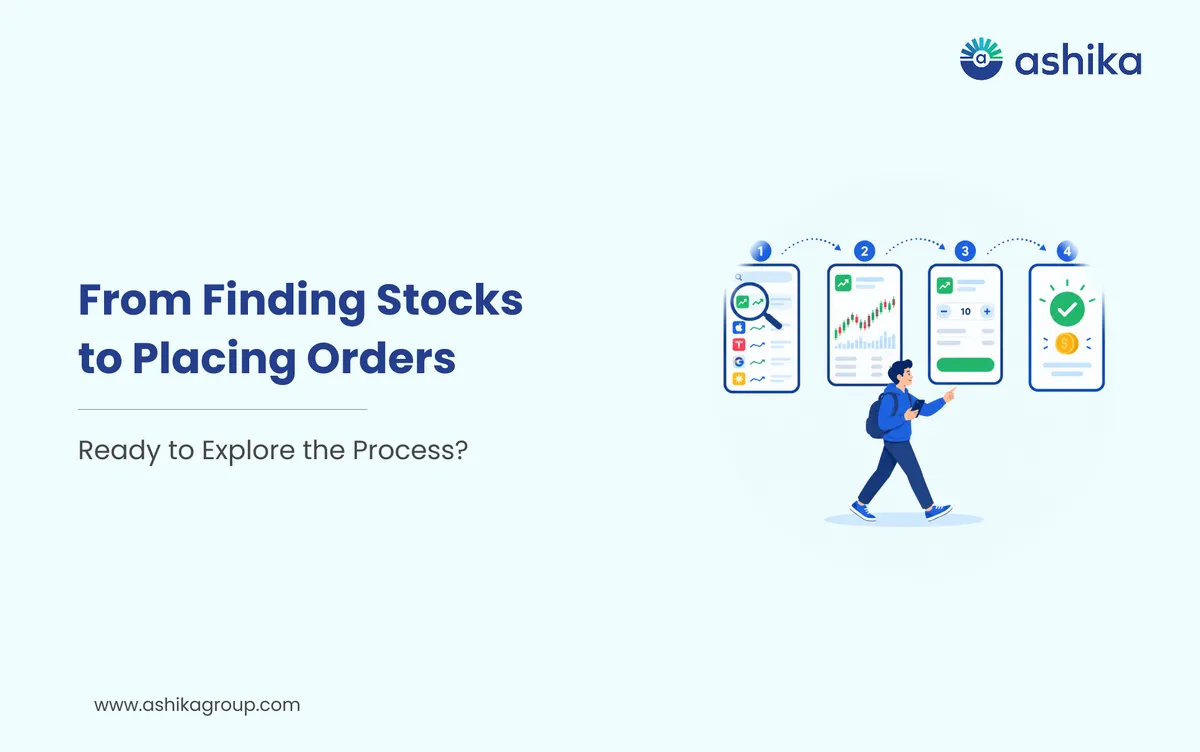

Nowadays, when you begin your journey into investing you won't have to go to a broker's office or complete a lot of forms. Most of the procedure can be carried out online and you'll be able to start looking at the stock market from either your phone or your computer.
It would be useful before making your first order to get used to the different stages involved, beginning with KYC and opening an account and ending with choosing an investment and carrying out your first trade.
The next step is a simple guide to getting started with online investing in India.
Table of Contents
- Step 1: Understand What You Need
- Step 2: Choose a SEBI-Registered Broker
- Step 3: Complete Your KYC
- Step 4: Open Your Trading and Demat Accounts
- Step 5: Add Funds to Your Trading Account
- Step 6: Decide What You Want to Invest In
- Step 7: Place Your First Trade
- Step 8: Track Your Investment
- Starting Your Investment Journey With Ashika
- A Simple Checklist Before Your First Investment
- Frequently Asked Questions
Step 1: Understand What You Need
To invest in securities through the stock market, you generally need three key accounts:
- Your securities are held in electronic form through a Demat account.
- Having a trading account allows you to have securities bought and sold through a stock broker.
- A bank account is employed for carrying out and receiving payments relating to your investments.
SEBI and the NSE state that the accounts work together in order to carry out transactions in the securities market.
Just put it down in simple terms—the money comes out of your bank account, the order is placed using your trading account and the securities are kept by your Demat account once you have bought them.
Step 2: Choose a SEBI-Registered Broker
Before you set up an account, choose a stock broker who is registered with SEBI and who offers the services and products that you need.
You can compare factors such as:
- Brokerage and other applicable charges
- Trading platform and mobile app
- Available investment products
- Customer support
- Research and educational resources
- Ease of account management
The NSE recommends that you check the broker's registration, the range of services that they provide, their reputation and their ability to offer support before you choose an online trading platform.
Step 3: Complete Your KYC
Know Your Customer, or KYC, is an essential element when one opens a trading and Demat account.
While you are going through the procedure of opening a digital account, you will be asked to give details and documents which are needed to verify both your identity and your address. The kind of documents required may differ depending on the account-opening procedure and might include your PAN together with other officially accepted identity or address documents.
Digital account opening can also make use of Video-Based In-Person Verification (IPV), in this way allowing the process to be completed without it being necessary to go to the intermediary's office.
Check that the information you give is correct and consistent with your official records.
Step 4: Open Your Trading and Demat Accounts
When your KYC details have been verified, your relevant trading and Demat accounts can be activated.
The Demat account is held via a Depository Participant who is associated with one of India's two depositories, namely NSDL or CDSL, and the trading account is kept with the stock broker.
Once it has been activated, you are given the credentials required to gain access to your investment platform.
Make certain that you understand the platform, the types of orders and the relevant charges before you place an order.
Step 5: Add Funds to Your Trading Account
You should have enough funds available as part of the relevant trading and settlement process if you are going to buy securities.
Make use of only the banking channels which your registered intermediary provides. SEBI recommends that investors should pay their money to registered intermediaries via banking channels and not through individuals who claim to represent the intermediary.
Do not give your banking password, trading password or one-time password to anyone.
Step 6: Decide What You Want to Invest In
Just because you have opened an account doesn't mean that you have to begin trading at once.
Start by getting a clear understanding of the investment product you're looking at.
Beginners may come across products such as:
- Stocks
- Mutual funds
- ETFs
- Bonds
- IPOs
- Government securities
- Derivatives
Each product has its own characteristics, risks, and length of investment.
When you are thinking about investing in individual stocks, you should consider various factors including the company's business model, its financial performance, the level of valuation, the outlook for the industry, and the risks involved.
Your choice of investment should also be in keeping with your financial goals, time horizon and risk tolerance.
Step 7: Place Your First Trade
After you have researched an investment and have decided to go ahead, you can place an order via your trading platform.
When buying shares you usually pick the company, put in how many you want and then select the appropriate order type.
For instance, a market order is carried out at the current market price, whereas a limit order lets you state the price at which you are willing to buy or sell.
Before you confirm the order, please go through it carefully.
The NSE advises investors to understand how their online trading software functions and to make sure that they get confirmation of their orders and trades after placing an order.
Step 8: Track Your Investment
The process should not be regarded as over once your order has been carried out.
Keep an eye on the shares you own, look over any announcements made by the company, and keep records of your portfolio.
SEBI also tells investors to regularly check their balances and their Demat statements and make sure these agree with their trades and transactions.
It is advisable not to look at your portfolio only during times when the markets are rising or falling sharply, since regularly reviewing it can help you determine if your investments are still in line with your original objectives.
Starting Your Investment Journey With Ashika
For investors who are seeking a digital platform on which to access market and investment services, Ashika's Dhanush 2.0 offers a variety of products and features within a single ecosystem.
A digital platform makes it easier to manage your Demat and trading accounts as well as to look into stocks, IPOs, mutual funds and all other market opportunities.
One should not rely on convenience alone. It is important to find out about the product, the related costs and the risks before making an investment and to base your decisions on your personal financial situation.
Ready to open yours?
Free account opening · Paperless eKYC · Live in 10 minutes
A Simple Checklist Before Your First Investment
Before placing your first trade, make sure you have:
✓ Completed KYC
✓ Opened and activated your trading and Demat accounts
✓ Linked the required bank account
✓ Understood the charges involved
✓ Researched the investment
✓ Considered your risk tolerance
✓ Understood the order you're placing
✓ Checked the trade confirmation after execution
It is technically just as easy to get started with online investing as it has ever been the case. The more crucial thing to do is to learn how the market works and to develop an investment strategy that fits your objectives.
If you set up your account properly and have some basic knowledge along with a disciplined attitude, your first trade can mark the start of a more informed investment journey.
Frequently Asked Questions
What do beginners need to start investing online in India?
You generally need a bank account, a trading account with a registered stockbroker and a Demat account to buy and hold listed shares electronically. You must also complete the applicable KYC process.
How do I complete KYC for online investing?
You need to provide your PAN and other accepted identity and address details. Depending on the intermediary's process, verification may also involve digital verification or Video-Based In-Person Verification (IPV).
How do I choose a stockbroker for online investing?
Check the broker's SEBI registration, brokerage and other charges, available investment products, trading platform, customer support and research resources before opening an account.
What should beginners consider before placing their first trade?
Understand the investment product, research its risks and costs, and consider whether it matches your financial goals, investment horizon and risk tolerance. Also, learn the difference between market and limit orders before placing an order.
What should I do after placing my first trade?
Check the trade confirmation, monitor your holdings and review your Demat statement and account balance regularly. Keep track of company announcements and assess whether your investments remain aligned with your financial goals.
Was this article helpful?
Thanks for your feedback!
 7 min read