Buying a stock because someone mentioned it in a WhatsApp group or because its price has been rising can be tempting. But investing based on a quick tip leaves out something important: research.
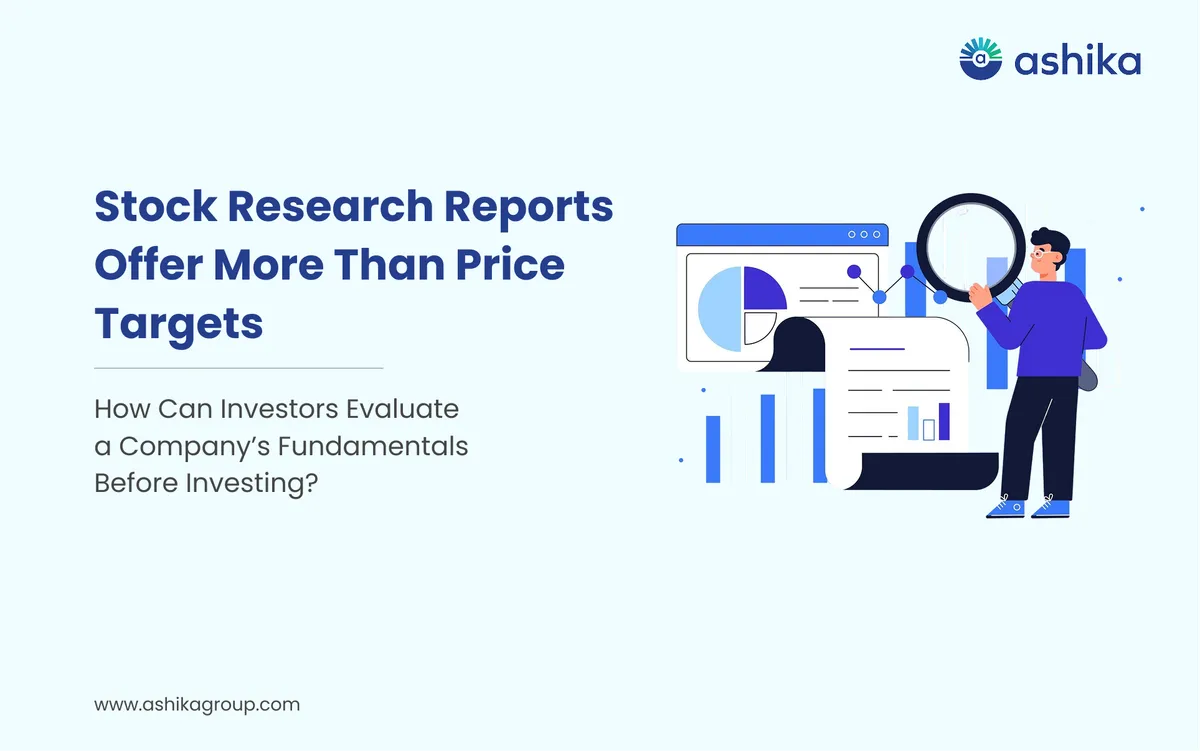
A stock research report brings together information about a company, its financial performance, industry, valuation and future outlook. For a new investor, these reports can look complicated at first. There are numbers, charts, estimates and financial terms everywhere.
The good news is that you don't need to understand every line to get useful information from one.
You just need to know where to look.
Table of Contents
- What Is a Stock Research Report?
- Start With the Investment View
- Understand the Business
- Look at Financial Performance
- Check the Balance Sheet
- Don't Ignore Cash Flow
- Understand the Valuation
- Read the Risks Section
- What Does a Buy, Hold or Sell Rating Mean?
- Research-Driven Investing With Ashika
- A Simple Way to Read Any Research Report
- Frequently Asked Questions
What Is a Stock Research Report?
A stock research report is a document prepared to analyse a company and its shares. It is usually prepared by a research analyst or research team.
Depending on the report, it may cover:
- Company and business overview
- Industry and competitors
- Revenue and profit
- Balance sheet
- Cash flows
- Valuation
- Future earnings estimates
- Key risks
- Investment view or recommendation
The purpose is to help investors understand the factors that could influence a company's performance.
A research report is not a guarantee that a stock will rise. It is one source of information that investors can consider before making their own decision.
Start With the Investment View
Most research reports begin with an investment summary.
This section is worth reading first.
It usually explains why the analyst has a positive, neutral or negative view of the stock. You may also find the current market price, target price and expected upside or downside.
Don't stop at the target price, though.
The more useful question is: Why does the analyst expect the stock to reach that price?
The answer will usually be explained in the rest of the report.
Understand the Business
Before looking at complicated financial ratios, understand what the company actually does.
Ask simple questions:
What does it sell?
Who are its customers?
How does it make money?
Who are its biggest competitors?
What could make the business grow—or struggle?
If you cannot explain the company's business in a few sentences after reading the report, it may be worth going back to this section.
Look at Financial Performance
The financial section tells you how the business has performed over time.
Some of the numbers investors commonly look at include:
Revenue: Shows how much money the company generates from its operations.
Profit: Indicates how much the company earns after expenses.
Profit margin: Helps show how much profit the company makes from its revenue.
Earnings per share (EPS): Shows the portion of a company's profit attributable to each outstanding share.
Instead of focusing on one year's figure, look for the trend.
Is revenue increasing?
Are profits growing at a similar pace?
Are margins improving or falling?
A single strong quarter does not necessarily tell you where the business is heading.
Check the Balance Sheet
A profitable company can still face financial pressure if it carries too much debt or has weak cash flows.
This is why the balance sheet deserves attention.
Look at:
- Debt
- Cash reserves
- Debt-to-equity ratio
- Working capital
- Other major liabilities
The importance of each measure varies by industry. A bank, for example, has a very different balance sheet from a manufacturing company.
So comparisons should ideally be made with similar businesses.
Don't Ignore Cash Flow
Profit and cash flow are related, but they are not the same thing.
A company can report accounting profits while its actual cash generation remains weak.
Research reports often include operating cash flow and free cash flow figures. Looking at these numbers can help investors understand whether the company's business is generating cash from its operations.
For a growing company, cash requirements may be high because it is investing in expansion. That is why cash flow should be viewed alongside the company's stage of growth and business model.
Understand the Valuation
A good company is not necessarily a good investment at any price.
This is where stock valuation comes in.
Research reports may use measures such as:
- Price-to-Earnings (P/E)
- Price-to-Book (P/B)
- Enterprise Value to EBITDA (EV/EBITDA)
- Price-to-Sales (P/S)
The appropriate metric depends on the company and sector.
Rather than asking whether a P/E ratio is simply "high" or "low", compare it with the company's historical valuation and similar businesses.
A high valuation may reflect strong growth expectations. But it can also leave less room for disappointment.
Read the Risks Section
This is one section investors shouldn't skip.
Analysts may identify risks related to competition, regulation, debt, commodity prices, customer concentration, foreign exchange movements or changing demand.
The risks can be different for every company.
Understanding them can help you decide whether the potential return is worth the level of uncertainty you are comfortable taking.
What Does a Buy, Hold or Sell Rating Mean?
Research reports often end with a recommendation such as Buy, Hold or Sell.
These ratings reflect the analyst's view based on their assumptions and valuation methodology.
They should not be treated as instructions.
An investor's financial goals, risk tolerance and investment horizon may be completely different from those assumed in the report.
The report is best used as a starting point for your own research.
Research-Driven Investing With Ashika
For investors who want access to market information and research-oriented resources, Ashika's Dhanush 2.0 brings various investment and market services together on a digital platform.
Research tools can make it easier to study companies, track market developments and review investment information. But the final investment decision should always be based on your own financial situation, objectives and understanding of the risks involved.
A research report can save you time. It cannot make the decision for you.
Ready to open yours?
Free account opening · Paperless eKYC · Live in 10 minutes
A Simple Way to Read Any Research Report
If you're new to stock research, follow this order:
1. Investment summary — What is the analyst's view?
2. Business — How does the company make money?
3. Financials — Are revenue and profits moving in the right direction?
4. Balance sheet — How much debt does the company carry?
5. Cash flow — Is the business generating cash?
6. Valuation — Is the current price reasonable compared with expectations?
7. Risks — What could go wrong?
This approach can help you get the important information without getting lost in dozens of pages.
The Bottom Line
A stock research report is useful when you know how to read it critically.
Don't look only for a Buy or Sell recommendation. Look at the business behind the stock, its financial performance, valuation and risks.
The goal of research-driven investing is not to predict every price movement. It is to make investment decisions with better information and a clearer understanding of what you are buying.
Frequently Asked Questions
What is a stock research report?
A stock research report analyses a company’s business, financial performance, valuation, industry position and potential risks to help investors make informed decisions.
Which section of a stock research report should beginners read first?
Start with the investment summary to understand the analyst’s view, target price and reasoning. Then review the business, financials, valuation and risks.
What financial details should investors check in a research report?
Look at revenue, profit, profit margins, earnings per share, debt, cash reserves and cash flow. Compare trends over multiple periods rather than relying on a single result.
Why is stock valuation important when reading a research report?
Valuation helps investors assess whether a stock’s market price is reasonable relative to its financial performance and growth expectations. Common measures include P/E, P/B and EV/EBITDA ratios.
Should investors follow a Buy, Hold or Sell recommendation blindly?
No. These ratings reflect an analyst’s assumptions and assessment, not a guarantee of returns. Investors should consider the company’s risks alongside their own financial goals, risk tolerance and investment horizon.
Was this article helpful?
Thanks for your feedback!
 7 min read