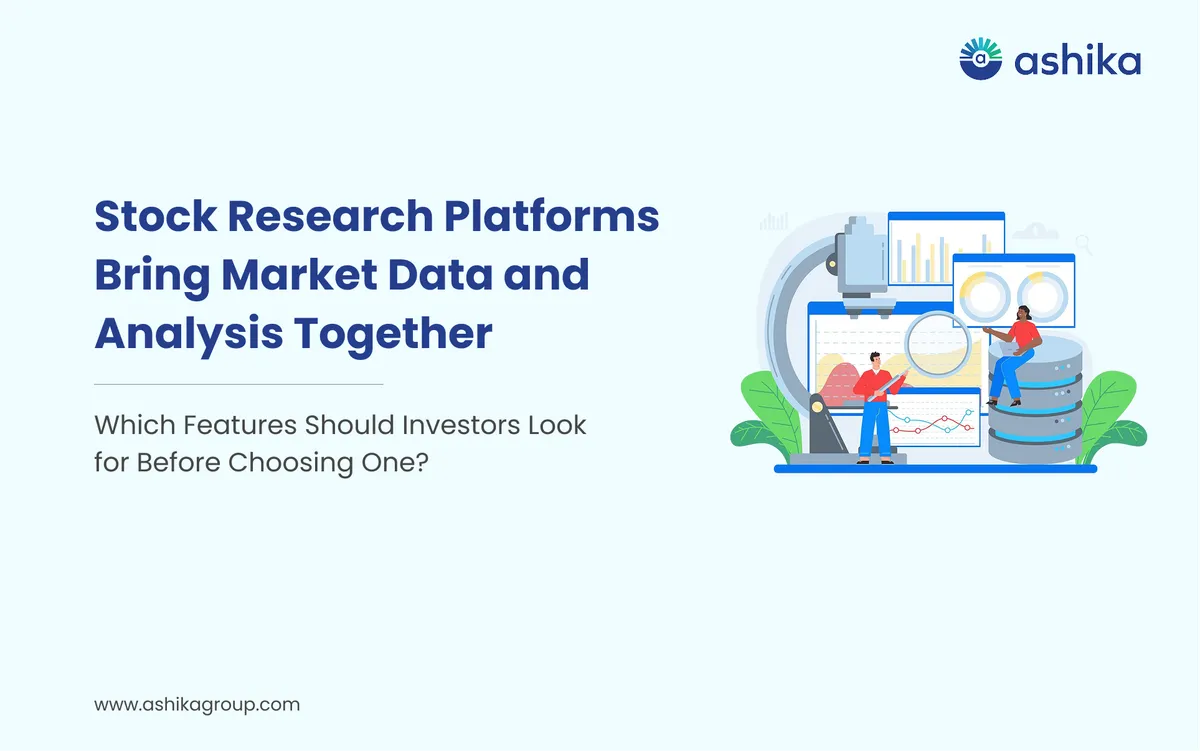
Choosing a stock is rarely just about looking at the price. You might well want to look at the company's financials, compare it with its peers, check out the market, assess the risks etc. A stock market research platform brings all of that together in one place so you can do your investment research without having to jump from one site to another.
However not every platform has the same offering or amount of information. Some are very chart and market focused, others will have company financials, screening tools, analyst research and portfolio tracking. Knowing what you're looking for will go a long way to helping you pick the right platform for your own requirements.
Table of Contents
- 1. Reliable Company Financial Data
- 2. Stock Screening and Comparison Tools
- 3. Charts and Market Information
- 4. Timely News and Company Announcements
- 5. Portfolio Tracking and Watchlists
- 6. Ease of Use, Transparency and Security
- 7. AI-Powered Research Features
- Choosing a Platform That Fits Your Needs
- Frequently Asked Questions
1. Reliable Company Financial Data
A good research platform should make it easier to get a handle on a company's financials. Investors will want to be able to look at revenue, profits, debt, cash flow, earnings per share and all the other key financials.
These figures can be used by users to look at how a business has performed over time rather than just looking at a single quarter or a single headline. Looking at the results over a number of periods can also highlight any changes in profitability, gearing or growth.
Data accuracy is just as important as the way it's presented. Investors need to know where the data comes from, when it was last updated and whether the figures are being presented in a consistent manner. For listed Indian companies the answer to all of the above is usually to be found in the exchange filings and official company disclosures.
2. Stock Screening and Comparison Tools
Research is so much easier when you can take a large list of stocks and whittle it down to a manageable number by applying a set of criteria. A stock screener enables you to filter companies according to the parameters you specify (market cap, P/E ratio, revenue, profitability etc).
For instance an investor looking at companies in a particular sector might use a screener to find the companies that met certain financial criteria. Those companies would then be looked at in more detail.
Analysis tools are useful for the same reason. You can use them to put two companies in context in terms of valuation, financials and business fundamentals. A low valuation or a good screening result in no way should be taken as a reason to invest though. You have to look at the business model, the industry and the risks as well.
3. Charts and Market Information
Financial statements are obviously the key to helping an investor understand a business. Charts can show you how the share price has performed over time. A research platform will typically provide you with historical price charts, historical trading volumes, technical indicators and all sorts of other market data.
These tools can be used to look at price action and changes in trading volume. The short-term trader will be looking at price and volume, the long-term investor will be looking at the chart to see what the market has done in the past.
Investors must remember that past prices don't predict future performance. Technical indicators are all based on past and/or current market data and can't guarantee the direction of a stock.
When you're comparing platforms look at how easy the charts are to use, whether the timeframes available are what you require and how often the market data is updated.
4. Timely News and Company Announcements
A company's share price can react to earnings releases, changes in management, corporate actions, regulatory news and general economic events. Having access to the news in a timely manner can help an investor to understand the context of the market movement.
A good research platform should make it easier to spot the relevant announcements and to separate the wheat from the chaff (so to speak) in terms of what is fact and what is opinion/commentary. Ideally you should be able to trace the key claims back to the actual source of the information (e.g. an exchange announcement, a company filing or a regulatory announcement).
News should be there to support the research rather than do the research for you. A headline might tell you why a share is moving, but it doesn't necessarily tell you whether it's a fairly valued share or whether it's appropriate for you.
5. Portfolio Tracking and Watchlists
Investors who are following a number of stocks will find the watchlist and portfolio tracking features very useful. The watchlist allows you to keep an eye on a number of individual securities without having to go searching for them each time.
Portfolio tools can show you your holdings, your current values, the changes in price and the P&L (profit and loss) depending on the platform. They can be a useful way of reviewing your portfolio in one place and can help you spot areas that may need more attention.
Before you pick a platform check that the portfolio information it provides actually reflects your holdings (rather than just a manually constructed list). It's also worth knowing how often the values update and whether the platform is capable of dealing with the asset classes you're looking to track.
6. Ease of Use, Transparency and Security
A platform can have absolutely superb research capabilities and still be very difficult to use. Clear navigation, readable charts, well presented company information and useful filters can all go a long way to making research take less time.
Transparency is just as important. Users need to be able to see where the data comes from, what the limitations of the analytical tools are and any subscription fees or other charges. If a platform is providing research or investment advice then the investor should check the provider's credentials and the relevant SEBI registration requirements as it is not necessarily the case that every service is regulated in the same way.
Account security is also an issue. Look for appropriate authentication options, transparent privacy policies and clear information as to how your data is going to be managed.
7. AI-Powered Research Features
Some of the modern platforms will have AI tools which will help you screen stocks, help you to organise your data and so on. They can make certain types of research much easier, particularly if you're dealing with a lot of data.
Still, AI generated summaries and screen results need to be checked against the actual data and original disclosures. They can miss the context, can be wrong in their interpretation and can be based on very limited information. AI should be treated as a research tool only and not as a replacement for your own independent judgement.
Platforms such as Ashika's Dhanush 2.0 provide access to market information and digital trading tools. The investor should look at what is available on the platform and determine whether it meets their research needs.
Ready to open yours?
Free account opening · Paperless eKYC · Live in 10 minutes
Choosing a Platform That Fits Your Needs
The right stock market research platform is going to be very much dependent on how you invest. The long term investor is going to be looking for financial statements, company comparisons and portfolio tracking. The active trader is going to be looking for charts, price information and the latest market news. The person just getting into the market is going to want clear explanations and a simple interface.
Before you choose, compare data quality, research tools, update frequency, cost and transparency. No platform is going to eliminate market risk or guarantee you'll make a profitable decision. Its value is in helping you to structure your information, ask better questions and assess opportunities more rigorously.
Frequently Asked Questions
What is a stock market research platform?
A stock market research platform brings together tools and information such as company financials, stock screeners, charts, market news and portfolio tracking to help investors research stocks.
What features should investors look for in a stock research platform?
Investors should look for reliable company financial data, stock screening and comparison tools, historical charts, timely news, watchlists, portfolio tracking, transparent pricing and appropriate security features.
How does a stock screener help investors?
A stock screener helps investors filter companies using criteria such as market capitalisation, P/E ratio, revenue and profitability. It can narrow down a large list of stocks for further research.
Are AI-powered stock research tools reliable?
AI-powered tools can help organise information, screen stocks and summarise data. However, their outputs should be checked against company disclosures and other reliable sources, as AI can miss context or interpret information incorrectly.
How should beginners choose a stock market research platform?
Beginners should compare data quality, ease of use, available research tools, update frequency, costs and transparency. They should choose a platform that suits their investment approach and remember that no platform can eliminate market risk or guarantee returns.
Was this article helpful?
Thanks for your feedback!
 7 min read