If you attempt to open a demat account without a PAN card in India today, the process will just stop at the first screen. What was once merely a documentation step has now become the one absolute barrier between you and all your future investments in the Indian markets——whether it's your first ₹500 SIP or a multi-lakh equity portfolio. Below is the reason why the PAN has attained this status, and what it means for anyone who is opening a demat account online in 2026.
Table of Contents
The Regulatory Foundation Behind This Rule
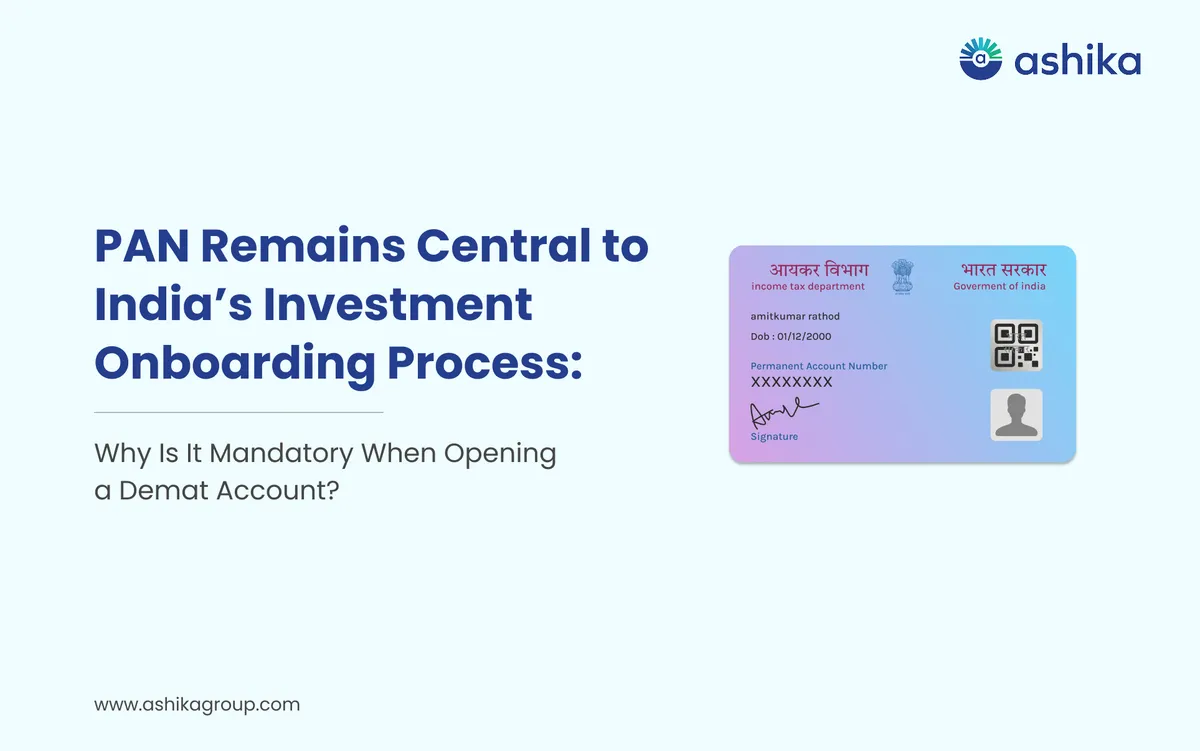
The rule isn't a new one, though it has become much stricter over time. According to a circular issued by SEBI in April 2007, it was made mandatory at the time of opening a demat account to submit your PAN card, no matter how large or small the investment, and this applied to resident investors with no exceptions. Under Rule 114B(d) of the Income Tax Rules, everyone who invests in the Indian stock market is required to have a PAN—whether they do so through a broker, an investment app, or a mutual fund platform—and importantly, there is no minimum portfolio size that applies; even a single, one-off investment brings the requirement into effect.
The regulations set by SEBI go an even further. According to the SEBI (Depositories and Participants) Regulations, 1996, and the later amendments which have strengthened the KYC requirements, each Depository Participant—that is, the bank or brokerage firm which assists with your demat account—is legally required to make sure that every account holder has a valid PAN connected to both their demat and trading accounts. This obligation does not apply only to individual investors; it also applies to corporations, partnerships, and trusts, thus establishing a consistent framework for financial supervision among all kinds of market participants.
Why PAN Specifically, and Not Just Any ID
The role of the PAN extends beyond mere identity verification; it serves as a unique identifier throughout all aspects of your investing activities, so that every transaction involving mutual funds, every equity trade, and each dividend or capital gain can be linked to a single, consistent identity—even when dealing with different fund companies and brokers. It is because of this that tax authorities and regulators are able to keep a clear record of your financial transactions, and that is exactly the objective: tracking based on the PAN is intended to prevent money laundering, tax evasion, and fraudulent market activity by ensuring that all transactions are traceable.
It's worth noting that the PAN alone is not considered an officially valid document (OVD) for proving your identity according to the PML Rules—you'll still have to provide separate proof of identity and proof of address together with it. However, if you don't have the PAN specifically, then no other combination of documents will be sufficient to open your demat account.
What Happens If Your PAN Isn't in Order
The impact of having an invalid, unlinked, or missing PAN extends to almost all aspects of your investing activities. Transactions with your Demat account may be completely blocked. When you attempt to buy mutual funds, the transaction can fail at the KYC verification stage, before it has even been processed. Capital gains from your investments may be subject to a heavy 20% TDS rate rather than the normal rate, thereby reducing your actual returns. Furthermore, any new account you decide to open—whether with your current broker or with a different one—will be rejected at the application stage.
That is precisely the reason why it has become a basic first move for anyone who is serious about investing to check the status of their Aadhaar-PAN link. Although PAN-Aadhaar linking is not strictly required for all transactions in the securities market—investors possessing a valid PAN can still carry on trading with their present intermediary even if the link has not been verified—their KYC records will not be transferable to a new broker or platform until the link has been established. In practice, an unlinked PAN can silently restrict your ability to switch brokers or platforms later on, even though your current account remains operational.
The KYC Process, Step by Step
When you open a demat account nowadays, the process is essentially the same throughout almost all SEBI-registered Depository Participants. You have to complete a standard KYC form — Part I, which is based on the templates provided by the Central Registry of Securitization Asset Reconstruction and Security Interest of India (CERSAI), and Part II, which includes further details relating to the intermediary you have selected. Together with your PAN, you must also provide proof of identity, proof of address, a passport-sized photograph, and either a cancelled cheque or a bank statement.
In-Person Verification, often referred to as IPV, is still a required procedure – although most DPs now provide it in the form of a Video-IPV, whereby a representative checks your identity and documents during a video call instead of asking you to visit a physical branch. After that, you can e-sign your account opening forms using Aadhaar-based e-Sign, thus making it unnecessary to provide a physical signature or to use a digital signature dongle. As soon as the verification is completed, your demat and trading accounts become active and you can start investing.
Special Cases Worth Knowing
A few situations are worth noting. In the case of minors, a demat account may be opened in the child's name, but it has to be managed entirely by a legal guardian, the guardian's PAN then serving as the identification document associated with the account—the minor's own PAN only becomes relevant when they reach the age of 18 and the account is changed over to a standard adult demat account by going through the necessary KYC procedures. As for NRIs, it is still necessary to provide a PAN together with proof of an overseas address, and in most cases separate demat accounts are required for repatriable and non-repatriable funds.
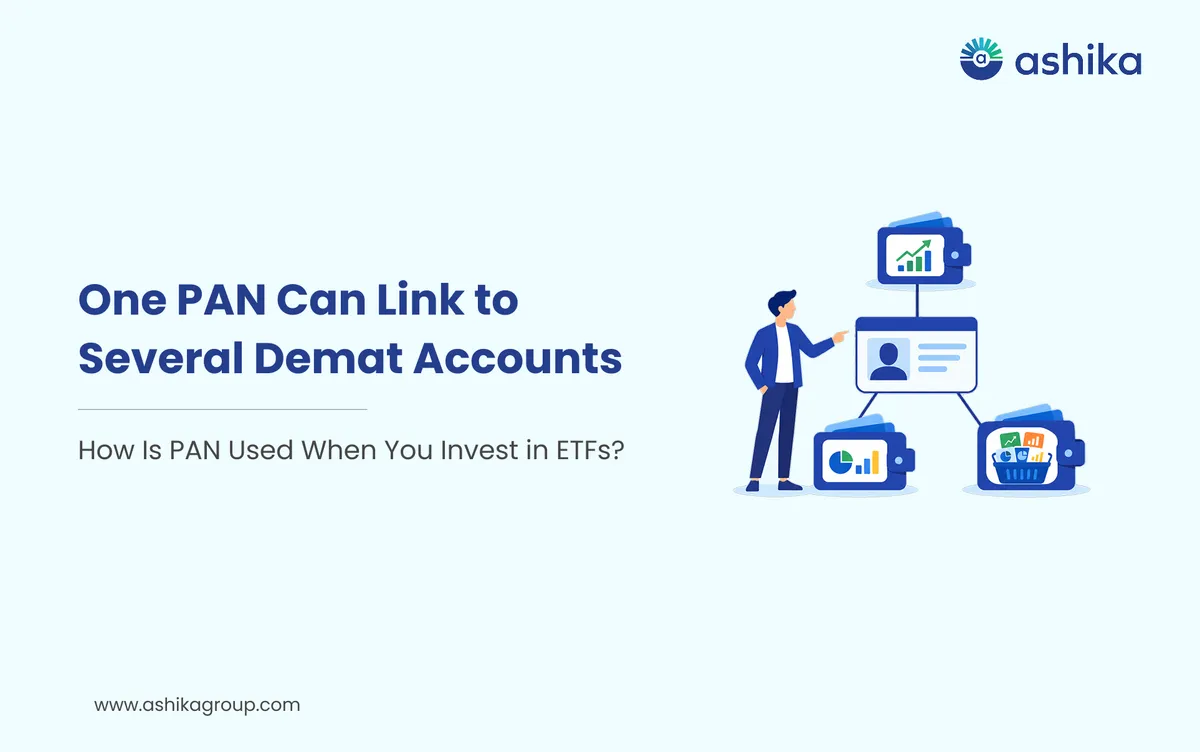
It's also important to put the usual misunderstanding to rest: although you can have several demat accounts, each and every one must be linked to the same PAN. There is no way around this requirement — the PAN serves as the anchor identity for all your holdings, no matter how many accounts or brokers you use.
Why This Matters More as India's Investor Base Grows
The number of demat accounts in India is anticipated to exceed 15 crore by 2026, which means that PAN-based tracking has now become an increasingly important measure for ensuring safety, rather than merely serving as a routine administrative task. Since a growing number of new investors are joining the market — a large proportion of them having no previous experience of formal KYC procedures — it is a strong and consistent identity verification system that ensures the overall market remains transparent and truly trustworthy. For new investors, the practical conclusion is simple: make sure your PAN is in order, check your Aadhaar linkage status, and regard this stage as the real foundation of your investing journey — not something to go through quickly.
Ready to open yours?
Free account opening · Paperless eKYC · Live in 10 minutes
What You Should Do Next
- Before opening any new demat account, check the status of your Aadhaar-PAN link on the Income Tax Department's e-filing portal.
- Make sure that the details of your PAN are the same on every account you open since discrepancies are one of the main reasons for KYC rejection.
- When you are opening an account on behalf of a minor, you must properly connect and provide documentation for the guardian's PAN from the beginning.
- You should not put off linking your Aadhaar and PAN even if your current relationship with your broker is still valid — because it will affect your ability to transfer your KYC to a new platform later.
The PAN card has stopped being merely a tax document it is now the one identity link that connects all your future investments in India's markets, which is precisely the reason it is important to get it right from the very beginning.
Frequently Asked Questions
Is a PAN card mandatory to open a Demat account in India?
Yes. Investors generally need to provide a valid PAN to open a Demat account, regardless of the investment amount.
Why is PAN required for a Demat account?
PAN acts as a unique identifier for financial and investment transactions. It helps regulators and tax authorities maintain consistent records and monitor financial activity.
Can I open a Demat account if my PAN is not linked to Aadhaar?
An inoperative PAN can create problems with account opening and KYC verification. Check your PAN status and Aadhaar-linking requirements with the Income Tax Department before applying.
Can a minor open a Demat account?
Yes. A Demat account can be opened in a minor's name and operated by a legal guardian. The required PAN and KYC documents must be provided as per the Depository Participant's process.
Can I have multiple Demat accounts with the same PAN?
Yes. You can hold multiple Demat accounts with different Depository Participants, but each account must be linked to your PAN.
Was this article helpful?
Thanks for your feedback!

 6 min read