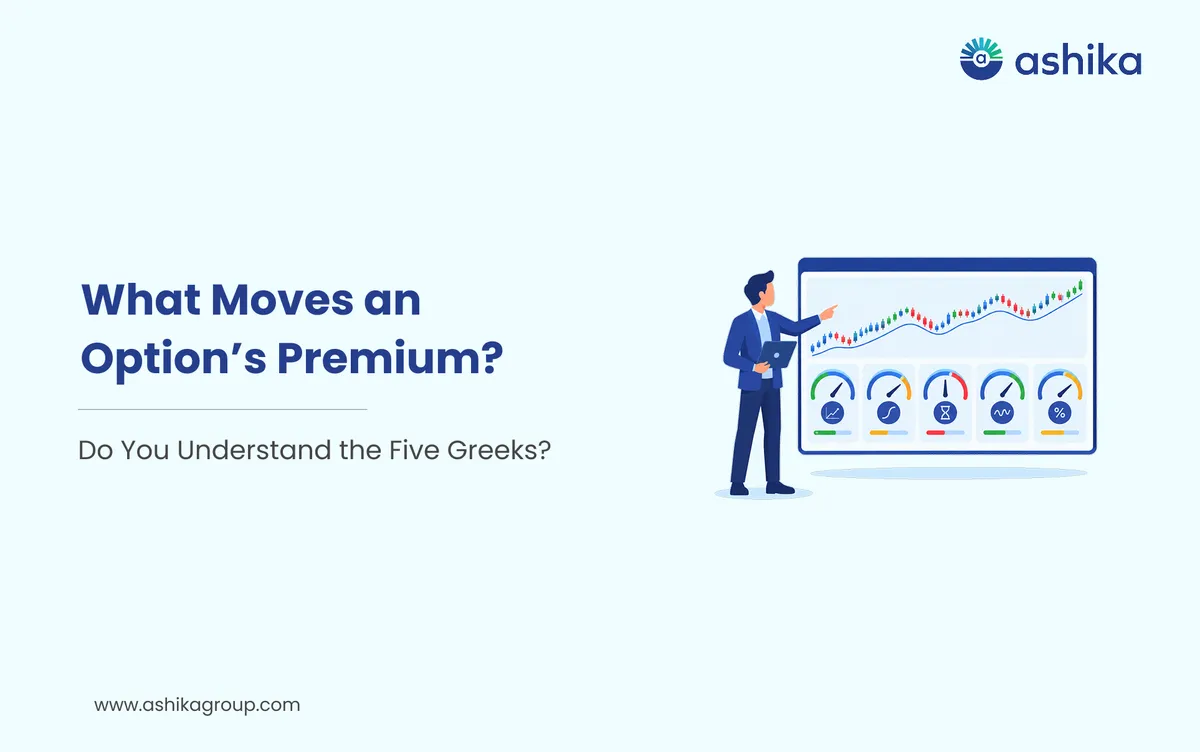
When you look at an options chain you'll see that every call and every put has a premium. So why does one option end up costing ₹120 and another for the same stock only ₹35? The answer is generally down to two components: intrinsic value and time value.
Knowing these components will go a long way towards helping the novice to make sense of options pricing, particularly in the case of premiums changing even if the underlying stock or index has only moved a little.
Table of Contents
What Is an Options Premium?
An options premium is the price the option buyer pays the seller for the right to buy or sell the underlying at the strike price as per the terms of the option contract.
For example, if a trader buys a Call option at a premium of Rs 50, they pay Rs 50 per unit of the contract. The total premium paid will be a function of the contract size and any applicable charges.
The premium is a function of a number of variables: the market price of the underlying, the strike price, the time to expiry, implied volatility and interest rates. For the beginner the concepts of intrinsic value and time value are a good place to start in terms of understanding how the premium is worked out.
Options Premium = Intrinsic Value + Time Value
This is the case for the standard option valuation concepts with the values being the value of the option at its current premium and intrinsic value.
What Is Intrinsic Value?
Intrinsic value is the amount by which an option is in the money. It's just the difference between the current market price of the underlying and the strike price of the option.
For a Call the intrinsic value is the amount by which the market price exceeds the strike price (if it does). For a Put it's the amount by which the strike price exceeds the market price (if it does).
Example: Intrinsic Value of a Call Option
Suppose the stock is at ₹1,200 and the trader has a call option with a strike of ₹1,150.
The Call’s intrinsic value is:
₹1,200 − ₹1,150 = ₹50
The option has ₹50 of intrinsic value as the stock is trading ₹50 above the strike.
Now suppose we have another Call option with a strike of ₹1,250. The stock is trading below that strike so the option has zero intrinsic value.
Example: Intrinsic Value of a Put Option
Suppose the same stock is at ₹1,200 and we have a Put option with a strike of ₹1,250.
Its intrinsic value is:
₹1,250 − ₹1,200 = ₹50
The Put has ₹50 of intrinsic value as the strike price is ₹50 above the current market price.
An at the money or out of the money option has zero intrinsic value. It will still have a premium though as it has time to expiry and its price could change.
What Is Time Value?
Time value is the amount of the option premium in excess of its intrinsic value. It represents the chance that the option will become more valuable prior to expiry.
For instance, let's say we have a call option with a premium of ₹80 and an intrinsic value of ₹50.
Its time value is:
₹80 − ₹50 = ₹30
The Rs30 difference is the option's time value.
Even if an option has no intrinsic value at the time, a buyer could still pay a premium as the underlying stock/index could move in their favour prior to expiry.
Time value is a function of the time to expiry, implied volatility and all the other pricing factors. The more time there is, the greater the opportunity for the underlying to move, though the actual premium will be a function of all the factors.
How does time to expiry affect an option's premium?
As an option nears expiry its time value will generally fall (all else being equal) which is of course known as time decay.
Consider two otherwise identical options on the same underlying. One expires in a few days, the other in several weeks. The one with the longer time to expiry will usually have more time value as there is more time for a favourable price movement.
Time decay is not necessarily linear. It can actually accelerate as you approach expiry, especially in the case of at-the-money options.
For the buyer of an option time decay can work against them if the underlying doesn't move sufficiently in their favour. For the seller of an option time decay may work in their favour, but of course selling options has its own set of risks (which can be quite significant in some cases).
How Does Implied Volatility Affect Time Value?
Implied volatility is a measure of the market's expectation of the magnitude of future price movement (as implied by the prices of options). It does not indicate whether the price is expected to go up or down.
When implied volatility goes up, option premiums will generally go up (all else being equal). When implied volatility goes down, premiums may go down.
For example an option buyer might be right to expect a rise in the underlying stock and still end up with a smaller than expected gain if implied volatility has dropped substantially. That's one of the reasons that the direction of the stock alone doesn't dictate the P&L on an options trade.
Intrinsic Value vs Time Value: Key Differences
| Factor | Intrinsic Value | Time Value |
|---|---|---|
| Meaning | In-the-money amount | Premium above intrinsic value |
| Depends on | Market price and strike price | Time, volatility and other pricing factors |
| At expiry | Remains according to the settlement value | Falls to zero |
| For out-of-the-money options | Zero | May be positive before expiry |
At expiry the option will have no time value. Its final value will be determined by whether or not it finishes in the money and the relevant settlement rules.
Why Should Beginners Understand Options Premiums?
Knowing how intrinsic value and time value work enables a trader to assess an option's price rather than just look at the strike price. It also explains why two options on the same stock can have vastly different premiums.
Tools such as an option chain on a trading platform can be used to compare strike prices, premiums, expiry dates and the available market data. Ashika Dhanush 2.0 has market tools which allow you to look at the trading data; you'll need to check the platform to see what exactly is available.
Before you even go into an options position you should consider the premium you're paying, the time remaining, the implied volatility, the liquidity and the fact that you can lose the entire premium if you're buying options.
Ready to open yours?
Free account opening · Paperless eKYC · Live in 10 minutes
Conclusion
An options premium is made up of intrinsic value and time value. The intrinsic value is the amount by which an option is in the money, and the time value is the amount of time value remaining before expiry.
Understanding both components gives a foundation for learning options pricing. However, premiums can change quickly, and neither intrinsic value nor time value alone can determine whether a trade will be profitable.
Frequently Asked Questions
What is the expiry date of a Futures contract?
The expiry date is the final date of a Futures contract's validity. On this date, the contract is settled according to the applicable exchange rules and contract specifications.
What happens on Futures expiry day?
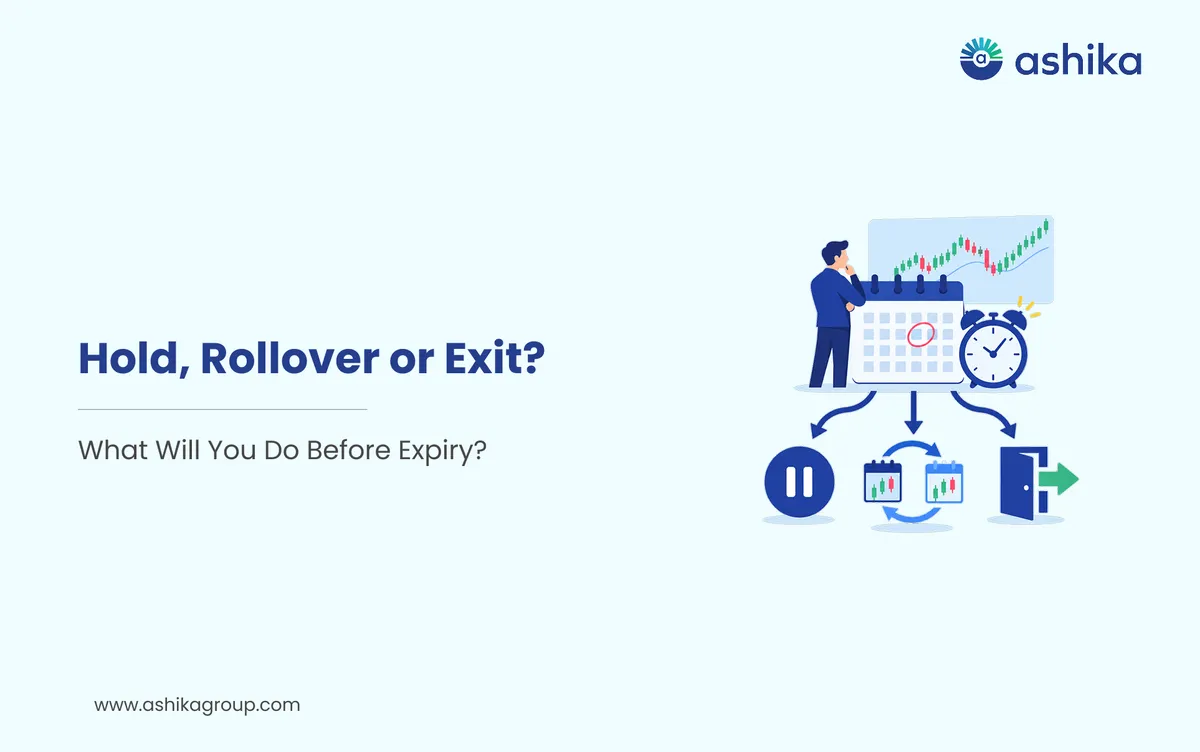
On expiry day, open futures positions are settled as per the contract's settlement mechanism. Traders may close their positions, roll them over to a later contract or allow them to go through settlement.
What is rollover in Futures trading?
Rollover means closing an existing Futures position in a contract nearing expiry and taking a similar position in a contract with a later expiry date. It allows traders to maintain market exposure beyond the current contract's expiry.
What is the difference between rollover and settlement?
Rollover involves shifting a position from an expiring contract to a later contract. Settlement refers to the process of fulfilling the contract's obligations at expiry, as specified by the exchange.
Can I hold a Futures contract until expiry?
Yes, a trader can hold a Futures position until expiry, subject to the contract specifications and applicable margin requirements. The position will be settled according to the exchange's rules, so traders should understand the settlement process before deciding to hold it.
Was this article helpful?
Thanks for your feedback!
 5 min read