Options trading enables market participants to take a position based on the anticipated movement of the underlying. In India the two main types of equity derivatives are index options and stock options. Both will have Calls and Puts, but the underlying is different, the price behaviour is different, the risks are different and the trading considerations are different.
If you're looking at options on an equity trading platform in India then understanding the differences is going to be key to you working out how each instrument operates before you actually go and trade it.
Table of Contents
- 1. What are Index Options?
- 2. What are Stock Options?
- 3. Index Options vs Stock Options: Key Differences
- 4. How do Call and Put options work?
- 5. What should traders consider before choosing?
- 6. Exploring Options on an Equity Trading Platform in India
- 7. Understand the Risks Before Trading
- Make an Informed Comparison
- Frequently Asked Questions
1. What are Index Options?
Index options are options on an index (e.g. NIFTY 50, BANK NIFTY, SENSEX). Rather than being based on the price of a single stock they are based on the movement of an index.
For example NIFTY 50 is a group of the major listed companies across various sectors. Its movement is the movement of the constituent stocks of the index, weighted in accordance with the index methodology.
A trader who thinks the index is going to go up might look at a Call option, whereas a trader who thinks the index is going to go down might look at a Put option.
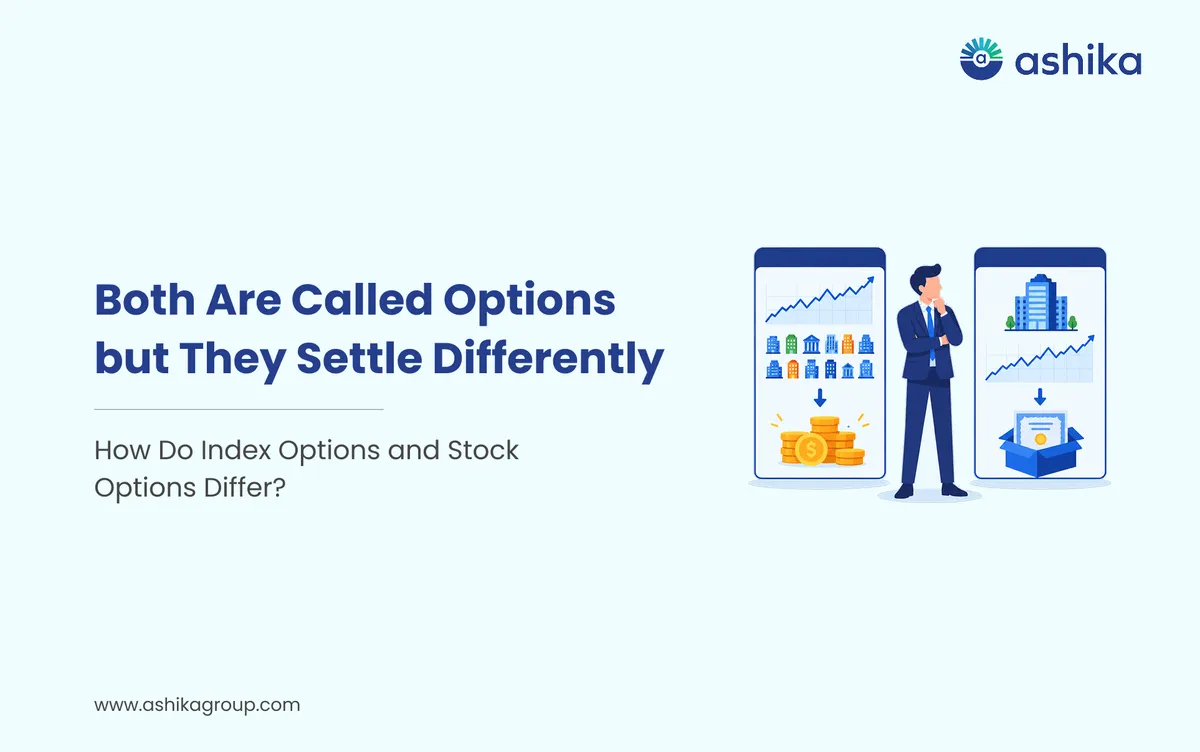
Index options are cash settled in India. The settlement value is based on the index value at expiry (rather than the physical delivery of the shares).
2. What are Stock Options?
Stock options are derivative contracts on the shares of an individual company. Their value is derived from the price of the underlying stock.
For instance a trader who is expecting the share price of a particular company to go up might look at buying a Call option on that stock. If the share price does move up the option could potentially gain value (depending on the strike price, the expiry and all the other relevant factors).
Similarly a Put option may be appropriate if the trader expects the share price to fall.
Stock options are linked to the performance of a single company and their prices will be affected by corporate announcements, earnings results, management changes and the like. Unlike index options.
3. Index Options vs Stock Options: Key Differences
The key difference is the underlying asset.
Index options track a market index and stock options track the shares of an individual company.
Index options are affected by the wider market, economic activity, interest rates and the performance of the index constituents. Stock options are affected by all of the above as well as company specific events.
The risk profile is also different. A stock can be subject to a significant price move as a result of an earnings release or some other corporate event. An index can be impacted by movements in a number of different stocks, with some stocks or sectors having a greater impact than others.
Both types of options involve premiums, strike prices, expiry dates and risk. Neither one is in any way safer or more appropriate for every trader.
4. How do Call and Put options work?
A Call option gives its buyer the right, but not the obligation, to buy the underlying at a specified strike price under the contract’s terms.
A Put option gives the buyer the right (but not the obligation) to sell the underlying at the strike price.
Consider a simplified example.
Suppose the stock is trading at ₹1,000 and you buy a call option with a strike of ₹1,050. If the stock price goes up substantially above ₹ 1050 prior to expiry the option could be worth a lot. You'd of course have to take into account the premium you've paid as well as any applicable charges.
The same principle holds for index options, just with the underlying being an index rather than a single stock.
An option buyer can lose the whole premium if the contract expires worthless. The risks for the option seller are quite different and can be substantial with potential for large losses and margin calls.
5. What should traders consider before choosing?
There is no one right answer as to whether index options or stock options are the better thing to trade. It's very much down to the trader's own level of understanding of the market, their risk appetite and their individual trading objective.
Some factors to consider include:
- Market outlook: Are you looking at the wider market or a particular company's price?
- Volatility: How much does the underlying price move (i.e. how volatile is it) and how will that affect the option premium?
- Liquidity: Are there sufficient buyers and sellers and is the bid ask reasonable?
- Expiry: How much time is left for the option to react to a price move?
- Premium and costs: What is the premium and what are the brokerage and other charges?
- Risk management: How much can you afford to lose and how are you going to manage the position?
Options prices can move very quickly. A correct call on the underlying direction doesn't necessarily result in a profitable options trade.
6. Exploring Options on an Equity Trading Platform in India
An equity trading platform in India will provide access to eligible index and stock options as well as the relevant market information and contract details.
For example Ashika Dhanush 2.0 brings the equity investments and derivatives trading together. Its options chain will show the relevant Call and Put information (prices, OI, IV and PCR where available).
These indicators can be used by traders to assess market activity and to compare the various contracts. They do not however predict future price movement or in any way guarantee a profitable trade.
Before you place an order you should check the underlying asset, the strike price, the expiry, the lot size, the premium, the liquidity and the margin requirements.
7. Understand the Risks Before Trading
Index and stock options are both leveraged products. Their prices will be a function of the price of the underlying, volatility and time to expiry.
Important risks include:
- Losing the premium paid when buying options
- Potentially substantial losses and margin requirements when selling options
- Rapid changes in option prices
- Low liquidity or wider bid-ask spreads in certain contracts
- Expiry-related risks and applicable settlement rules
Beginners should be familiar with the contract specifications and of course avoid trading with money they can't afford to lose.
Ready to open yours?
Free account opening · Paperless eKYC · Live in 10 minutes
Make an Informed Comparison
Index options and stock options are two different ways of getting exposure to the market. Index options are options on an index, stock options are options on a stock.
Understanding how each one works, assessing the risks and carefully going through the contract details can all go a long way towards enabling the trader to make a more informed decision when looking at options on an Indian equity trading platform.
Frequently Asked Questions
If NIFTY rises, will every NIFTY Call option become profitable?
No. The outcome depends on the strike price, premium paid, time remaining until expiry and changes in volatility. Even if the index rises, the option may lose value if the movement is insufficient to offset these factors
Can a stock option be affected by a company's quarterly results even if the overall market remains stable?
Yes. Stock options are linked to an individual company's share price, so events such as earnings announcements, management changes and corporate developments can affect their premiums independently of broader market movements.
Do index options and stock options have the same settlement process in India?
No. Index options are cash settled. Stock options are generally subject to physical settlement in India, so traders must understand the applicable delivery and expiry requirements.
Why can two Call options on the same stock have different premiums?
Their strike prices and expiry dates may differ. The premium also reflects factors such as the underlying stock price, volatility and time remaining until expiry.
What should I look at in an options chain before choosing a contract?
Check the available Call and Put premiums, open interest (OI), implied volatility (IV), put-call ratio (PCR), bid-ask spread and trading volume. These indicators provide information about market activity and liquidity, but they do not predict the direction of the next price movement.
Was this article helpful?
Thanks for your feedback!
 6 min read