Futures trading allows you to take a position on the expected price movement of an asset (a stock, an index or a commodity). It's not the same as buying shares for delivery. In futures trading you're entering into a contract for a certain quantity and a specific expiry date.
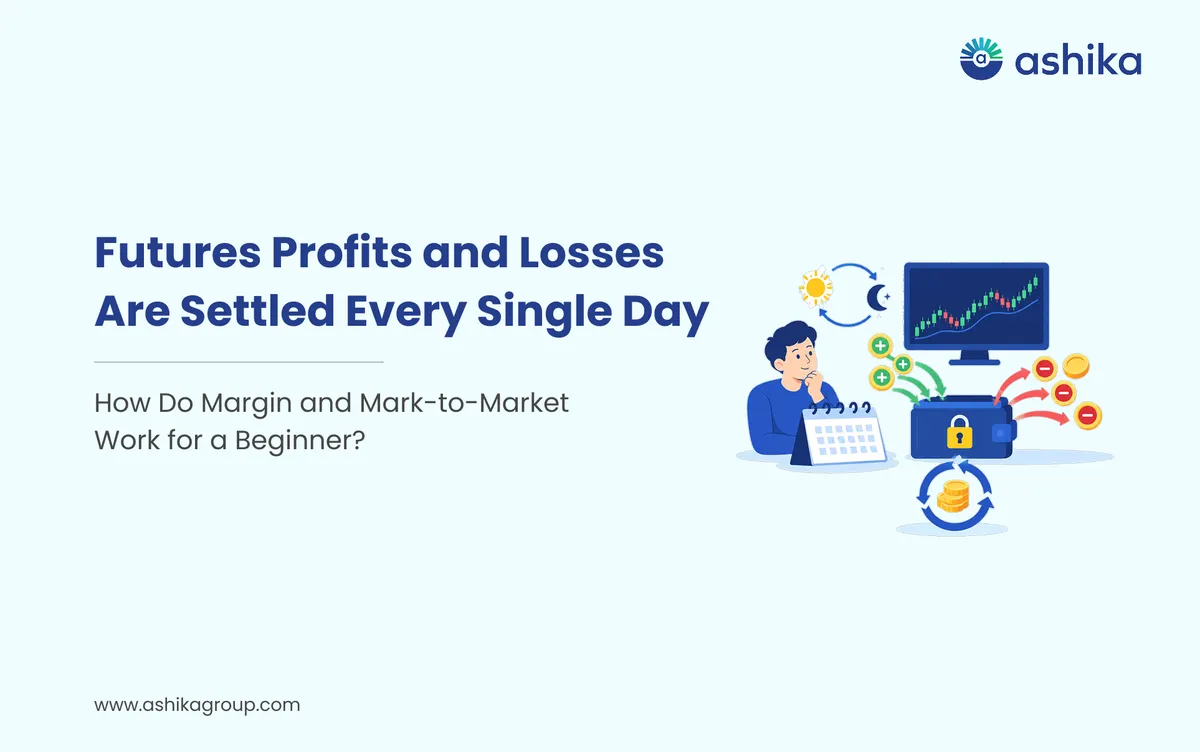
Futures trading doesn't require you to pay the full value of the contract upfront. You just pay a margin (which is your deposit). The contract is also subject to daily mark to market (MTM) settlement where the daily settlement price is used to calculate your profit or loss.
It's vital to get a clear understanding of these two concepts before you start trading futures as a position can in fact require additional margin even if you haven't closed it.
Table of Contents
- 1. What is Margin in Futures Trading?
- 2. Types of Margin in Futures Trading
- 3. What is Mark-to-Market (MTM)?
- 4. How daily settlement works: A simple example
- 5. What happens when a Futures Position makes a loss?
- 6. Why Margin and MTM matter to traders
- Understand the settlement before trading
- Frequently Asked Questions
1. What is Margin in Futures Trading?
Margin is the amount of money you have to have with your broker in order to open or maintain a futures position.
Futures are exposed to a much larger contract value than the amount of margin that's actually deposited so margin is there to manage the risk of loss.
For instance, if you have a futures contract of ₹5 lakh in value you may only be required to put down a fraction of that as margin to take the position. The amount of margin required will vary depending on the contract, the market and the margin requirements in force.
Margin is not the maximum amount you can lose. If the market moves against you, your losses could in fact be greater than the initial margin you put down.
2. Types of Margin in Futures Trading
Different margins will apply when trading futures.
Initial margin is the amount required to open a futures position. In the equity derivatives segment, exchanges use risk-based margin systems, including SPAN, to calculate the required margin.
Extreme Loss Margin (ELM) is an additional margin collected to account for potential losses under extreme market movements.
Mark-to-market margin relates to the daily profit or loss generated by an open futures position. If a position incurs a loss, the trader may need to pay the amount as part of daily settlement.
These margins have very different functions. The initial and extreme loss margins are there to manage risk prior to and during the life of a position. The MTM settlement is the P&L that results from the daily price movements.
3. What is Mark-to-Market (MTM)?
Mark to market is the process of working out the daily P&L on an open futures position using the daily settlement price.
At the end of each trading day the exchange will establish a settlement price for the futures contract. The difference between the prior settlement price and the current settlement price is then used to calculate the day's profit or loss.
The amount is settled via the clearing system. On a daily basis the open position is effectively reset to the new settlement price for the purposes of the next day's calculation.
This means that profits and losses are not simply accumulated until the contract expires. They are settled daily.
4. How daily settlement works: A simple example
Suppose a trader buys one futures contract at ₹1,000 (lot size of 100).
The total contract value is:
₹1,000 × 100 = ₹1,00,000
Assume the trader puts in ₹15,000 as margin. That's a hypothetical amount, not the actual margin that would be required for a particular contract.
By end of first trading day, the futures settlement price is up to ₹1,020.
The daily profit is:
₹20 × 100 = ₹2,000
The Rs2000 profit is credited via the daily settlement.
On the following day the settlement price falls from ₹1,020 to ₹990.
The day’s loss is:
₹30 × 100 = ₹3,000
This loss is settled via the clearing system and will therefore reduce the funds available in the trading account.
Notice that the second day’s loss is calculated from the previous settlement price of ₹1,020, not the original entry price of ₹1,000.
5. What happens when a Futures Position makes a loss?
If the market moves against a trader's position the daily MTM loss can create a payment obligation.
For example if the trader takes a ₹5,000 loss that has to be settled as per requirement. The trader may be required to add funds to maintain the position and meet the applicable margin requirements.
If there aren't sufficient funds available the broker may issue a margin call or take action pursuant to its policies and the relevant rules (which could include reducing or closing the position).
That's why having extra funds beyond your initial margin can be important. A futures position can easily see several days of losses in a row prior to your intended exit or prior to contract expiry.
6. Why Margin and MTM matter to traders
Margin and MTM are linked, but they are not the same.
Margin is the amount required to support the position. MTM is the daily settlement of the profit or loss that arises from price movement.
A trader may have the funds to enter a futures position but still find themselves in a cash shortfall later on if the market moves against them.
Before you go in on a futures trade you should bear in mind the contract value, the margin required, the possible daily loss, the expiry date and the funds available to meet your settlement obligations.
Ready to open yours?
Free account opening · Paperless eKYC · Live in 10 minutes
Understand the settlement before trading
Futures trading is more than just working out whether the price is going to go up or down. You also have to understand how margins are calculated, how daily settlement works and what happens when you're in a losing position.
Platforms such as Ashika Dhanush 2.0 may give you access to futures trading and the relevant market data (depending on the features available and your eligibility). The margin requirements and settlement obligations will be as per the rules of the relevant exchange and clearing house.
Frequently Asked Questions
If I have paid the initial margin, why might my broker ask me to add more money later?
Initial margin allows you to open and maintain a position, but it does not cover every possible loss. If your futures position moves against you, daily MTM losses can reduce your available funds and you may need to add money to meet settlement and margin requirements.
Is my daily MTM loss calculated from the price at which I originally entered the trade?
Not after the first settlement. Each day's profit or loss is calculated using the difference between the current settlement price and the previous day's settlement price.
What happens to the MTM profit credited to my account if the futures price falls the next day?
The next day's loss is settled separately and deducted from your available funds. A profit credited on one day does not protect you from losses on subsequent days.
Can I lose more money in futures trading than the margin I initially deposited?
Yes. Margin is a deposit to support your position, not a cap on your potential loss. If the market moves sharply against you, your losses can exceed the initial margin.
What happens if I cannot pay an MTM loss or meet a margin requirement?
You may face a margin shortfall, and your broker may reduce or close your position in accordance with its policies and applicable exchange rules. This can happen even if you intended to hold the contract until expiry.
Was this article helpful?
Thanks for your feedback!
 6 min read