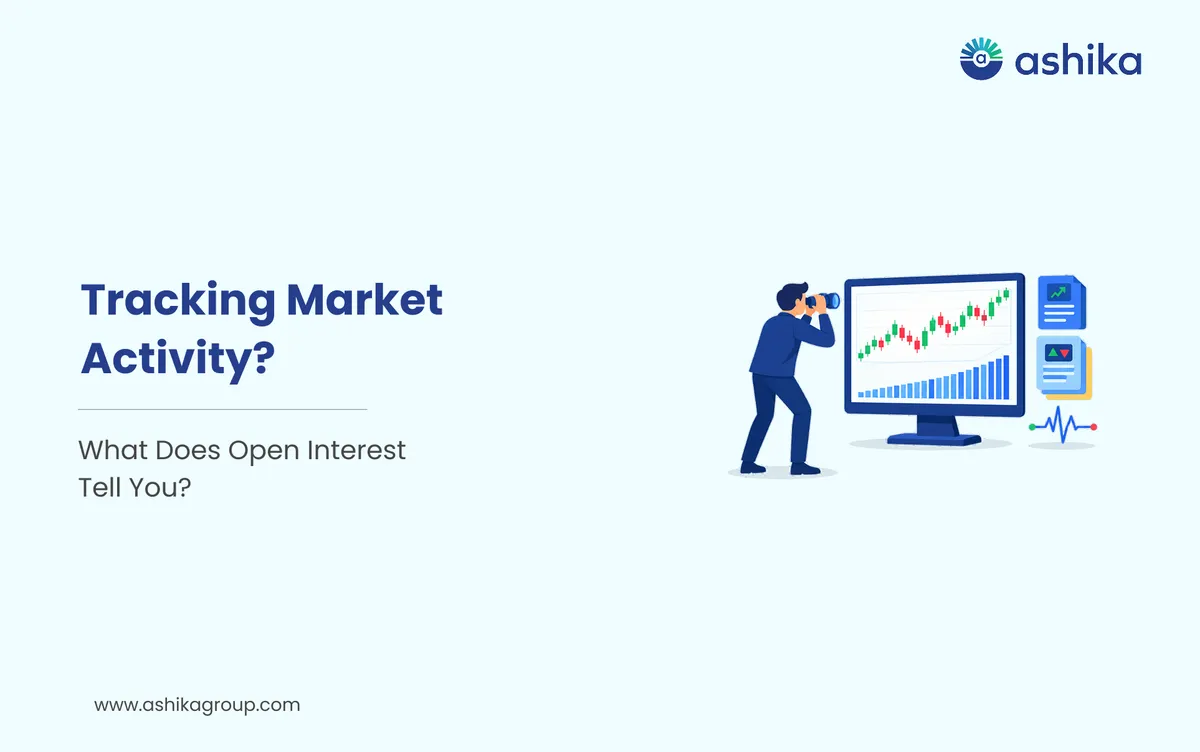
When people look at the F&O market they don't just look at the price of the stock/index. They'll look at a whole host of other things as well. One of the numbers you'll frequently see in there alongside the price, the volume and all the other market data is Open Interest (OI).
Open interest can be a useful indicator in terms of helping traders to gauge the level of participation in the market and the degree of market activity (particularly when it's viewed in conjunction with price). It can tell you how many derivative contracts are currently outstanding. It doesn't in itself tell you whether the market is going to go up or down though.
Table of Contents
What Is Open Interest?
Open interest is the total number of outstanding futures and options contracts that have been created and have not yet been settled, closed or expired.
Every derivative contract has two legs to it: a buyer and a seller. If a new buyer and a new seller enter into a contract then open interest goes up by one contract. If both sides of an existing contract close then open interest goes down.
For example if a trader buys one NIFTY futures contract from another trader who is opening a new short position then that creates a new contract and so open interest is increased.
If a trader closes out an existing position by going the other way, open interest can go down. If one party closes a position and another party opens a position, open interest can stay the same.
Open interest is therefore a measure of the number of outstanding contracts, not the number of traders or the total amount of money that's invested.
Open Interest vs Trading Volume
Open interest and trading volume are related, but they are entirely different things.
Trading volume is the number of contracts traded over a given period. Open interest is the number of contracts which are outstanding at any particular time.
A contract can be traded numerous times during the day, each trade adding to the volume. Open interest will only change when a contract is created or when a contract is closed.
For example if 500 futures contracts are traded during the session the volume is 500. If only 100 new contracts are created and the rest of the trading is simply the closing or transfer of existing positions then open interest may have only increased by 100 (or indeed may have fallen).
This is the distinction that helps the trader to work out whether the market is creating new positions or merely seeing existing positions being traded.
How Traders Interpret Price and Open Interest
Traders often examine price movement and changes in open interest together. Four commonly discussed combinations are:
1. Price rises and open interest rises
This could be an indication that new positions are being added as the price moves higher (i.e. the market is moving up). It could be read as a sign of increasing participation in the upward move. It's worth bearing in mind though that OI by itself doesn't tell you whether the market is bullish as every contract has a buyer and a seller.
2. Price falls and open interest rises
This implies that more contracts are being created as prices are falling. Some traders will no doubt see this as an indication of greater participation in the downward move.
3. Price rises and open interest falls
This can be an indicator that existing positions are being closed as the price moves higher. In certain instances short position holders will be buying back the contracts which will of course be a contributing factor to the price move.
4. Price falls and open interest falls
This could be indicative of traders closing out their positions as prices are falling. It could be a reflection of reduced participation in the existing move.
These interpretations are routinely used as a framework, but they are by no means guaranteed to be signals. The outcome is very much subject to market conditions, contract expiry, volatility and the actions of the various participants.
Understanding Open Interest in Options
In the options market open interest is available for individual strike prices and for both Calls and Puts.
A trader can look at OI across various strikes to see where the OI is concentrated. The NIFTY option chain is a case in point with a large amount of Call OI at one strike and a large amount of Put OI at another.
Some market participants will use this to identify potential areas of interest or potential support and resistance. High OI doesn't necessarily mean that a given level will provide support or resistance.
OI can also move very quickly as traders open, close and/or adjust their positions. A strike with high OI today may have a very different meaning tomorrow.
What Open Interest Cannot Tell You
Open interest is of use but it has its limitations.
It doesn't reveal who the participants are in the contracts, what their intentions are (whether they are hedging, speculating or risk managing) or the direction of the market on its own.
A rise in Call OI shouldn't be treated as a negative signal in itself. Calls can be bought or sold for a variety of reasons, including for hedging and as part of a multi-legged strategy.
Similarly a fall in OI doesn't necessarily mean that traders have lost confidence in the market. The positions could simply be being closed down for a variety of reasons (profit booking, risk management, approaching expiry etc).
Using Open Interest Alongside Other Market Data
Rather than use OI on its own, traders will typically look at it in conjunction with price action, trading volume, implied volatility and all the other indicators.
An option chain can be used to show the OI across the strikes, price charts can provide context as to how the market has moved recently and changes in OI over time can help a trader determine whether there is an increase or decrease in participation.
Platforms such as Ashika Dhanush 2.0 provide market related tools and information that the trader can use to review the activity. Before making a trading decision the user should be aware of the data available to them and the risks involved.
Conclusion
Open interest provides a useful indication of the total number of futures and options contracts which are outstanding. When viewed in conjunction with price, volume and other market data it can be a useful tool for traders in interpreting changes in market participation.
OI is not a standalone predictor. An important part of understanding how the derivatives market works is in understanding what OI measures and what it doesn't.
Ready to open yours?
Free account opening · Paperless eKYC · Live in 10 minutes
Sources: SEBI Investor, NSE , NISM
Frequently Asked Questions
What does an increase in open interest actually mean in F&O trading?
It means more derivative contracts have been created and remain open. It indicates an increase in outstanding positions, but does not reveal whether the market is bullish or bearish on its own.
Can open interest be high even when trading volume is low?
Yes. Open interest measures contracts that remain outstanding, while volume measures contracts traded during a particular period. They track different aspects of market activity.
What does it mean when the price of a stock rises but open interest falls?
It may indicate that existing positions are being closed as prices rise, possibly due to short covering. However, this combination alone does not confirm the reason behind the price movement.
Does high Call OI mean a particular NIFTY level will act as resistance?
Not necessarily. High Call OI shows a concentration of outstanding Call contracts at that strike, but positions may be held for hedging, speculation or other strategies. It does not guarantee resistance.
Can open interest alone tell me whether to buy or sell a futures or options contract?
No. OI does not reveal the intentions of market participants or predict price direction. Traders generally examine it alongside price action, volume and implied volatility. "
Was this article helpful?
Thanks for your feedback!

 5 min read