
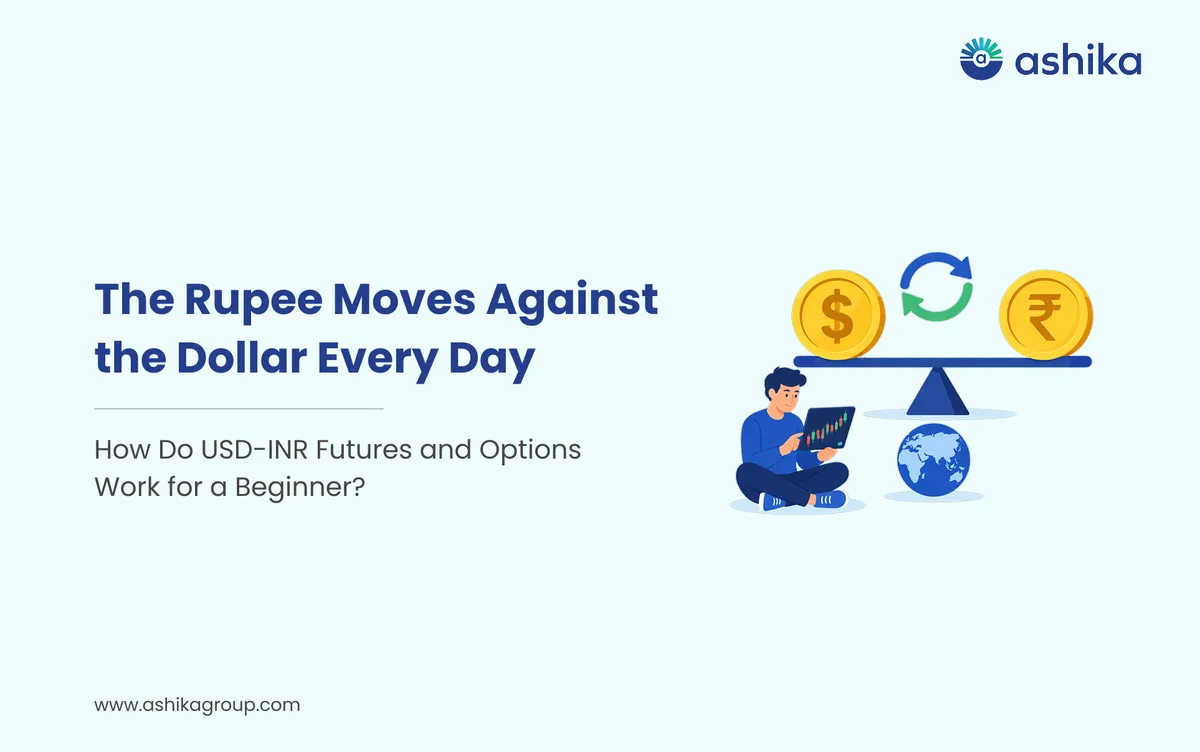
The value of the US dollar in relation to the Indian rupee has an impact on businesses, tourists, importers, exporters and investors. A change in the USD/INR exchange rate will have an effect on the cost of overseas purchases, the cost of international payments and the cost of any financial transactions.
For those wanting to get a handle on these movements, currency derivatives provide a means of either trading or hedging against movements in exchange rates. USD-INR futures and options are amongst the currency derivatives available on the Indian exchanges.
If you're looking at a currency trading platform in India it's important to understand how the contracts work, what drives the prices and the risks involved so that you can make more informed decisions.
Table of Contents
- 1. What is USD-INR trading?
- 2. What are USD-INR Futures?
- 3. What are USD-INR Options?
- 4. What influences USD/INR prices?
- 5. Futures vs Options: What should beginners understand?
- 6. Exploring USD-INR on a Currency Trading Platform in India
- 7. Risks to Consider Before Trading
- Understand Currency Derivatives Before You Trade
- Frequently Asked Questions
1. What is USD-INR trading?
USD-INR is the rate at which the US dollar is traded against the Indian rupee (i.e. how many rupees you'd need to buy one US dollar).
For example if USD/INR is at 86.50 then that means one US dollar is worth 86.50 rupees.
When the exchange rate goes up the dollar becomes more expensive in rupee terms. When it goes down the dollar becomes cheaper.
Currency derivatives enable traders to take a position on the expected movement in that exchange rate without actually exchanging any currency.
In India USD/INR futures and options are traded on the recognised exchanges in accordance with the relevant regulations and contract specifications.
2. What are USD-INR Futures?
A currency futures contract is an agreement to buy or sell a certain amount of currency at a set price at a future date of expiry.
Traders can take a position on the USD/INR based on their view of where the exchange rate will be.
For instance if a trader thinks the dollar is going to strengthen against the rupee they might look at buying USD/INR futures. If the rate goes up they could make a profit on the position, if the rate goes down they could lose money on the position.
USD-INR futures are standardised contracts. On the NSE one contract is for USD 1,000 and the rate is quoted in rupees per US dollar. The contracts are cash settled in INR.
Futures trading is very different to buying dollars through a bank as you don't actually get the physical dollars. Your profits and losses are settled in cash.
3. What are USD-INR Options?
Currency options offer another way of getting exposure to movements in the exchange rate.
A call option gives the buyer the right (but not the obligation) to buy the underlying at the strike price. A put option gives the buyer the right (but not the obligation) to sell the underlying at the strike price.
For instance a trader expecting USD/INR to go up might look at buying a Call. If the rate does move in their favour the option could be worth something.
A trader who is looking for USD/INR to fall might look at a Put.
However the value of an option will depend on more than just the spot rate. The strike price, the time to expiry, the volatility and the premium will all have an impact on the price.
The option buyer pays a premium to take the position. If the option expires worthless the buyer will have lost the premium paid (plus any applicable charges).
4. What influences USD/INR prices?
Several factors can influence the exchange rate:
- Interest rates is the difference between US and Indian interest rates) can have an impact on currency movements.
- Inflation arecchanges in inflation will affect the relative purchasing power of currencies.
- Economic data includes GDP growth, employment figures, trade data, etc., which will also play their part in shaping market expectations.
- Global demand for the dollar can strengthen during periods of global uncertainty or increased demand.
- RBI and central bank action: Monetary policy decisions and the like can have an impact on currency markets.
These factors in no way guarantee a particular price movement. The foreign exchange markets can react very quickly to new information and expectations may already be priced in.
5. Futures vs Options: What should beginners understand?
The key difference is the nature of the contract and the risk involved.
With futures both the buyer and the seller have a contractual obligation. A position can make or lose money as the spot rate moves and there are of course margin requirements.
With options the buyer pays a premium for the right to exercise the contract. Their loss on a purchased option is generally limited to the premium paid. The risks and margin requirements of the option seller are quite different and can be substantial.
Neither instrument is going to be suitable for every trader. The novice trader must be fully aware of the contract specs, the expiry dates, the margin requirements and the potential for loss before they go any further.
6. Exploring USD-INR on a Currency Trading Platform in India
A currency trading platform in India offers access to exchange traded currency contracts and the relevant market data.
For instance Ashika Dhanush 2.0 brings together a number of investment and trading segments including currency derivatives. Eligible users can view the available contracts and the relevant market information on the platform.
Before you place a trade you need to check the contract's expiry, price, lot size, margin requirement and the charges that apply. You also need to know how positions are settled and what happens if the market moves against you.
A trading platform gives you access to the market tools; it doesn't remove the risk of trading or guarantee any return.
7. Risks to Consider Before Trading
USD-INR futures and options can be very risky. The exchange rate can move in an unpredictable way and with leverage the potential for loss can be many times greater than the margin you have deposited.
Other considerations include:
- Market volatility and sudden price movements
- Margin requirements and additional funds needed
- Option premium loss and expiry risk
- Brokerage, taxes and other transaction charges
- Liquidity and the difference between bid and ask prices
Beginners should take the time to understand these risks and avoid trading with money they can't afford to lose.
Ready to open yours?
Free account opening · Paperless eKYC · Live in 10 minutes
Understand Currency Derivatives Before You Trade
USD-INR futures and options offer different methods of exposure to movements in the currency market. The futures contract is a contract to buy or sell. The option contract is a contract which gives the buyer the right to buy or sell.
Understanding how these instruments work is the essential first step before you go on to use a currency trading platform in India. You need to understand the contract, you need to assess the risks and then you need to make your own decision as to whether you are in a position to trade based on your own financial circumstances and your own level of market knowledge.
Frequently Asked Questions
If USD/INR rises, does that mean I will make a profit by buying USD-INR futures?
Not necessarily. Your profit or loss depends on the price at which you entered the contract, the subsequent movement in the futures price, and applicable charges. A rising exchange rate alone does not guarantee a profit.
Do USD-INR futures give me actual US dollars when the contract expires?
No. Exchange-traded USD-INR futures in India are cash settled in Indian rupees. You receive or pay the settlement amount rather than exchanging physical US dollars.
What is the difference between buying a USD-INR Call and a USD-INR Put?
A Call gives the buyer the right to buy the underlying at the strike price, while a Put gives the right to sell it. A trader expecting the dollar to strengthen against the rupee may consider a Call, while one expecting it to weaken may consider a Put.
Can I lose my entire investment in USD-INR options even if the exchange rate moves in my expected direction?
Yes. An option's premium is influenced by factors such as the strike price, time to expiry and volatility, not just the exchange rate. If the premium falls or the option expires worthless, you may lose the entire premium paid.
What should I check before placing a USD-INR futures or options trade?
Check the contract's lot size, expiry date, quoted price, margin or premium requirement, settlement method and applicable charges. Also consider liquidity and the potential loss before placing an order. "
Was this article helpful?
Thanks for your feedback!
 6 min read