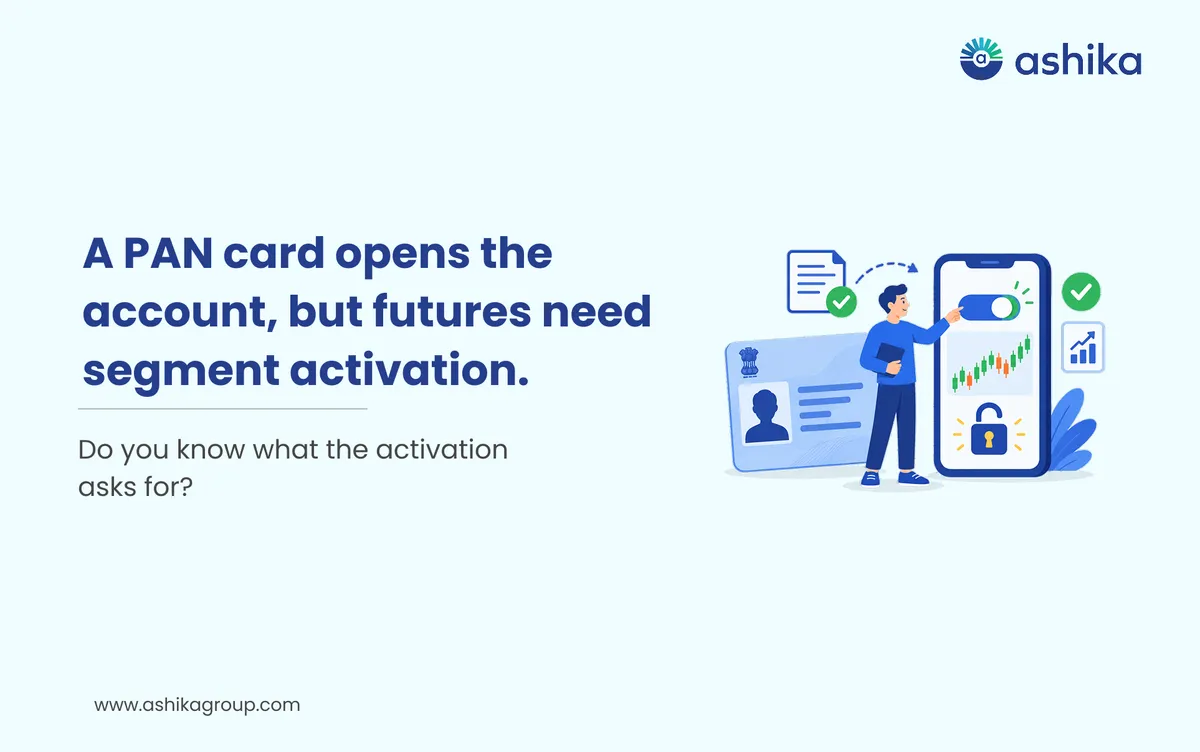
Any thoughts about trading in the futures segment of the stock market? Before you go and place your first trade you need to ensure your trading account is all set up. That means you need to have your PAN details in order, you need to have completed your KYC and you need to check that your broker has actually turned on the F&O segment for your account.
If you already have a share trading account you may well be under the impression that you can just go straight into futures trading. You can't necessarily do that. Derivatives trading can involve further verification and documentation. It's important to be aware of that at the outset so as to avoid any delays and be in a position to move forward when you're ready.
This guide explains why PAN is important, what docs your broker may ask for, how the F&O segment activation works and what a novice should know before they start trading futures.
Table of Contents
Why Do You Need a PAN Card for Futures Trading?
A Permanent Account Number (PAN) is a key identification document for all financial transactions in India. It enables the stockbroker to verify the client's details and to satisfy the relevant regulatory and tax requirements.
When you open up a trading account you'll need to supply your PAN and go through the KYC process. Your broker will likely verify the PAN as part of the KYC process along with other details such as your identity, address and bank account details.
You do not automatically get access to futures trading just because you have a PAN card. If your account is presently only enabled for equity trading you may need to apply for activation of the respective derivatives segment.
Think of PAN as one element of the account verification process. You'll also need to complete any further checks that your broker requires before you can start trading futures.
What Is F&O Segment Activation?
A trading segment is a type of product that you can trade via your broker.
The equity segment enables you to buy and sell shares, the derivatives segment gives you access to eligible futures and options contracts. The products are different so brokers may require further verification prior to allowing you to trade in derivatives.
If you've just opened a trading account the F&O segment won't be active by default. You'll likely need to submit an activation request via the broker's website, mobile app or customer support.
During the process your broker may ask for financials to assess your eligibility and to complete their due diligence. The exact requirements will of course vary from broker to broker and will be determined by the broker's own policies at the time.
Before you go ahead and request activation, make sure you understand what a futures contract is and how it's different from simply buying shares for delivery.
Which Documents Might You Need?
Other than having the correct PAN details and having completed your KYC, your broker may ask for proof of income or proof of financial capacity prior to enabling you in the F&O segment.
Depending on the broker’s requirements, accepted documents may include:
- Bank statements: Recent statements showing your account details and your financial transactions.
- Income Tax Return (ITR) acknowledgement: Proof that you have filed an ITR where accepted.
- Salary slips or Form 16 (if you're a salaried person) can be useful in establishing your income.
- Demat Holdings statement: A statement showing the securities held in your Demat account which are eligible for transfer.
- Net worth certificate: A certificate from an eligible professional (if accepted by the broker).
You don't necessarily need to submit all of the documents listed above. The brokers will have different requirements in terms of what proofs they will accept, the validity of the documents and the verification process.
Before you upload your documents ensure they are clear, up to date and consistent with the details on your registered account. If there is a discrepancy between your name and other details across the various records then get in touch with your broker to find out how to resolve it.
Use only your broker's official website or app to submit documents. Don't ever give your account password, PIN or OTP to anyone who claims to be activating your trading segment.
How to Activate the F&O Segment
The process is pretty much straightforward, although the exact steps will vary from broker to broker.
Step 1: Log in to your account. Go to your broker's website or app and look for the F&O or segment activation.
Step 2: Select the segment. Pick the appropriate derivatives segment and read the declarations and risk disclosures that are provided.
Step 3: Upload the required documents. Submit the accepted financial proof and complete any further information that is requested.
Step 4: Complete verification. You may be required to verify your details via an OTP, electronic signature or some other form of authentication.
Step 5: Wait for confirmation. Your broker will look at the request and get back to you when the segment has been activated or if they need any further information.
Don't assume the segment is active straight away upon submission of your application. Check your account status and wait for confirmation before you attempt to place a futures order.
What If Your Activation Request Is Rejected?
An activation request may be delayed or rejected if the documents are incomplete, unclear, out of date or inconsistent with your registered details. You may also have submitted a document that the broker doesn't accept or have missed a verification step.
Read the notification very carefully to understand why you've been actioned. If the instructions aren't clear then please get in touch with your broker's official customer support team.
If your PAN or KYC details need amending, ask the broker what the correct procedure is. Fixing the root problem prior to making another request will go a long way to avoiding further delays.
What Beginners Should Know Before Trading Futures
Getting your F&O segment activated is just the first step. Futures trading is all about leverage, margin and the potential for significant losses.
A small change in the price of the underlying can have a big effect on your position. Depending on the contract and the movement of the market, losses can pile up very quickly and you may find yourself required to have sufficient funds on hand to meet your margin requirements.
Before you place your first trade you need to get your head around the contract specifications, the lot sizes, the expiry dates, the brokerage and all the other transaction charges. You need to understand how margins work, how your positions are settled and what happens if the market moves against you.
Futures and options are different products. Turning on the derivatives segment doesn't mean you should be trading every single instrument that's available.
Don't borrow money or use funds required for basic living expenses to get involved in futures trading. If you're new to the stock market then take the time to understand the products and the risks involved before you decide whether or not derivatives are right for you.
Ready to open yours?
Free account opening · Paperless eKYC · Live in 10 minutes
Final Checklist Before You Start
Before you place your very first futures order you need to ensure your PAN is valid, your KYC is complete and your broker has accepted the documents. You need to confirm the F&O segment is active, check the charges that apply and read the relevant risk disclosures.
A properly activated account gives you access to the trading facilities offered by your broker. Understanding the products, managing risk and making informed decisions remain your responsibility.
Frequently Asked Questions
I already have a PAN card and a trading account. Can I start trading futures immediately?
Not necessarily. Your KYC must be complete, and your broker must activate the F&O segment separately if it isn't already enabled.
Why does my broker ask for income proof to activate F&O trading?
Your broker may ask for financial documents to assess your financial capacity and complete its verification process before granting derivatives access.
Which documents can I submit for F&O segment activation?
Depending on your broker, accepted documents may include bank statements, ITR acknowledgements, salary slips, Form 16 or a Demat holdings statement. Check the broker's requirements before uploading anything.
How long does it take to activate the F&O segment after submitting the documents?
The timeline depends on the broker's verification process. Submitting the request does not mean you can start trading immediately; wait for activation confirmation.
If my F&O activation is approved, can I start trading futures without any further preparation?
Activation only gives you access to the segment. Before placing an order, understand contract size, expiry, margins, leverage and the possibility of substantial losses.
Was this article helpful?
Thanks for your feedback!
 5 min read